
| Reviews & Columns |
|
Reviews DVD TV on DVD Blu-ray 4K UHD International DVDs In Theaters Reviews by Studio Video Games Features Collector Series DVDs Easter Egg Database Interviews DVD Talk Radio Feature Articles Columns Anime Talk DVD Savant Horror DVDs The M.O.D. Squad Art House HD Talk Silent DVD
|
 DVD Talk Forum |
|
|
| Resources |
|
DVD Price Search Customer Service #'s RCE Info Links |
|
Columns


 
|
|
|
General, The
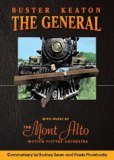
What hasn't already been said about The General, Buster Keaton's masterpiece? Just this year the American Film Institute included it in their list of the Greatest Movies of all Time, it came in at an astounding #18 just above On the Waterfront and It's a Wonderful Life. The General constantly tops list of the best silent films, and with good reason; it is a tightly paced comedy of epic proportions that has aged very well, but more importantly it is very, very funny. This classic has been released twice before in a restored format (and countless times in horrible quality by public domain publishers) once by Kino in 1999 and again by Image in 2003. Now the Mont Alto Motion Picture Orchestra has released a version under their Private Reserve label. With a glorious new soundtrack by the group and a lovely print, this is the most enjoyable DVD release of The General yet.
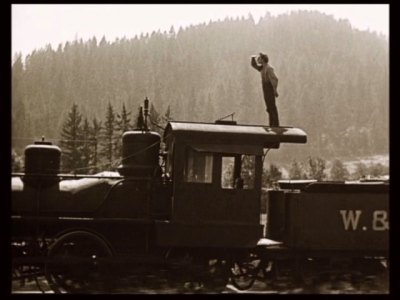 Johnnie Gray (Buster Keaton) is a train engineer living in the South during the Civil War. As a title cared points out, he has two loves in his life, his train, The General, and his girlfriend Annabelle Lee (Marion Mack.) It's only natural that when a group of Northern spies steals Johnnie's train, along with Annabelle who is accident caught in their scheme that the spunky train driver goes after them. Johnnie chases the spies; on foot, on push car, on bike, and eventually with another engine, like an early version of Indiana Jones, he just won't give up until he has his train back. Eventually he ends up behind enemy lines and overhears the Northern attack plans. How can he save the girl, retake his train, and warn the Confederates without getting caught or killed?
This is one of those few pictures that really deserves the label "classic." It just works well from start to finish. The beginning is a bit sedate, with some light gags that are amusing but only hint at what is to come while setting up the story. As the film progresses, the action gets quicker and the gags more frequent, not to mention more hilarious. The climax involving a train falling through a burning bridge was the most expensive stunt that was preformed during the silent age, and it's still impressive today.
There are a couple of reasons why this film has aged so well. First of all, Buster Keaton who co-wrote and co-directed the film made sure that the uniforms and costumes were historically accurate. Many times silent historical dramas will use whatever costumes are at hand, and this makes them look a bit silly and quaint by today's standards. The General's attention to detail gives the movie a modern feel, you could almost believe this was made in the last decade.
 The other reason this film is still so funny today as it was 80 years ago is that the script, and especially the gags, are so tight. Keaton spent a lot of time working on comedy bits for his films, and this work paid off. There's a logical reason for just about everything that happens. This logic grounds the movie in reality, but then the absurd twists of fate make for some unforgettable comedy. At one point Johnnie's train is pulling a cannon that he wants to use against the spies. He loads a charge, aims the barrel so that it will shoot over his engine and hit the one he's following. While climbing back to the cab however, his foot gets caught in the spar that attaches the cannon to the train and he has to uncouple the two. This spar however starts hitting the railroad ties which causes the car to jump which in turn causes the cannon barrel to slowly start to move downward until it's pointing directly at Johnnie. There's a lot of comic tension as the poor engineer tries to figure out what to hide, but of course there's nowhere to go. The resolution to his predicament is also logical. Just as the train rounds a curve, the cannon goes off flinging its explosive ball half a mile in front, nearly hitting the Union spies. Taken together this is a hilarious sequence, and it works since there is a reason for everything. In contrast look at a Keystone comedy from this same period. There's not much rhyme or reason to the action, it's just frantic gags strung together.
I could go on about how this fits in with other Keaton films, he loved using big props like ships and trains, and how it carries on the theme of an honest, loyal man fighting against insurmountable odds, but that's more academic than this review warrants. Instead let me just say that this is a fantastic epic comedy that everyone should see.
The DVD:
This disc, available only from the Mont Alto Motion Picture Orchestra web site, is a genuine pressed DVD, not a DVD-R. It comes in a standard keepcase with color cover.
Audio:
The General has been a very popular film for decades and there have been countless scores written for it over the years. On the Kino release of this film, Robert Israel provided a solid musical score. Image released a version of this film on DVD with a soundtrack by the Alloy Orchestra which many silent film aficionados, myself included, found to be distracting, intrusive, and unappealing. This version has music constructed and composed by the Mont Alto Motion Picture Orchestra.
Mont Alto is the finest silent movie musical group around today, and this is an excellent score. Pianist Rodney Sauer uses an authentic silent era music 'library'1 to create the music that is played during the film and he has made some very good selections. The music really accents the film without going overboard. This group doesn't try to add feeling that isn't there; they don't try to make a slow moment in between gags funny by playing some goofy music. Instead they let the movie speak for itself; their music accents the emotions and attitude already present of the film.
This audio track eschews sound effects (there is only one, Keaton knocking on a door at the beginning if I remember correctly.) While I usually think that sound effects add an extra dimension to a silent film, and they certainly were employed in some theaters for some films, I can understand Mont Alto's reluctance to use them on this one. The two times that cannon balls explode during the railroad chase scene for example would be difficult to do. Just hitting some low notes on a piano would sound inadequate, and dubbing in an explosion sound wouldn't be authentic. Yet would be awkward to include some effects and leave out bigger ones so I can definitely see why the decided to leave them all out.
The General is one of my favorite films, and I've seen it many times and with many different accompaniments. I can confidently say that this Mont Alto score is my favorite so far. They did a wonderful job accompanying a fantastic film.
Video:
The tinted full frame image is gorgeous. The print was provided by Film Preservation Associates and seems to be identical to the Image release. The tinted image had very good contrast and blooming wasn't a problem. The only real problem I had with the print is that the image was a bit dark, especially in the night scenes, such as when Johnnie is rescuing his girlfriend. There are a couple of extraneous spots on the print, but these are fairly rare.
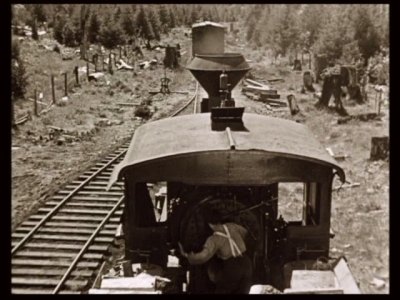 | 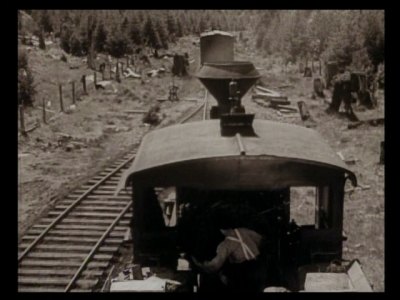 |
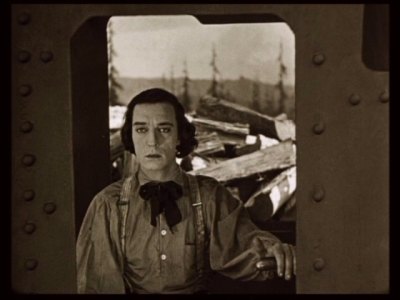
Comparing this version to the Kino release, I have to say that I like this picture a bit more. The level of detail is greater, the image is sharper and the sepia tones are more pleasing. There's not a huge difference, but it is there. In the example above, note the added details on the face of the furnace that Buster is stoking. You can see bolts and handles that are obscured in the Kino version. This image also has a bit more image on the right and bottom of the screen. Check the tree stump on the right side of both screen caps. On this Mont Alto most of the stump is visible while only a sliver can be seen on the Kino disc. The Kino version isn't as dark however, and the night scenes have more detail. Given that this is only 10 minutes or so out of the whole movie, the edge still goes to this edition. (Both are significantly better than the numerous bargain basement DVDs of this movie floating about. I've seen a couple of the $5 cheapies and they don't even come close to the quality of either the Kino, Image, or Mont Alto versions.)
Extras:
There are some very nice bonus items too. Rodney Sauer from the Mont Alto Orchestra and film critic Howie Movshovitz provide a scene specific commentary to the film. Both of them chime in with historical facts about the filming and Mr. Sauer has a lot to say about the score explaining how and why he selected certain pieces. I have to admit that Mr. Movshovitz wasn't able to convince me of one of his premises, namely that this movie isn't a comedy but an epic with comic parts. He makes some good points, noting that a few scenes, such as when Buster is trying to woo his sweetheart at the beginning, could have been humorous but aren't. I'd counter by saying that nearly the whole film could have been played seriously if Keaton had wanted a drama. Even though I didn't agree with everything, Mr. Movshovitz's comments were food for thought. This was a very enjoyable commentary and a pleasure to listen to. (And with the number of commentary tracks I have heard, that is a big compliment.)
Rodney Sauer comes back for a featurette on the scoring of the film. He starts out by explaining how movie scores were created in the silent era (very few films had dedicated scores written for them) and then he does something that's immensely interesting that I hadn't seen before: He takes the cue sheet for the film, a two page list of suggestions of musical lines and types of music that the studio sent to theaters along with the film, and analyses it. He plays the few bars that are given for some scenes, talks about the mood that the music creates, and then explains why he agrees or disagrees with that choice. At one point he points out that the cue sheet recommends some very fast music for something on the order of 15 minutes and comments that playing it like that would wear out the musicians and the audience. This was a great bonus item that is entertaining and informative.
People who are interesting in exactly which musical pieces were selected for each scene are in for a treat. There is an optional subtitle track that lists name, author, and year of each selection used to make up the score. This is a novel idea and one that I hope other publishers try. Finally there is also a modern trailer for the film.
Final Thoughts:
This is a great, great movie. Funny, touching, and, well, funny, it is one of those productions where everything just comes together perfectly. The new soundtrack by the Mont Alto Motion Picture Orchestra is wonderful to listen to and fits the movie very well. It's the best available score for this film which makes it easy to Highly Recommend this disc.
1) Only a relatively few silent movies had scores composed for them, for the vast majority of films the musicians at the various theaters could play what ever they wanted. To aid the musical director, most theaters had libraries of music. When a new movie came in, the theater's musician would pull out fast pieces for the chase scenes, slow soft music for the romantic parts, etc. and quickly compile a score that way. This is what Mont Alto does also, using only music that could have been played in a silent theater. You won't hear any rock riffs or rap beats in their compositions.
|



| Popular Reviews |
| Sponsored Links |
|
|
| Sponsored Links |
|
|
| Release List | Reviews | Shop | Newsletter | Forum | DVD Giveaways | Blu-Ray | Advertise |
|
Copyright 2024 DVDTalk.com All Rights Reserved. Legal Info, Privacy Policy, Terms of Use,
Manage Preferences,
Your Privacy Choices 
| |||||||