
| Reviews & Columns |
|
Reviews DVD TV on DVD Blu-ray 4K UHD International DVDs In Theaters Reviews by Studio Video Games Features Collector Series DVDs Easter Egg Database Interviews DVD Talk Radio Feature Articles Columns Anime Talk DVD Savant Horror DVDs The M.O.D. Squad Art House HD Talk Silent DVD
|
 DVD Talk Forum |
|
|
| Resources |
|
DVD Price Search Customer Service #'s RCE Info Links |
|
Columns
  


 
|
|
|
Jazz Singer, The
On October 6th, 1927 the death knell of silent films was sounded. On that date the first feature film with synchronized dialog was released: Warner Brothers' The Jazz Singer. Had the film been a flop, talkies may have been pushed back a few more years, but it was a hit and soon all the major studios were rushing to release sound films. Of course the change didn't happen over night, and it took years to covert theaters over to sound (especially in the middle of the US) but the writing was on the wall.
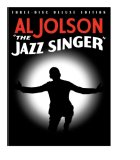
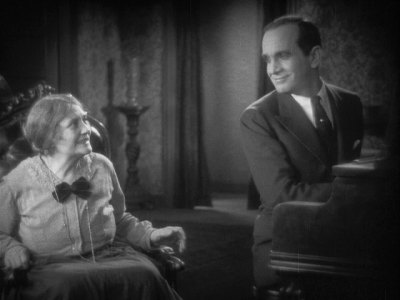 In honor of the revolutionary film's eightieth anniversary, WB has released The Jazz Singer in a very attractive package that's filled with extras. Not only has the film been restored, but this three disc set has a new feature length documentary on the origins of sound film, early Vitaphone movies, an excellent commentary, and a host of other shorts. This is a very impressive set.
The men of the Rabinowitz family have been cantors for generations. Jakie Rabinowitz (Bobby Gordon and later Al Jolson) loves to sing, but not the boring old traditional songs, he loves jazz. His father (Warner Oland) can't believe that his offspring would turn his back on the church to become a jazz singer and after a nasty fight Jakie storms out and leaves home.
Years pass. Jakie has changed his name to Jack Robin and works the vaudeville circuits. He's talented and had started to become an in-demand performer. He meets Mary Dale (May McAvoy) another up and coming talent, and she manages to get Jack a Broadway gig! Returning to New York, Jack goes home for the first time since he was a kid. His mother is overjoyed and he sings her a song, but when his father walks in things get icy. The elder Rabinowitz is still not ready to forgive his son, and kicks him out of the house once again.
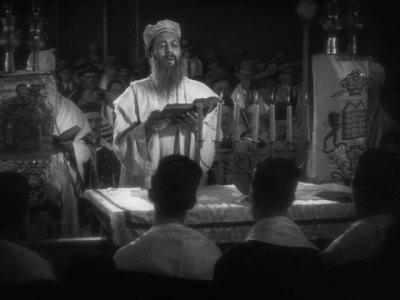 The opening night of Jack's big Broadway debut arrives, but the singer learns some dreadful news. His father has fallen seriously ill and can't sing on the eve of Yom Kippur, one of the most sacred Jewish holidays. Family friends beg Jack to sing in his father's place that evening, which puts the man in a tight spot. Is his first allegiance to his family and religion or to his career and show business?
Even people with only a passing interest in film know that The Jazz Singer was the first 'talkie' but what surprises most people is that there are intertitles. This film is really a hybrid, a silent movie with some synchronized sound songs added in. Many people in Hollywood envisioned sound as only being used during musical numbers. After all, there's no need for people to talk, we can still use intertitles. That would also make the movies easier to sell overseas, since it is much, much easier to translate intertitles than to dub a film in another language.
 This wasn't even the first talking film that was commercially released. WB had released some shorts with their Vitaphone system and these mainly consisted of bands playing popular songs, and Don Juan (1926) had an all-music Vitaphone soundtrack with sound effects. The thing that set this movie apart was that it was a feature with synchronized dialog. Jolson ad-libbed a lot of his lines and director Alan Crosland wisely left it in. His impromptu "Wait a minute. Wait a minute, you ain't heard nothin' yet!" has gone down in music history.
Aside from the history, how is it as a film? Actually not bad. It isn't a great movie and doesn't compare to Metropolis, The General, or Sunrise, which were also released in 1927, but it's a solid film. Though it is sappy and maudlin in parts, the movie works well. It's easy to identify with Jack's dilemma and the character is so happy-go-lucky through most of the film that the section where he's more morose really drives the point home. Jolson is a decent actor but his songs are the high point of the film. They are entertaining and enjoyable and elevate the film from an average feature to something special. Yes the ending is a bit of a stretch, but the movie is a lot of fun to watch, especially when you consider the impact it must have had in 1927.
The DVD:
This film comes in a jam-packed three disc set. The discs are housed in a fold-out case with each disc getting its own page. The printed booklets come in a pair of holders and all of this fits into a very attractive heavy board slipcase.
Audio:
The mono soundtrack sounds fine for an old Vitaphone recording. Of course due to the technology available at the time, the range is very limited and the sound isn't very full. The audio track has been refurbished and though there is some background noise it isn't as obtrusive as it could be. There's a touch of distortion in some of the talking bits, but the songs sound fine. For a film that's 80 years old, I really can't complain.
Video:
The full frame image has been restored and it looks great. The contrast is very good with nice deep blacks and a full range of grey tones. Details are strong, even minor ones are well defined. There are a few missing frames scattered through the movie and some very minor print damage that doesn't affect the viewing experience. On the digital side of things, there is more mosquito noise than I was expecting in the picture, but this isn't a major concern. Aliasing, blocking, and other common compression artifacts aren't a problem.
Extras:
This release sets a new standard for extras on early films. The three discs are overflowing with quality bonuses. One disc one, along with the movie itself, there's a commentary track by film preservationist Ron Hutchison and Nighthawks Bandleader Vince Giordano. I really enjoy most commentaries by historians, and this one in no exception. The pair is very knowledgeable about early sound films in general and this one in particular and goes into some detail about the movie. What's even more impressive is that it's entertaining as well as informative. After you've seen the film, you need to listen to this commentary.
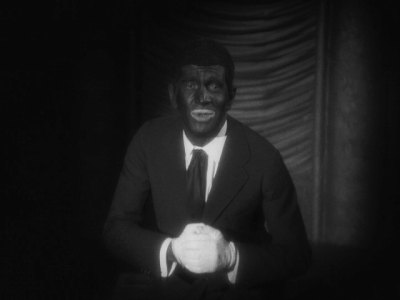
Also on disc one is Al Jolson singing in black face in an early talkie short, A Plantation Act (1926). He sings some popular songs acting as the happy-go-lucky, hard working Negro who doesn't have a care in the world. This is pretty offensive by today's standards, but historically interesting. Next up is the rather unwieldy titled An Intimate Dinner in Celebration of Warner Bros. Silver Jubilee. Mr. and Mrs. Warner Brothers are celebrating their 25th anniversary with their daughter Little Miss Vitaphone. (No really, that's what it's about.) All of the WB stars make an appearance including Douglas Fairbanks Jr., Edward G. Robinson, Joe E. Brown, and Walter Huston. There's the Tex Avery cartoon, I Love to Singa, which is a parody of The Jazz Singer from 1936, and the radio version of the movie as presented on the Lux Radio Theater in 1947.
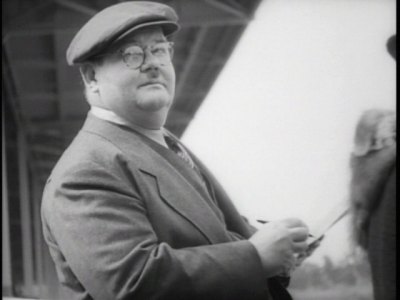 The 1938 musical short Hollywood Handicap is also included, directed by none other than Buster Keaton. At this point in his career, everyone had pretty much given up on the comic genius. After making some shorts for the poverty row studio Educational Pictures, Keaton directed a couple of shorts at MGM. This was the first, and it is pretty uninspired. This is another all-star feature, with several movie stars briefly appearing in the stands at the race (including Al Jolson). The plot, what little there is of involves a group of singers who are given a top race horse by their boss for their loyal service to him over the years. All they need to do is raise some money to get the entry fee for a handicap race. That's a little harder to do than they thought. Al Jolson turns up in the stands once again in A Day at Santa Anita, a 1938 Technicolor short. The first disc is rounded off with a set of six trailers to Jolson films.
If that was all of the bonus material, I would have been very happy. But there's more, a lot more. Disc two starts off with a feature length documentary on sound entitled The Dawn of Sound: How Movies Learned to Talk. This is an excellent overview of the people and inventions that led to the first talking pictures. While it doesn't include many of the early attempts that were little more than lab curiosities (for those see the documentary Learning to Talk available on the Discovering Cinema collection.) it does cover all the major inventions and players and discusses the two major systems that were developed, Vitaphone, basically a record synchronized with the film, and Movietone, a sound on film process developed by Theodore Case. Film historians, scholars, and people who were in the movie industry at the time tell the story in an engaging and entertaining manner.
The rest of the disc is taken up with earlier documentaries on the beginnings of sound. The Voice from the Screen (1926) discusses the technical aspects of making talkies, (this film was originally presented to the New York Society of Electrical Engineers), Finding His Voice (1929), is an animated explanation of sound on film, and The Voice That Thrilled the World (1943) looks back at the invention of sound films. Okay for Sound (1946) has Warner Brother's patting themselves of the back for bringing synchronized sound to the public 20 years earlier, and When the Talkies Were Young (1955) is an early Robert Youngson short that looks at the late 20's and early 30's. There are also two excerpts from Gold Diggers of Broadway (1929). Unfortunately the film is lost except for these clips.
Disc three is devoted to early talkies. Over three and a half hours worth! Most of these are musical shorts, but they're oddly compelling and a lot of fun to watch. They include:
 Elsie Janis in a Vaudeville Act: "Behind the Lines"
Bernado Depace: "Wizard of the Mandolin"
Van and Schneck: "The Pennant Winning Battery of Songland"
Blossom Seeley and Benny Fields with Musical Boxes
Hazel Green & Company
The Night Court
The Police Quartette
Ray Mayer & Edith Evans: "When East Meets West"
Adele Rowland: "Stories in Song"
Stoll, Flynn and Company: "The Jazzmania Quintet"
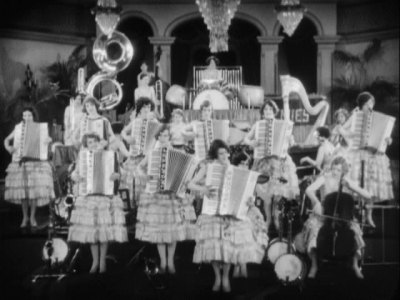
The Ingenues in "The Band Beautiful" (image to the left - an all girl band that plays on accordions, and then switches to banjos!)
The Foy Family in "Chips of the Old Block"
Dick Rich and His Melodious Monarchs
Gus Arnheim and His Ambassadors
Shaw and Lee: "The Beau Brummels"
Roof Garden Revue directed by Larry Ceballos
Trixie Friganza in "My Bag O' Tricks"
Green's Twentieth Century Faydetts 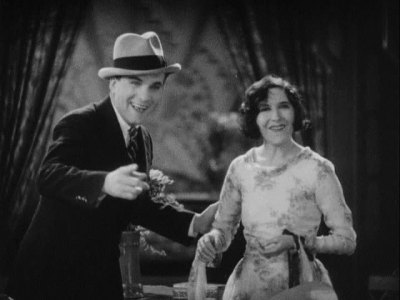 Sol Violinsky: "The Eccentric Entertainer"
Ethel Sinclair and Marge La Marr in "At the Seashore"
Paul Tremaine and His Aristocrats
Baby Rose Marie: "The Child Wonder"
Burns & Allen in "Lambchops"
Joe Frisco in "The Happy Hottentots"
Included with the discs are some nice printed items too. There's a reproduction of a telegram that Al Jolson sent Jack Warner after the premier, a 20-page souvenir program, a 12-page booklet promoting Vitaphone, 10 postcards with production stills, and yet another booklet that has pages from the shooting script as well as a listing of what's included on the DVDs. A very nice package indeed.
Final Thoughts:
Warner Brothers went all out for this 80th anniversary release of The Jazz Singer. The restored image looks very good, but even more impressive than the film itself are the copious extras. The dozens of shorts, feature length documentary, and engaging commentary track are worth the price of the set along. A good film that's also historically important, this set is Highly Recommended.
|



| Popular Reviews |
| Sponsored Links |
|
|
| Sponsored Links |
|
|
| Release List | Reviews | Shop | Newsletter | Forum | DVD Giveaways | Blu-Ray | Advertise |
|
Copyright 2024 DVDTalk.com All Rights Reserved. Legal Info, Privacy Policy, Terms of Use,
Manage Preferences,
Your Privacy Choices 
| |||||||