
| Reviews & Columns |
|
Reviews DVD TV on DVD Blu-ray 4K UHD International DVDs In Theaters Reviews by Studio Video Games Features Collector Series DVDs Easter Egg Database Interviews DVD Talk Radio Feature Articles Columns Anime Talk DVD Savant Horror DVDs The M.O.D. Squad Art House HD Talk Silent DVD
|
 DVD Talk Forum |
|
|
| Resources |
|
DVD Price Search Customer Service #'s RCE Info Links |
|
Columns
  


 
|
|
|
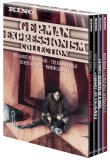
German Expressionism Collection
Kino has released a nice collection of four films made in German at the height of the Expressionist movement: The Cabinet of Dr. Caligari, Warning Shadows, The Hands of Orlac, and Secrets of a Soul. The first is the most well know Expressionist film, but the other three are also good examples of this style. While the popularity of the movement itself died out by the 1930's, it's still influencing film makers today, and this set is a nice way to become acquainted with Expressionist films.
So, just what is an Expressionist film and why are they identified with Germany? The term was first used to describe a style of painting, but quickly migrated to theater, film, sculpture, and even architecture. Previous to its start, artists painted in a realistic style. They tried to faithfully reproduce on canvas the physical appearance of the objects that they were painting. Expressionists discarded this philosophy and instead tried to reproduce an artist's feelings and emotions about what he was seeing. Paintings like The Scream are filled with powerful emotions have an intensity of feeling rarely captured in realistic paintings.
After WWI, the German film industry was going quite well, but money was still a problem. With inflation running rampant in post-war Germany film makers found it hard to compete with the production values that the films from Hollywood exhibited. (Though there are a few famous exceptions including Lang's Die Nibelungen.) Instead, the German directors started to create their own style of film creation. Embracing the Expressionist movement, they started making films that reproduced the emotions and feelings of the characters more intensely. Playing with pacing, symbolism, set design, camera movement and especially lighting, they created stylized and surreal films that were very effective. The most famous, quite justifyibly, is the lead film in this set; The Cabinet of Dr. Caligari.
The Films:
One of the best films to come out of the silent period, The Cabinet of Dr. Caligari has been remade and reproduced several times, but the artistic gauntlet that it threw down at the feet of other filmmakers was never picked up. No one rose to the challenge to be that daring, creative, and experimental in a mainstream film. The Cabinet of Dr. Caligari stands alone as a unique and brilliant film that is still as powerful and awe-inspiring today as it was nearly 90 year ago.
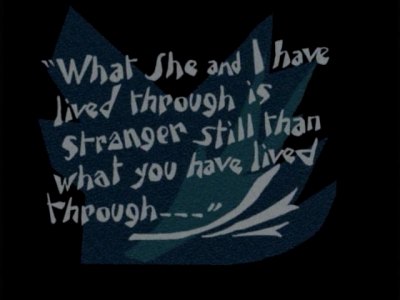 Sitting in a quiet garden, Francis (Friedrich Feher) starts to tell his friend about how his fiancée, Jane (Lil Dagover), went mad. They had both experienced something horrible and tragic about a year ago when a carnival came to town. In a flashback, Francis tells his friend about the awful events when Dr. Caligari (Werner Krauss) came to town with his attraction, a somnambulist, Cesare (Conrad Veidt). Cesare is always asleep, even when he eats, and can only be awakened by Caligari. When he does come out of his trance, he predicts the future, and his predictions often involve people dieing.
When his first prediction comes true and a man turns up dead, the police arrest a common thug and try to pin the crime on him. Francis isn't sure they've got the right man however. He's convinced that Caligari is behind the murders and that Francis may be next!
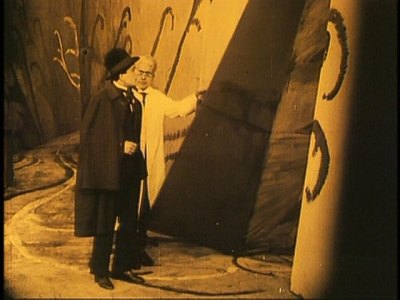
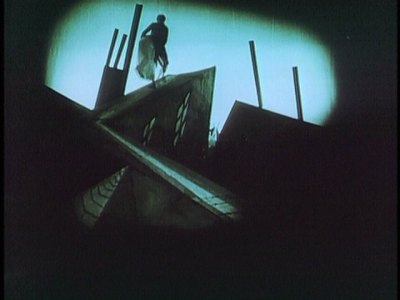 With this movie, director Robert Wiene created a masterpiece. Not only is the story interesting and engaging, but nearly every shot in the movie looks like an Expressionist painting. The sets, designed by Hermann Warn along with to painters, Walter Rohrig and Walter Reinmann, are filled with strange angles, triangular doors, and crooked roofs. Complex and intricate architecture, odd stairways, and bizarre props such as giant stools near enormously tall desks all serve to give the film a unique look. The entire production feels like the dream of a madman.
Not only do the sets appear like Expressionist paintings, but the characters themselves do too. The heavy, exaggerated make-up with sharp angular lines painted across the characters faces and the triangular costumes serve to accent the sets and props. No film has ever captured insanity so well.
The lighting is very important in this film, and a key aspect to expressionist film. The stark, harsh, shadow filled lighting gives all of the scenes a nightmarish quality. The sets are painted with shadows which makes the movie even more eerie and otherworldly than it would have been otherwise. In one of key and often imitated moments in the film, a murder is shown only as shadows on a wall.
Even without the stylized lighting and sets, the story itself tells a solid tale. All too often avant garde films eschew narrative and plot for interesting visuals, but that's not the case here. The murderous Ceasar and his puppet-master Caligari are eerie and fascinating creatures and the crimes they perpetrate are more than enough to keep a viewers interest. The twist at the end also works quite well even today and is the capping masterpiece to the film.
The DVD:
This disc is the same as the earlier Kino release.
Audio:
This film has two musical tracks to choose from, one by Donald Sosin and a more modern track by Rainer Viertlock. I wasn't overjoyed by either of the scores, too much synthesizer for my tastes, but I did appreciate Sosin's much more. The latter track was too odd and strange for my tastes.
 Video:
The first time I popped this version of Caligari in my DVD player, I was shocked. The beginning sequence, where Francis is in the asylum telling his tale, looks absolutely wretched. The detail is weak, the contrast is very poor, and there is more than a little film decomposition. As soon at the narrative changes to Francis' home town however, things start to look much, much better.
For the bulk of the movie the contrast if good and the detail is acceptable. In some close-up shots the level of detail is much better than I would have hoped. There is some mild blooming on the highlights and some details are lost in dark areas. The film is also tinted, following an early German print of the film.
Extras:
There is a good selection of bonus items on this disc. First off is a 43-minute condensation of Robert Wiene's film Genuine: The Tale of a Vampire another unique looking production. There's also a film clip of Wiene working on his film I.N.R.I. in 1924, and a clip for Caligari with the original German intertitles. Finally the disc has a very nice selection of production photos and advertising (some of which I've used to illustrate this review.)
An interesting experiment in narrative style, Warning Shadows is a German Expressionist film that deserves to be more widely known. While The Cabinet of Dr. Caligary and Metropolis are justifiably famous examples of expressionist film, Warning Shadows comes very close to the standard those films set, telling a story where the visuals and what is included in the frame are just as important as the actions the characters take.
Told without intertitles (aside from the opening credits) the film is populated with nameless characters who's only identification is the role that they play; man, woman, youth.
A German count is insanely jealous of the attention four men are giving his attractive, young, and very flirtatious wife. One evening the wife invites the four rivals for he affections to have dinner with her and her husband. While she teases and flirts with the men, the count starts to boil. When a strange little man shows up and offers to put on a puppet show with shadows, the Count agrees to let the traveling showman entertain the group, but he gets more than he bargained for. While the guests watch the shadows dance across the wall, they become hypnotized and the men see what will happen they continue to peruse the count's wife.
While the story is rather simple, this film is a masterpiece of style. From the opening credits were the shadow of a man's hands introduces the players to the final reel, the entire film is creatively staged and filmed. 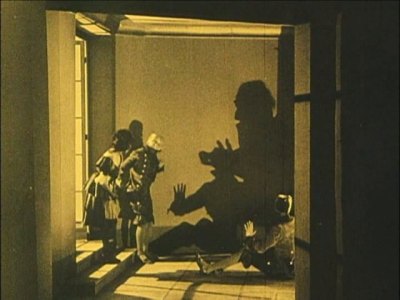 Of course shadows are a technique used extensively in German Expressionism, are they are very important to this film and are used to good effect here. The shadows cast upon the wall are often more important than the actors themselves, revealing a character's personality or thoughts. The superimposition of the shape of a wolf's head over a man's shadow tells more about him than minutes of dialog could.
Director and cowriter Arthur Robison, an American working in Germany did a very good job crafting this film. Though there are not titles, the action is fairly easy to follow. There are a couple of segments that aren't as clear as they could be, but generally viewers will have no trouble following the story.
Even though Robison's direction is skilled, much of the credit for the movie's success has to be placed at the feet of cinematographer Fritz Arno Wagner. Responsible for the filming of the Fritz Lang films M and Spies, Wagner was also behind the camera (or more accurately next to it turning the crank) for F.W. Murnau's masterpiece Nosferatu. He helps give this film the slightly eerie feeling it has by drawing the viewer's eye to the seemingly ever present shadows that are an integral part of the film.
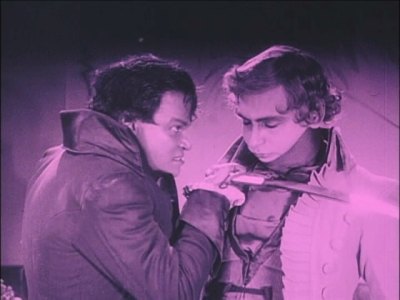 A sadly neglected film in the US, this is the first time it has been released on DVD. (I'm unaware of a VHS or Beta release too.) The film is a triumph of style and a great example of an early psychological thriller.
Audio/Video:
This film has been restored by Cineteca del Comune di Bologna, the Cinematheque Francaise and the Friedrich Wilhelm Murnau Stiftung using two main sources, an original tinted French print from Cinematheque Francaise, and a dup negative held by the Museum of Modern Art. The editing of the film was based on an examination of all existing prints of the film. Though the French print had intertitles in the film itself, this restoration has left them out as the original German release was title-less.
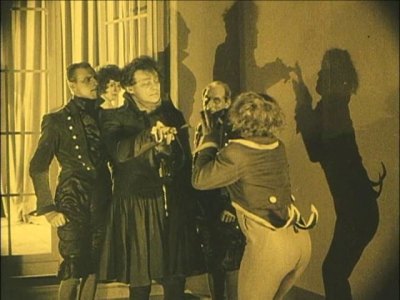 The full frame black and white tinted image looks good, especially for a film this old. There is still a fair amount of print damage, scratches, spots, and dirt, but that isn't unusual. The contrast is pretty good overall, though some scenes are a bit too bright causing details to be lost in the highlights. The tinting scheme works well and isn't intrusive. Overall a very nice looking film.
The music for the soundtrack composed and performed by Donald Sosin. The track, piano with a few sound effects added, is scene specific and compliments the film very well.
Extras:
Unfortunately there are no extras on this disc.
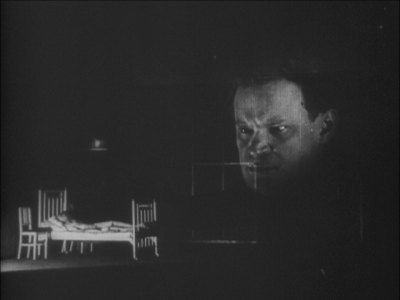 Reuniting the director and star of Caligari, Robert Wiene and Conrad Veidt, are at the helm of The Hands of Orlac is an interesting psychological thriller. While not as creative and stylized as Caligari, the movie about a pianist who is given the hands of a murderer after an accident has some interesting touches and effectively illustrates the torment that the lead goes through as he feels the compulsion to kill.
Retuning home from a concert tour, pianist Paul Orlac (Conrad Veidt) is in a train accident when the wrong switch is thrown. His wife, Yvonne Orlac (Alexandra Sorina) rushes to the scene and discovers his still-living body and manages to get him to a hospital. The doctor there saves his life but reveals that the musician's hands have been terribly damaged. Pleading to save her husband's hands, the doctor transplants the hands of an executed killer onto the young pianist.
While still recovering in the hospital, Orlac starts seeing visions of the murderer whose hands he has acquired which disturbs him greatly. Reading a description of the murder that his hands were supposed to have committed, Orlac discovers that a knife with an X on the handle was used to kill a shop keeper, a knife that has mysteriously appeared in Orlac's house.
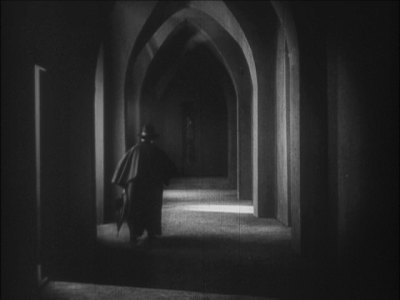 Tormented by the murderous knife and fighting an urge to kill, Orlac can't sleep. He vows to never touch anyone again with his criminal hands, and gives up playing the piano. Of course Paul and his wife can't continue to live in a large house with servants when they have no income, and the creditors soon come knocking at the door. Yvonne appeals to Paul's rich father to help them but is rebuffed, and when Paul finally goes to his father, he discovers the elder Orlac dead, killed with a knife with an X on the hilt and the executed murderer's fingerprints on the handle.
The plot to this movie would be copied and repeated several times, and this original version is very good in a lot of ways. The film does an excellent job of showing Orlac's decent into madness and paranoia, and the mystery of his father's murder really propels the narrative. Unfortunately the movie is slowly paced at the beginning and really drags in places. Having seen Caligari which moves at a good rate several times, I have to wonder if the slow pacing was intended or if it was the result of the editor in charge of the restoration wanting to use every scrap of film that was available. As it is, a lot of the scenes last too long and there are several clips that I would have eliminated altogether to quicken the pace.
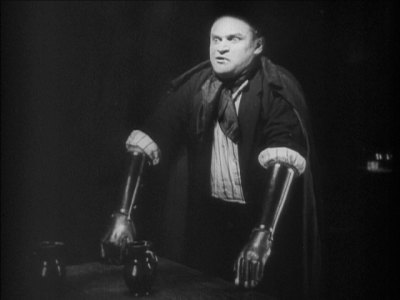 The film does pick up pace quite a bit in the final reels when the conflict about the creditors and, ultimately, the murder take center stage metaphorically speaking, and even the early part has some interesting sections. Veidt does a great job in the role, and it was fun to watch him on screen. Unfortunately the same couldn't be said of Alexandra Sorina who horribly over-acted her part. While Veidt did exaggerate his motions for effect, Sorina really went overboard acting more like Douglas Fairbanks in one of his action comedies, alternately waving her arms and crumpling into a cringing ball. It's too bad, because a more sedated performance would have made the film much better.
While not as surreal and stylized as Caligari, the film's use of lighting, the barren urban setting for one section and the anti-hero at the center of the drama puts this firmly in the expressionist genre.
The DVD:
Audio:
While I'm sure many people will enjoy this stereo soundtrack, I actively disliked it. The music, composed by Paul Mercer, consisted of piano, violin, viola, percussion, and some scant vocals. Unfortunately Mercer uses a lot of discordant sounds and irritating noise-like tones to illustrate Orlac's madness. Not only are these parts of the soundtrack not pretty, they distract from the film. It's hard to get engrossed in the movie when your ears are cringing. Aside from this stylistic choice that I didn't agree with, the musicians were all very capable and performed the music ably.
Video:
This movie was restored in 1995 by Bundesarchiv-Filmarchiv, Fredrich Wilhelm Murnau Stiftung, and Deutsches Filminstitut. In addition to this, some additional scenes were added by Bret Wood from a 16mm print that was found in the Raymond Rohauer Collection. These additional scenes were sections not found in the FWMS restoration, naturally. The 16mm sections were easy to tell, they had less resolution and were much softer, but they also had a bit more contrast. The FWMS restoration was good, but there's only so much film restorers can do. This print still had a lot of dirt and spots on the print and in one or two places there were sprocket scratches were the film had jumped the gear at some point in time. The contrast wasn't wonderful, with dark areas losing a lot of detail and there was some minor blooming on highlights in a few places. About average for an restored film of this age: not great but not bad.
Extras:
There were some great bonus items on this disc, most notably a scene comparison. Now my eyes usually glaze over on the storyboard to film comparisons that are included on some DVDs, but this was much more interesting. Scenes from the FWMS restoration and the Rohauer print are shown, either individually or side-by-side. These were often from two different cameras. In the silent era it was common to have two cameras cranking side by side: One film for the domestic release and one for foreign distribution. In addition to the different angles and sometimes different takes, the scenes were often edited differently between the two prints with some middle sections of a single shot being removed in some instances. I was also quite surprised to see that the camera were cranked at different speeds occasionally. A scene would be lined up to start, and after a few seconds it would get out of synch. Three extended scenes are compared with optional commentary.
In addition to that there is a text piece on the restoration, film notes by John T. Soister, an image gallery, and the trailer for Mad Love, a 1935 remake of the film staring Peter Lorre.
The final movie in this set is the weakest, but it has some interesting aspects that make it worth viewing.
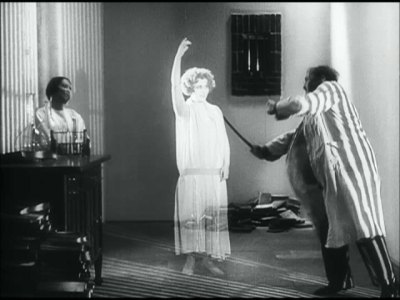 The Kulturfilm Abteilung branch of UFA, the German film studio, was charged with making films that would appeal to a more high-brow audience; films aimed at an academic and more cerebral audience. In the mid-20's the science of psychoanalysis was still very new and relatively unknown to the general populace, and Kulturfilm head Hans Neumann thought the subject would be the perfect subject for a movie. He wanted to get the science right, so he approached Sigmund Freud and asked that he be technical advisor. Freud turned him down instantly, since he felt that psychoanalysis was much to abstract to be accurately portrayed in a film, and that they only wanted his stamp of approval, not his input. Not deterred, Neumann went to people in Freud's inner circle and finally convinced Dr. Karl Abraham to help with the project. This ended up causing a rift between Abraham and Freud especially when UFA leaked a story that Freud approved of the film and some news stories even said that he was directing it! UFA promised to issue a retraction, but they were very slow in doing so causing Freud to issue his own statement distancing himself from the project. It seems that studios back then were as sly and conniving as they are now.
Billed as a "psychoanalytical thriller", the film has more psychoanalysis than thrills. When Martin Fellman (Werner Krauss) is trimming the hair on the back of his wife's neck (Ruth Weyher), he hears a cry of "HELP!" as a neighbor is murdered, causing him to nick his wife slightly.
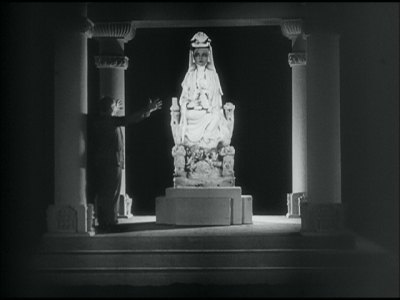 In the days that follow, Fellman starts to act strangely. He's terribly afraid of knives and sharp instruments and starts to feel compelled to kill his wife! He has strange nightmares and has trouble sleeping. At the same time an old friend of both Martin and his wife's arrives from out of town, but Martin's phobias and compulsions start to ruin the visit. When Fellman encounters a psychoanalyst (Pawel Pawloff), he starts to undergo therapy. Slowly, after describing his nightmares and his past, Fellman starts to discover what's really causing these unusual reactions and when the root is finally discovered, he is cured.
Viewed today, the film is pretty lackluster. The acting is stilted and unimpressive and the plot creeps along. Even worse is the resolution, where just talking about an event in the past miraculously causes the disease to disappear. As presented in this film, psychoanalysis bears more than a little resemblance to Scientology, where they similarly preach that forgotten events in the past can cause all sorts of ailments.
The highlight of the film is the dream sequence that is very interesting and quite impressive. The use of double exposures and very surreal images are used to create an intense and visually striking trip into a neurotic man's nightmare. The film is worth watching for that sequence alone.
The DVD:
Audio:
This disc comes with a piano score by Ekkehard Wolk which I quite enjoyed. He wasn't trying to make the music dominate the scenes as in The Hands of Orlac, but to supplement the action on screen. A nice and appropriate score.
Video:
This is one of the better looking films in this set. The level of detail is very strong and the contrast is good. There is some blooming of white objects, especially the wife's dressing gown at the beginning, and there was some dust and spots on the print used, but overall it is a solid looking film.
Extras:
The only bonus item is text piece on the film that is illustrated with production stills.
Final thoughts on the set:
This is a good introduction to German Expreessionist film. While these (with the exception of Caligari) aren't necessarily the best know Expressionist films, they do illustrate the techniques and style used by this short-lived film movement. The Cabinet of Dr. Caligari is mandatory viewing for any student of film, and the other selections are strong too. If you don't have any of these films in your library, the set is highly recommended. All of these films are also available separately for those who already have the two previously released movies.
|



| Popular Reviews |
| Sponsored Links |
|
|
| Sponsored Links |
|
|
| Release List | Reviews | Shop | Newsletter | Forum | DVD Giveaways | Blu-Ray | Advertise |
|
Copyright 2024 DVDTalk.com All Rights Reserved. Legal Info, Privacy Policy, Terms of Use,
Manage Preferences,
Your Privacy Choices 
| |||||||