
| Reviews & Columns |
|
Reviews DVD TV on DVD Blu-ray 4K UHD International DVDs In Theaters Reviews by Studio Video Games Features Collector Series DVDs Easter Egg Database Interviews DVD Talk Radio Feature Articles Columns Anime Talk DVD Savant Horror DVDs The M.O.D. Squad Art House HD Talk Silent DVD
|
 DVD Talk Forum |
|
|
| Resources |
|
DVD Price Search Customer Service #'s RCE Info Links |
|
Columns
  


 
|
|
|
H.P. Lovecraft Collection, Vol. 1: Cool Air, The
It would be easy to write off H. P. Lovecraft as an over-rated hack. After all, his plots are very simple more often than not, there's frequently little in the way of character development, and his prose is turgid and opaque. Indeed critics have raised all those points and more (especially the way he labels a creature as indescribably horrific only to describe it two pages later) but these people miss the point. Lovecraft's strength, and the reason he's remembered today when so many of his contemporaries are forgotten, is in his unique ability to create a horrific atmosphere and a pervading sense of unease. No other writer has been able to consistently generate a feeling of foreboding and discomfort the way Lovecraft can. He's the father of modern horror fiction, and has influenced such diverse writers as Stephen King and Batman scribe Denny O'Neil (who named Gotham's Arkham Asylum after the fictions city of Arkham Massachusetts which appears in Lovecraft's fiction.
Because of his prose style and the way he leaves much of the horror to the readers imagination, Lovecraft's stories are innately difficult, some would say impossible, to accurately adapt to other mediums, especially a visual one like film. This hasn't stopped many people from trying, and the results have been more often than not unsatisfactory, at least as far as the feature films are concerned.
Lurker Films has now released a series of discs containing adaptations of Lovecraft-inspired movies that do capture the horror master's style and atmosphere on film. Known as The Lovecraft Collection, each of these discs offers some interesting takes on Lovecraft's stories.
Volume One:
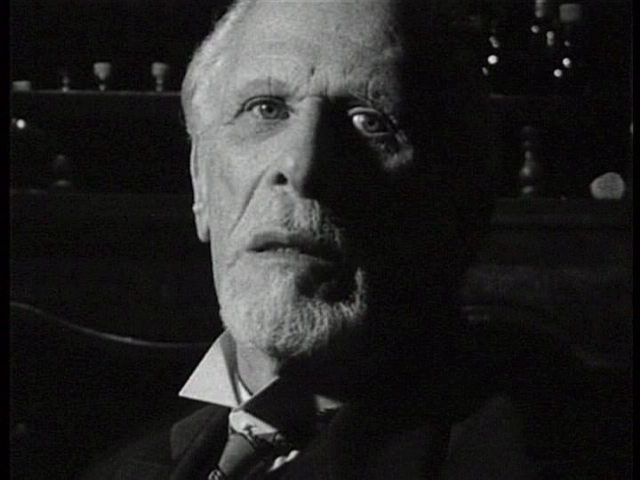
Cool Air (43 minutes): The featured film on this disc is excellent. It is one of the better Lovecraft adaptations around. When writer Randolph Carter moves to New York City in the summer of 1925, he takes a room in a boarding house run by an overbearing landlady. It's hot and muggy everywhere in the city. Everywhere except for the room right above Carter's, which is rented by the reclusive Dr. Murnoz, is unnaturally cool.
When Carter suffers a near-fatal heart attack, he manages to crawl up to the Doctor's room before collapsing. Waking the next day, he discovers he's in the man's cool, dry room. Murnoz has saved his life, and the two men become friends. It turns out that the room is so cool due to a strange machine that runs on ammonia, a sort of pump that cools the air. This is required to keep the good Doctor alive, ever since he contracted a rare disease years ago. When the machine fails however, Carter will learn his friend's dark secret.
This was an excellent film. A faithful adaptation, it doesn't try to mimic the story (though it does a good job of that) but rather to recreate the feelings that reading the story evokes. Hearing the Doctor's story viewers feel sad for the man trapped in a small room, and the sympathy that the film evokes is even more pronounced than in the short story. The climax of the movie was well done too, opting not to go for cheap special effects the creators wisely left much of the visuals to the viewer's imagination, just as Lovecraft often did.
Main character Randolph Carter (writer/producer/director Bryan Moore) is rather wooden and unconvincing in some of the film, but Jack Donnor (of Star Trek (the original series) fame) does a magnificent job as Dr. Murnoz. He really caries the film an makes viewers feel sorry for the man without getting rid of the creepy feeling that the man evokes. The scene where he's telling of his past is heart-wrenching, but at the same time he seems a bit sinister.
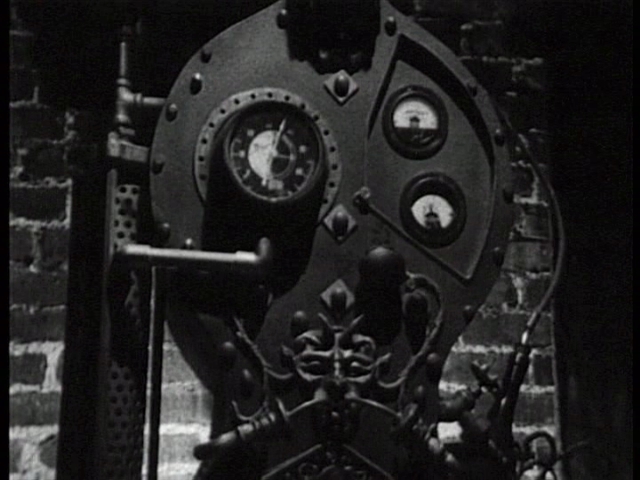
A/V: The full frame black and white image looks very good. There is a lot of grain in the picture, as the creators intended, and a few scratches that they didn't. (This occurred with the very first screening of the film due to an inexperienced projectionist.) The image has a good amount of detail and digital defects are minor.
The stereo soundtrack is excellent and really accents the mood that the images are trying to create. The film makes good use of slow, bass-heavy music to set the tone. An excellent example of how music can really enhance a low budget film.
Nyarlathotep (13 minutes): Based on a short prose-poem, this film tells of a Egyptian archeological expedition that causes the God-King Nyarlathotep to arise. This ancient being tours the world illustrating his magical powers and wreaking havoc. A fair adaptation, the acting is a bit stilted in places but overall they go a good job of capturing the mystery and fear of the piece.
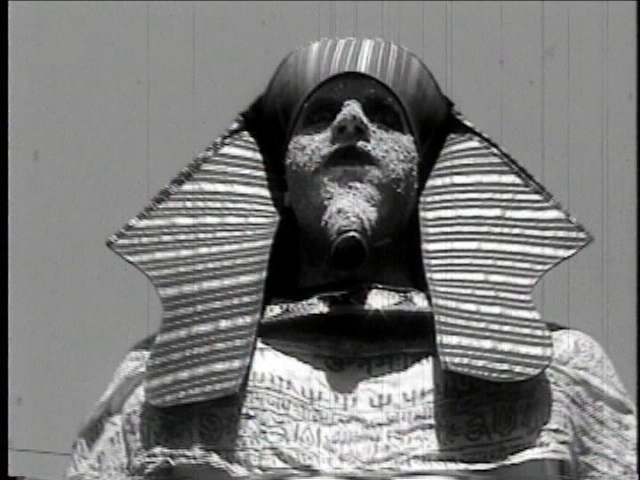
A/V: The full frame black and white image has some grain and scratches added in to make it fell like an older film. There is a good mount of aliasing, especially in the background. The audio is mixed a little low, and the narration is muddled and sometimes hard to hear.
An Imperfect Solution (16 minutes): Taken from the same series of stories that the Re-animator films were adapted from. A doctor has come up with a solution that he believes will bring the dead back to life. He needs the right subject to prove his theories though, and if he can't find the right corpse, ....he'll make one.
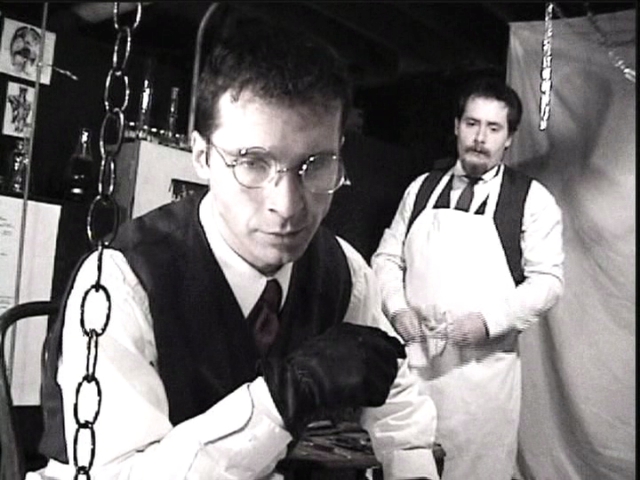
This was a very nice adaptation that was a lot of fun. It's set in the 1920's, as the stories were, and they have more of the Lovecraft flavor because of it. There's a nice sense of dread through most of the film. My favorite of the shorts on this disc, Bob Poirier's performance as Herbert West is excellent. It's just as I've always envisioned him.
A/V: The color full-frame image looked fine. The colors were muted to create and old-time atmosphere, but the picture was sharp with only some light aliasing to mar the otherwise fine presentation.
The Hound (18 minutes): This is one of the more difficult stories to adapt, and though the creators made a valiant attempt, the result isn't as satisfying as I was hoping. The black and white film tells the story of two men who collect and study unholy objects that they collect by robbing graves. On one such expedition they take an unusual jade icon from around the neck of a long diseased man who was rumored to be a ghoul. Afterwards they are pursued by an unseen evil presence that turns deadly.
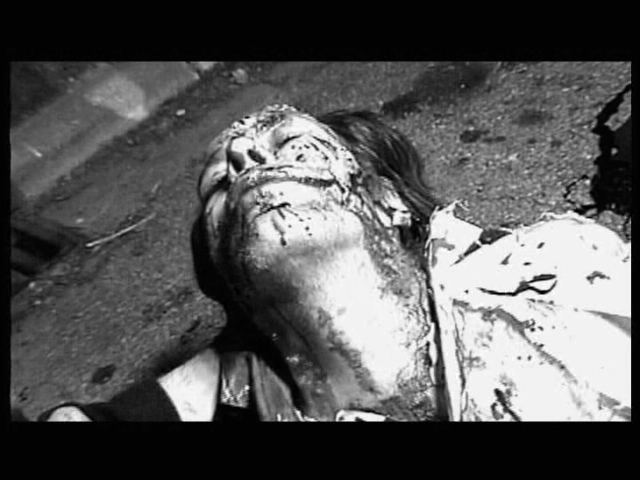
The tale is completely told with narration, a very close reading of the Lovecraft story. The images that accompany Lovecraft's words don't accurately illustrate what is being said. How could someone (especially a filmmaker on a small budget) recreate the museum that the pair had created? As Lovecraft described it:
Our museum was a blasphemous, unthinkable place, where with the satanic taste of neurotic virtuosi we had assembled an universe of terror and decay to excite our jaded sensibilities. It was a secret room, far, far, underground; where huge winged daemons carven of basalt and onyx vomited from wide grinning mouths weird green and orange light, and hidden pneumatic pipes ruffled into kaleidoscopic dances of death the lines of red charnel things hand in hand woven in voluminous black hangings.In the film much of this description was omitted, but the "unthinkable place" was just a dank basement with brick walls. Similarly the actors didn't seem to convey the terror that the pair of men were experiencing when the Hound was hunting them.
Still it is an admirable attempt, and the narrator does a very good job of reading the story.
A/V: The non-anamorphic widescreen black and white image was okay but not great. The white levels were slightly off which caused some blooming at times. The detail was fine, and the black levels were adequate. There was some aliasing in places but it was never distracting. The stereo soundtrack had its problems however. The narration was very muddled and it was hard to understand some of the words at times. It isn't a fatal flaw, but it does take away some of the enjoyment of the film.
The Hapless Antiquarian (7 minutes): An A-B-C poem (A is for the Antiquarian.....B is for the Book....) of a book collector who has the poor luck of discovering a copy the Necronomicon in an old book story and the fate that befalls him. While not based on a Lovecraft story, it was very cute and I was impressed that they were able to follow the ABC format and rhyme scheme while telling a good, if a bit simple, story.
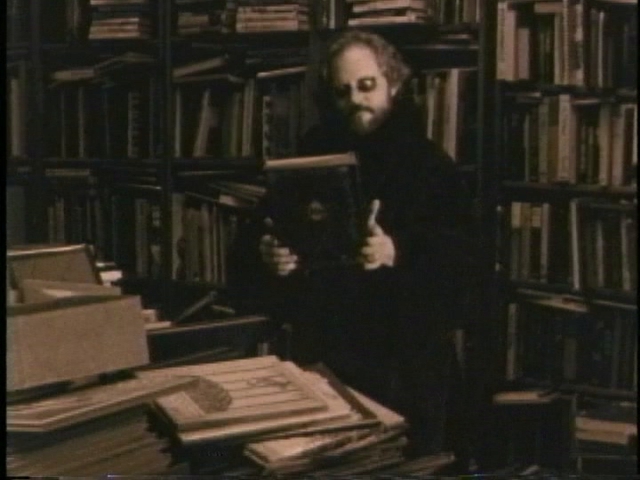
A/V: The full frame sepia-toned image looked nice, if a bit soft, and fit the subject matter well, as did the stereo soundtrack.
Extras:
In addition to the five films, there are a number of nice bonus features. First is Behind the Machine, a 25-minute look at the making of Cool Air. The cast and crew are interviewed and they relate some interesting anecdotes including how they had to break into the abandoned building that they used to shoot the film.
The Lovecraft scholar S. T. Joshi is interviewed also, and he has a lot to say. He talks about how Lovecraft's reputation has risen in the last 30 years, and discusses the backgrounds to the stories that were adapted in this volume.
The final two bonus items are Dunwhich 1927 and The Scroll. Both of these are short humorous advertisements for the H. P. Lovecraft Film Festival.
There is also a nice 8-page insert that includes an interesting essay about Lovecraft and his opinion of movies, as well as pieces about some of the films presented on this disc.
Final Thoughts:
As a Lovecraft fan, I enjoyed seeing these films that were obviously made by others who appreciate the man's work. You don't have to be a fan in order to enjoy these however. Most people who enjoy suspenseful films that contain a feeling of dread rather than revulsion will appreciate these offerings. Cool Air and An Imperfect Solution are excellent, and the other movies are definitely worth watching. With over an hour and a half worth of films and copious extras, this disc is Highly Recommended.
|



| Popular Reviews |
| Sponsored Links |
|
|
| Sponsored Links |
|
|
| Release List | Reviews | Shop | Newsletter | Forum | DVD Giveaways | Blu-Ray | Advertise |
|
Copyright 2024 DVDTalk.com All Rights Reserved. Legal Info, Privacy Policy, Terms of Use,
Manage Preferences,
Your Privacy Choices 
| |||||||