
| Reviews & Columns |
|
Reviews DVD TV on DVD Blu-ray 4K UHD International DVDs In Theaters Reviews by Studio Video Games Features Collector Series DVDs Easter Egg Database Interviews DVD Talk Radio Feature Articles Columns Anime Talk DVD Savant Horror DVDs The M.O.D. Squad Art House HD Talk Silent DVD
|
 DVD Talk Forum |
|
|
| Resources |
|
DVD Price Search Customer Service #'s RCE Info Links |
|
Columns
  


 
|
|
|
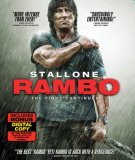
Rambo
The forth film in the ongoing saga of John Rambo, simply titled Rambo, successfully accomplishes the near impossible task of revitalizing a franchise that had, to be blunt, become a bit of a joke. While the first entry in the series, First Blood, was a nice blend of action, suspense and drama but the second and third entries were more than just a little bit silly, even if they were a fun time at the movie. Following the success of Rocky Balboa (which also successfully brought back a clichéd character), Stallone's wound up standing as one of the best action films of the last ten years.
When the picture begins, John Rambo (Sylvester Stallone) is living the life of a recluse in Thailand where he makes a meager living catching and selling snakes and by bringing people up and down the nearby river in his antiquated wooden boat. Rambo enjoys the quiet life and minds his own business but when a group of American Christian missionaries, lead by Michael Burnett (Paul Schulze of The Sopranos), attempt to hire him to bring them upriver into war-torn Burma, he's eventually persuaded thanks to the sincerity of one of the missionaries, Sarah Miller (Julie Benz of TV's Angel).
After taking down a boatload of Burmese pirates, Rambo successfully drops the crew off in Burma and is told that they'll be leaving by ground and that his services are no longer needed. He heads back home but is soon notified by an American minister (Ken Howard) affiliated with the group that they've been abducted by a Major Tint (Maung Maung Khin). He persuades Rambo to bring a group of mercenaries to the spot where he last saw the missionaries so that they can bring them out of Burma alive. While the mercenaries, lead by a surly Englishman named Lewis (Graham McTavish), don't want Rambo's help, they soon find that they have no choice in the matter and he finds himself drawn back in to the life he thought he'd finally left behind.
Lean, mean, and astonishingly violent, Rambo builds to one of the most gratuitously blood soaked conclusions seen in a mainstream motion picture in a long, long time. Heads are blown off, torsos explore, throats are ripped out, landmines fling body parts into the air and machine guns turn men into goo and it's honestly surprising that this film passed with an R-rating. That said, there's more to Rambo than just carnage. The picture builds with a palpable intensity and it's interesting to see Stallone's character reluctantly work his way back into his former self and face the life he tried to leave behind head on. The picture also attempts to make some sort of social commentary by shedding some light on the realities of life in Burma, a country that's been suffering the effects of war for decades.
Stallone, who directed and co-wrote the film with Art Monterastelli, is as cold as ice as the man of few words who decides to die for something rather than live for nothing and he brings a delicious sense of menace to the part that has been lacking in past entries. Rambo is scary here, he's a powder keg waiting to explode and explode he does once the action moves to the internment camp where the missionaries are being held. The supporting cast are all fine in their parts, but this really is Stallone's show all the way through and the cinematography really plays up his sour face and burly features. The film also takes a more realistic approach to war this time around, with Rambo working with a team rather than as the one man wrecking crew he'd become by the time that Rambo III hit theaters. This gives us a more believable film that uses violence as a ways of delivering its message rather than as the message itself. The end result is an interesting, tense, exciting and fairly bleak action film that doesn't let up and hits all the right notes.
The DVD Video:
Lionsgate presents Rambo on Blu-ray in a nice 2.35.1 1080p AVC anamorphic widescreen transfer that does a very nice job of replicating how the film looked in theaters earlier this year, meaning that the colors are intentionally bleached a bit and that the picture is constantly gritty looking. That's how the film looked on the big screen, and that's just how it looks on Blu-ray as well. This results in some detail loss where the image should otherwise be crisp and sharp. That said, the transfer is quite well done and there's certainly no shortage of little details to pick out, particularly in facial close-ups and tighter interior shots. Color reproduction is solid (though again, flatter than you might expect) with whites and lighter colors looking hot. There aren't any problems with compression artifacts nor are there any issues with heavy edge enhancement or shimmering effects. Grain is moderate in some spots, intentionally so, but there isn't any actual print damage to complain about. The greens and browns of the jungle look nice and accurate though black levels could have been a touch inkier, at times showing a blue tint. The reds, important during the carnage of the last half hour of the movie, are nice and bright without looking oversaturated and there's more detail during the various gore scenes than was evident during the theatrical presentation this reviewer attended. This may not be a reference quality Blu-ray transfer, but it absolutely looks as good as it needs to, maybe even a little better.
Sound:Rambo is the recipient of a spiffy 7.1 DTS HD Master Audio track in the film's native English language and a Dolby Digital 5.1 Surround Sound mix for the optional French dub that has been included. Removable subtitles are provided in English and Spanish. How does it all shape up? Quite nicely! This is a very aggressive and impressive sound mix that makes great use of the surround channels and the sub during the action sequencing. Bullets fly around during the shoot outs and the explosions used in the film pack a serious wallop. On the flip side, the quieter scenes are nice and clear with very distinct dialogue and some nice subtle background sound effects. The score has some nice bounce and punch to it and the levels are all very well balanced. Bass response is very strong and directional effects are well placed within the soundstage.
Extras:First up, concerning the supplemental material, is an audio commentary track with co-writer/director/star Sylvester Stallone. There are two ways you can enjoy this track, the first of which is standard audio commentary mode where Stallone simply talks over the film. The second option is a Blu-ray exclusive picture-in-picture mode called Bonus View which embeds a bunch of interesting silent behind the scenes footage and periodically launches some exclusive featurettes into a window on top of the feature film itself. Seeing as this film was Stallone's baby through and through it would stand to reason that the man has a lot to say about the history of this production. He talks about the location shooting in Thailand and about some of the other ideas that almost turned into the movie we see before us. He gives some interesting insight into the character and the changes that Rambo goes through in this film and about many of the criticisms that have been levied against him and his films over the years. He talks about how he genuinely want to turn a light on in regards to what's happening in Burma and why, and he spends a fair bit of time discussing the reality and the politics that have made that unfortunate situation what it is. All in all, this is an excellent commentary that does a great job of enlightening us as to what went into making this picture but also giving us some insight into Stallone's creative process. The Bonus View option is incorporated well alongside the commentary and the transitions to and from the feature to the featurettes and behind the scenes footage is reasonably smooth and it also adds some visual evidence to a lot of what Stallone discusses on the track.
Up next is a series of six featurettes relating to the film (and all of which are presented in high definition):
It's A Long Road: The Resurrection Of An Icon (19:44) - This is a look at who did what on the movie as it includes interviews with most of the key cast and crewmembers all of whom have some interesting stories to share about their experiences on set. Mixed in with the interviews are some behind the scenes clips that give us a look at what life was like on set. Stallone begins the piece by talking about why it took him so long to want to make another Rambo movie as he really wanted it to be more than just a caper, he wanted it to have some significance. The producers talk about how the movie left the Caralco stable and wound up being produced as an independent film and there's some discussion here as to the 'almost' storyline about Rambo heading to Mexico to deal with a kidnapping (this is also discussed in the commentary) and they also talk about how some United Nations discussion lead to the switch to place the film in the Burmese conflict. This is an interesting look at the path this film took from idea to finished product.
A Score To Settle: The Music Of Rambo (6:31) - This is a peek at the work that composer Brian Tyler did for the film and how his score was used in the picture. He talks about the late, great Jerry Goldmsith and gives credit where credit is due in that department, as he scored the original film which influenced his work on this film and he also talks about what it was like working with Stallone on this project. Stallone, on the other hand, shows up to talk about how much he enjoyed working with Tyler and how much he liked the score.
The Art Of War: Completing Rambo - This featurette is produced in two parts. The first part, Editing (6:47), begins with Stallone talking about cutting the film in his garage but soon lets editor Sean Albertson discuss his work on the project and his relationship with Stallone (they first worked together on Rocky Balboa). The two discuss timelines and deadlines and some of the quirks involved in editing a film like this as well as the importance of the editing in this picture. The second part, Sound (3:15), covers the sound mix that Albertson helped create for the film. Albertson talks about what Stallone wanted for the film while the two sound editors who were brought on board to finish the project discuss Stallone's intuitive directing style. These two featurettes give us a look at the importance of some of the post-production work that is very important to the success of any film.
The Weaponry Of Rambo (14:23) - This documentary explores the various weapons that show up to different degrees in the film and how Stallone wanted things to be as authentic as possible in this department to further accentuate the realism he wanted in the film. The weapons supervisor, Ken Johnson, shows up and talks about his work on the picture, Stallone noting that he's been nicknamed 'eager beaver over achiever' due to his insane eye for detail. There's a fair bit of behind the scenes clips in here that show how literally thousands of items were picked to be used in the film. This, again, is something that we don't usually see covered in behind the scenes material and it's nice to be able to learn about what goes into this aspect of filmmaking, from the sniper rifles to the machine guns to the truck mounted machine gun that Rambo uses in the finale. Look for a brief alternate scene to show up in here.
A Hero's Welcome: Release And Reaction (9:31) - This featurette starts off with some footage from the film's opening night with many of the cast and crew in attendance. Interview segments let performers, producers and the like discuss the opening at the 1500 seat theater in Las Vegas where the film debuted. Who knew Arnold Schwarzenegger turned up? He's here, along with a few other interesting people. They also discuss the marketing for the film as well as the poster art and how the movie was really embraced by members of the U.S. military. Stallone talks about how many celebrities have taken it upon themselves to shed lead on atrocities around the world but how no one really seems to have done much about Burma, and about if you're caught with a copy of this film on DVD you can go to prison for ten years. The lovely Ms. Benz talks about how her work on this film lead her to help out in a diplomatic sense to shed light on the events and Stallone ends the piece by stating that he hopes this film will be a rallying point to have more attention paid to these problems. A perfect way to end this featurette, and into segue into the last (and most important) one...
Legacy Of Despair: The Struggle In Burma (10:42) - Here we learn how and why Stallone chose to set the film around Burma, which he found through some research to be considered by many to be one of the nastiest places on earth. Some people who grew up in Burma chime in to talk about how on the forties it was a nice place to live but once the country gained its independence from Great Britain, the civil war broke out and now the government controls everything. There are child soldiers, torture is used, soldiers will shoot to kill, and you can be held in prison for whatever reason the military regime wants to make up. The military regime in power really only uses their weapons against the rebels in the country. In 2007 a group of unarmed Buddhist monks marched and preyed for an end to the violence and the military opened fire on them and killed over two hundred people. Subsequently, monasteries were raided and destroyed and many monks had to go into hiding or leave and flee to Thailand. People from various political groups chime in and talk about how the Karen people have been targeted more than others and how the Burmese military are taking over their land. Lots of actual footage helps this piece really hit hard and as such, this featurette is a real eye opener in a lot of ways.
From there, be sure to check out the selection of Deleted Scenes that can be found on the disc. You can watch then via a 'play all' button or individually and the scenes are as follows: Do You Believe In Anything? (2:29, a discussion between Rambo and Sarah regarding Rambo's decision to help the missionaries),Who Are You Helping? (4:42, a discussion between Rambo and Sarah about the merits of the missionary work - this is an extended version of the same discussion we see in the film),Boat Ride (4:12, Sarah talks to Rambo as he pilots the boat upriver, extended from the same scene used in the feature allowing Rambo to elaborate on his past a little more), and Let's Keep Going! (2:21, Rambo helps Sarah with her wounded foot and he wraps her wound).These are all presented in 2.35.1 anamorphic widescreen though the video quality isn't quite as sharp as that seen in the feature film. The audio is presented in English language only, Dolby Digital 48 kHz 224 kbps 2.0 Stereo.
Lionsgate has also included a Molog feature for profile 2.0 compatible Blu-ray players. When enabled, this interactive feature connects to the internet and allows viewers to engage in discussions with other viewers and to Blog about the film in real time. The initial download takes a few minutes but once the little yellow bar is done moving and the setup is complete you can monkey around with audio clips, make nifty little animations, modify groups and objects and create simple animations and talk about the movie as it plays out if that's your bag.
Rounding out the supplements is a Rambo Series Trailer Gallery where widescreen trailers for all four films in the series can be found. Some spiffy animated menus and chapter stops are included as is a bookmarking option and trailers for a few other, unrelated Lionsgate Blu-ray releases..
Although the packaging and advertising for this release promote it as a '2-Disc Special Edition' the second disc contains only a 'digital copy' of the movie so that those who want to watch the movie on their PC or iPod can do so. It's fairly deceptive to market the release as a '2-Disc Special Edition' when the second disc contains no new material...
Final Thoughts:Rambo is, quite simply, one of the finest action films to come out in some time. It provides just enough social commentary to give the movie some context but doesn't skimp in the last on the action, excitement and tension that makes this film the raving success that it is. Lionsgate has done an excellent job with the presentation and the supplements and this release easily earns a highly recommended rating.
Ian lives in NYC with his wife where he writes for DVD Talk, runs Rock! Shock! Pop!. He likes NYC a lot, even if it is expensive and loud.
|



| Popular Reviews |
| Sponsored Links |
|
|
| Sponsored Links |
|
|
| Release List | Reviews | Shop | Newsletter | Forum | DVD Giveaways | Blu-Ray | Advertise |
|
Copyright 2024 DVDTalk.com All Rights Reserved. Legal Info, Privacy Policy, Terms of Use,
Manage Preferences,
Your Privacy Choices 
| |||||||