
| Reviews & Columns |
|
Reviews DVD TV on DVD Blu-ray 4K UHD International DVDs In Theaters Reviews by Studio Video Games Features Collector Series DVDs Easter Egg Database Interviews DVD Talk Radio Feature Articles Columns Anime Talk DVD Savant Horror DVDs The M.O.D. Squad Art House HD Talk Silent DVD
|
 DVD Talk Forum |
|
|
| Resources |
|
DVD Price Search Customer Service #'s RCE Info Links |
|
Columns
  



 
|
|
|
Perils Of The New Land: Films of the Immigrant Experience
Flicker Alley and Blackhawk Films have teamed up to release some of the classics of early cinema and their association is a blessing for silent film fans. Their latest collaboration is Perils of the New Land: Films of the Immigrant Experience 1910-1915. This two disc set includes two feature films and a trio of Edison shorts that are concerned with various social problems of the time. The first movie, The Italian, looks at the life of an immigrant and the hardships of living in urban New York, while Traffic in Souls examines white slavery. Both are interesting in their own way and offer a unique glimpse into life around the turn of the previous century.
The Italian (1915): This film has a framing sequence which is a bit confusing. Curtains are pulled up, like on a stage play, and the scene is the living room of an obviously wealthy man (George Beban). He takes a book from the shelf, entitled The Italian, and starts to read. The whole movie is him 'reading' the book and at the conclusion he closes the book and the movie ends. The confusing part is that Beban plays the lead in the movie, the immigrant Beppo. I'm not sure whether this is supposed to illustrate that Beppo later becomes wealthy and writes a book about his experiences, or if it is just supposed to lend an air of class to the production.
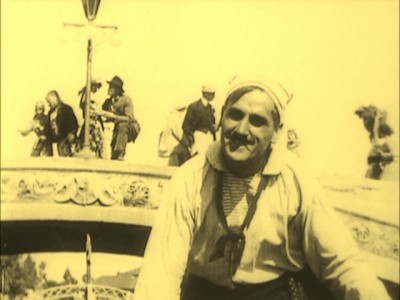
In either case the narrative starts in Italy, where Beppo, a poor but happy gondolier, is in love with Annette (Clara Williams). Annette has another suitor though, a well to do businessman. Though she loves Beppo, Annette's father is afraid that he won't be able to provide for her. He give the young man one year to prove himself. If he can't support her at the end of that time, she'll marry Beppo's rival.
With little economic opportunity in Italy, Beppo sails for America. Once there he takes up shining shoes on a street corner and saves up enough money to send for his love. Once the two are united they get married, and a year later have a baby. Things don't go so well for them however. They are living in poverty and their child gets sick from being fed contaminated milk. The doctor instructs them to only give the child pasteurized milk, which is expensive. Beppo works hard to get the money for his son's milk, but when he gets mugged and all of his money stolen after work one day, he gets desperate.
At first I wasn't too enthused about this film. It starts as a typical melodrama, and Beban, who was a pretty big star when this was released, tended to overact. When he first goes to see Annette at her father's house, the two start to laugh when they see each other, for no reason other than that they are happy, and Beban doubles over and slaps his knee. While Douglas Fairbanks can get away with that in a larger than life picture like Robin Hood, in a melodrama it looks silly.
The plot was a bit simplistic at first too. Beppo is able to live in New York City and save up enough for Annette's boat passage while only shining shoes? It seemed a bit far fetched.
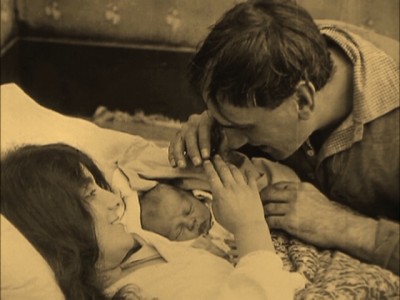
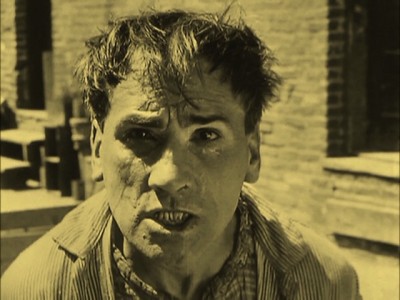
The movie picks up significantly in the second half though, and against my will I found myself being sucked in. Beppo is a delightful character, and his wife is calm and paitent. That's why it's so emotional when their child gets sick. Beban's acting style also changes for the better. When he walks into his apartment after his wife has given birth, he moves very slowly and carefully. He takes off his hat and gently bends down to look at his son for the first time. It's a touching scene and one that is in stark contrast to the almost slapstick manner in which he was running about earlier. His rage after being robbed was another standout moment. The camera does a very tight closeup, one to the closest I can recall for a film from 1915, and his anger and fear are almost palatable. Beban certainly could act, and I'd be interested to see some of his other work.
The ending of the film is also very dramatic and works well, without a false Hollywood happy ending (unless that's what the framing sequence was supposed to imply.) It was nice to see the hardships of poverty portrayed without any easy answers, something that doesn't often happen.
Traffic in Souls (1913): This is a fairly famous film for a few reasons. It was one of the earliest feature length films, and the very first feature (according to the commentary track) that wasn't based on a literary work. This movie was an early sensationalistic film too, bringing the problem of prostitution and white slavery to the big screen. It was banned in many localities even though it was supposed to be warning young women to beware of strange men who could kidnap them. Made for a reported $57,000, it ended up taking in over $500,000 and convinced the producer Carl Laemmle to build a studio in California, Universal Studios. With such a huge profit margin, it also started a wave of white slavery films.
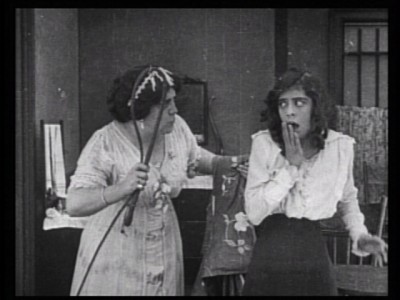
In this film William Trubus (William Welsh) is the head of a local morality league that wants to stamp out the sex trade, but he's only using that as a front. In reality this well respected citizen is the head of a white slavery ring. Well insulated from the actual dirty work, he has men scour the city to procure new women for his brothels.
Some of these men wait by the train station to lure poor innocent country girls who are coming to the city to seek their fortunes. Others hang out on Ellis Island to trick new immigrants to come with them. Then there's the worst of the lot; the men that prey on girls who work in stores. Lorna Barton (Ethel Grandin) works in a candy store to support her invalid father. When a smooth talking man starts flirting with her, she goes out and gets drunk, and ends up imprisoned in a brothel, held captive against her will. It's up to Lorna's sister to gather the evidence needed to arrest the leader and discover where her sister is.
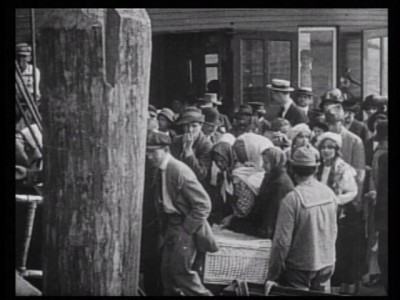
While this film is very simplistic in its outlook (the girls are simply rescued, but the economic and social forces that lead them to prostitution are still in place and not even mentioned) and offers little in the way of solutions to the problems it is still interesting to watch today. There are several scenes that were shot on location, and these are always worth watching. Of special note is a shot of immigrants leaving Ellis Island and entering America for the first time. The street scenes and candid shots of New York City are amazing in their own right.
The film also has a surprising outlook. It's not the civic organizations or politicians who are able to solve the problem....they are the problem. The main villain uses a philanthropic society to cover his crimes and talk of progressive social programs are useless. It's the cop on the beat who is the hero. In once scene an officer turns down a bribe and gets in a gun fight to save some immigrants.
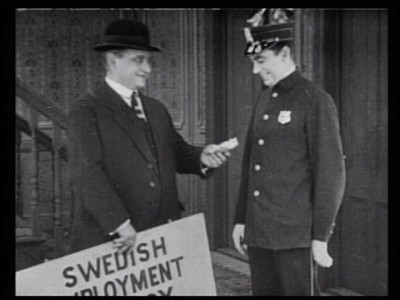
This is also a sensationalistic film, pure and simple. At one point they proclaim that 50,000 women a year are stolen off the streets and forced into prostitution. Of course nothing of the sort was true. Studies done at the time (as discussed in the commentary) discovered that brothels were not uncommon but that the workers joined willingly due to the high pay compared with other forms of work. Even so, this is an interesting and historic glimpse into the early part of the last century.
The DVD:
Audio:
The Italian has a score compiled and performed by the Mont Alto Motion Picture Orchestra who, as usual, are wonderful. The score was complied from music of the time which gives the movie an old-time feel, and is also scene specific. Mont Alto are my favorite silent film orchestra and it's hard to rave about them without repeating what I've said in other reviews. Suffice to say that I have yet to hear a score of theirs that wasn't excellent.
Traffic in Souls is accompanied by Philip Carli on piano, a score that was recorded in 1994. He does a good job with the subject, and while I prefer a full orchestra, his work never interfered with the film and was pleasant to listen to.
Video:
Both features are presented with a 1.33:1 aspect ratio. The Italian is the better looking of the two. Pieced together from three copies, most of the film has a very good amount of detain and is fairly sharp, especially for a film this old. The tinted movie has excellent contrast too. There are some sections that look like they are taken from a 16mm reduction print, they're significantly softer and not as detailed, but those sections are short overall. The print is also very clean with only minimal spots and scratches. A very good looking film.
Traffic in Souls also looks good, but isn't as impressive as the first feature. The transfer was made from the only existing print of the domestic release. Though it is taken from a 35 mm print, the image is very soft, but the contrast is fine over all. There are a fair amount of scratches and dirt on the print, and more than a couple missing frames, but these never interfere significantly with the film. For some reason there are a lot of jagged lines in this movie. I'm not sure if the aliasing is caused when the film was digitized for the DVD or if it happened somewhere earlier in the restoration chain, but it was fairly noticeable.
Extras:
These two discs also come with a trio of early Edison shorts: Police Force, New York City (1910) showing the work that New York cops perform including stopping a run away horse; McQuade of the Traffic Squad (1915) a nice cops and robbers chase flick, and The Call of the City (1915) where a country girl goes off to the big city, narrowly escapes a white slavery ring, and finds true love. All three are accompanied on piano by Rodney Sauer from the Mont Alto Orchestra and look very good. The last two are exceptionally crisp and clear.
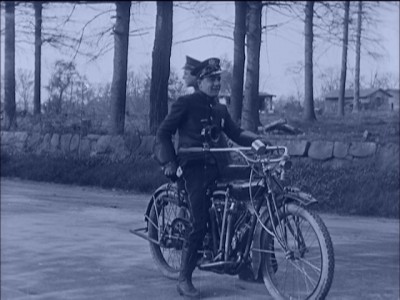
I did a quick search of my collection and, though it is not complete, I didn't find these shorts on any other collection leading me to believe that this is the first time they've been released on DVD.
There are also commentary tracks to both features. The Italian has a track with Dr. Giorgio Bertellini. He talks about the star, George Beban, quite a bit as well as the cinematic devices used to tell the story. It did drag in parts, but was worth listening to. The second film has an audio commentary by Professor Shelley Stamp that was very good. Dr. Stamp goes into a lot of detail about the social background of the film, just what options women had at the time and what life was like back in 1913. She quotes studies and papers but her comments never get dry or dull. A very informative commentary track to an interesting film.
Final Thoughts:
These are two interesting movies, but for different reasons. While Traffic in Souls is historically important as a very early feature and exploitation film The Italian is a fine melodrama that starts off a little on the ordinary side but soon becomes very engaging in a large part due to George Beban's wonderful performance. The extras are great too, with three Edison shorts and a pair of commentary tracks to the features that are well worth listening to. Flicker Alley and Film Preservation Associates have put together another wonderful collection. This gets a very high Recommendation.
|



| Popular Reviews |
| Sponsored Links |
|
|
| Sponsored Links |
|
|
| Release List | Reviews | Shop | Newsletter | Forum | DVD Giveaways | Blu-Ray | Advertise |
|
Copyright 2024 DVDTalk.com All Rights Reserved. Legal Info, Privacy Policy, Terms of Use,
Manage Preferences,
Your Privacy Choices 
| |||||||