
| Reviews & Columns |
|
Reviews DVD TV on DVD Blu-ray 4K UHD International DVDs In Theaters Reviews by Studio Video Games Features Collector Series DVDs Easter Egg Database Interviews DVD Talk Radio Feature Articles Columns Anime Talk DVD Savant Horror DVDs The M.O.D. Squad Art House HD Talk Silent DVD
|
 DVD Talk Forum |
|
|
| Resources |
|
DVD Price Search Customer Service #'s RCE Info Links |
|
Columns


 
|
|
|
A.I. Artificial Intelligence
Ya know what? I loved teddy. He's the user-friendly HAL 9000.
Although it doesn't change Savant's feelings about Steven Spielberg's pictures that rub the wrong way, AI is a very surprising experience. Perhaps it was the Stanley Kubrick influence. Did working on a project by somebody he respected, bring out the best in Spielberg?
I always felt Kubrick needed more heart. Spielberg usually has way too much heart on screen and too little in the office - my take on many of his films is that they're designed mainly to make millions and attract Oscars, while pandering to our emotions. Spielberg's taking over Kubrick's AI project initially came as very bad news. I feared he was trying to be Kubrick, especially after watching the verbal tripe he came out with about honoring his mentor in the interview on the Eyes Wide Shut disc. Spielberg looked as though he wanted to absorb Kubrick, and like an auteurist flatworm, inherit Stanley's critic-proof quality. The most unpleasant part of the interview was Steven's recounting of a dinner party where he showed his guests the emotional final scene from Paths of Glory, and what a profound experience it was. He told the story as if we mortals needed permission to worship Kubrick.
My resentment (jealousy?) of Spielberg's all-encompassing power was at a high point, and the idea of watching another insulting emotional bulldozer film about a boy searching for the love of his mother kept me away from AI in the theater. When I finally put the review disc in the machine, it was with some apprehension. I wasn't expecting a positive experience, and I didn't look forward to yet again telling the world WWWWS (what was wrong with Steve). Instead, I found AI to be pleasingly restrained: certainly not perfect, but a real movie with real ideas. Like some of the best science fiction films, a few of these ideas felt vitally important.
Written by Spielberg but adapted by others from a Brian Aldiss source book, AI is a novel expression of the old struggle between machine and man, and man and God. This originated as a supernatural/spiritual concept, even when Science became part of the equation - Frankenstein plays God, and then spurns his own creation. Like an abused child, the monster suffers for disappointing the unreasonable expectations of its creator. It just wants to be human, to be loved, just as Mankind wants to be loved by the Gods it invents for itself.
The idea of Spielberg 'channeling' the spirit of Stanley Kubrick to make a Pinocchio retread, sounded terribly simplistic. Pinocchio's a robot - get it? It brought up depressing memories of feeble groaners like Logan's Run or V'ger from the first Star Trek movie, and painful memories of movies where Spielberg definitely did not 'get it', as with Hook. But this Artificial Intelligence: AI works. Pinocchio is central to its theme and not an hommage, as it seemed in Close Encounters of the Third Kind (CE3K), the epic where Spielberg initiated his claim on Disney turf.
The photoplay wastes no time with trappings and gets right to story issues, with speechifying in the very first scene. Of course the philosophy in William Hurt's lines are present-day concerns, not those of the future ... present day people are who AI is made for. Rather than the dimwitted, get-on-with-it exposition of the Jurassic Park movies, this exposition is all critical to the thesis of the film. It is new territory, and like reluctant cavemen around the campfire in the opening montage of Amazing Stories, we pay rapt attention.
Savant personally believes that as a functional reality, artificial intelligence (fully self-conscious self-motivated) is a problem that won't fully develop for a few more generations. I therefore take all of these Blade Runner-style 'robots who ya can't tell from humans' as analogs for other issues. So it is the concepts in AI that interest - it's ethical sci fi.
In AI, we run into the universal problem of humans trying to fulfill spiritual needs by artificial means, and this leads directly to defining Man outside of a religious framework. Fundamentalists may be confused or incensed by this blurring of lines between fairytales and religion. People with narrow views on sexuality are going to be vexed by the ideas in AI, which are MPAA-safe, yet potent just the same.
The big concept stretch in AI, is that if Professor Hobby has built into David all the qualities we're told he has, well, David is human, period. The conflict of the show could be over human-rights issues exclusively, as in the fairly flatfooted missing link movie Skullduggery, or the Outer Limits episode I, Robot. Personally, religious reservations against artificial life (or the manipulated, mutations of genetic engineering) aren't the problem - the problem is that the modern world has already made us behave like pod-people consumers, and now it's becoming possible to physically alter our offspring for even greater compatability.
David is a commercial enterprise, a misguided attempt to tinker a marketable solution to a problem of the human heart. A doll bought off a shelf can be a splendid fantasy playmate, but is no substitute for parental love. The best thing about AI is its willingness to present consumerism as false. Gigolo Joe's customers and David's parents buy what's available to calm their emotional instability. The display line of super Super David 'toys' ready for consumption are a double vision: they represent everything we buy as a sop for inner needs we don't know how to address. They're also our replacements, pod people. And we made them, they didn't fall from the sky or grow in farms.
The dysfunctional Utopias of science fiction frequently stress innovations that pre-empt our own humanity. In Brave New World, Soma drugs are a substitute for socially unproductive sex. The public is given worship substitutes, as in THX 1138, or political consciousness rallies to effect mass brainwashing, as with the 5-minute Hates in 1984. Television in A Clockwork Orange shows programming theme-coded to the basest human interests - sex, violence, etc. These sci fi extrapolations all make sense because they have cognates in our present culture. The sex substitutes of AI are equally, frighteningly credible. Gigolo Joe and Gigolo Jane are sophisticated personal masturbation aids that probably would supplant the sex needs of many men and women. The scene of the pitiable woman being calmed and comforted by Gigolo Joe is disturbing, precisely because there's nothing unbelievable about it. Even in traditional relationships, how many of us tell one another, "You're the only one for me", preferring security to truth?
It's not just children who need fantasy in their lives, and people will turn to whatever makes them feel good and tells them the right stories - and keeps alive their hope they'll find whatever magic they're looking for. On a different level, modest entertainments like movies do the same thing. Studios started calling themselves 'Dream Factories' in the 1920s. Spielberg is surely aware that his biggest successes are excellent examples of efficient manufactured dreams, happily bought by the public to fulfill fantasy needs.
The details of AI are very rewarding, even as we get critical with them. The general public, almost always portrayed as lemming mobs in sci fi extravaganzas, are here the only ones beyond the odd Professor Hobby who seem to appreciate the authenticity of David's humanity. Why they care enough to riot on his behalf is a conceptual goof - are they debased and dehumanized by the Flesh Fair, Steven, or ain't they ? Less troublesome is the apparent humanity of Gigolo Joe, who empathizes with and aids David. Well, he's programmed to empathize and 'care' about the feelings of strangers, isn't he?
The idea of according robots a place in our hearts is a problematic one. AI isn't about the problems of the humans, it's about the problems of the robots - so the solution doesn't seem to be to grind up all the fake people and reestablish relations solely with flesh and blood creatures. Humans haven't yet found a collective way of respecting each other, or preserving the animals who share our world, so the likelihood of good relations with our eventual robot friends seems even more remote.
Robby the Robot in Forbidden Planet is quick to assert his superiority over mere humans.But AI's David doesn't sneer at his Cain-like stepbrother and claim superiority, as do the simulacra of Blade Runner or Creation of the Humanoids (or Invasion of the Body Snatchers, whose pods I've already suggested might as well be organic robots). In AI's Flesh Fair, notice that how much we care about individual robot victims, depends on how closely they resemble people. We're 'patterned' just like the robots are. A piece of mechanics with a minimal female face is a person worthy of our empathy, while a walking water heater with a television for a face is not.
David's technological curse, and the attribute that in one way makes him very un-human, is the fact that he has been programmed to love one pattern, one person only. People aren't like that, even though we generally focus most of our attention on just one 'other' at a time. A loved one can die, and we can adapt. David is thus a very handicapped life-form, with a gross limitation we don't have. Does this mean that we can therefore divorce ourselves from concern over his predicament? Is he a badly engineered kitchen appliance, better off replaced? Heck, even HAL in the botched sequel 2010 was mature enough to accept the necessity for his own death .. when he got an explanation that jibed with his self-definition. When Mommy ditches him, David's left high and dry, a misfit. If we destroy Frankenstein's monster because (sniff) he just doesn't belong, why is it so tough to think of wiping out David, about whom we can make a case that his creation was a big mistake?
The answer is that we're not all that sure our own creation wasn't a similar mistake. We're certainly flawed enough. Our philosophers been working for eons on ways to convince ourselves of a higher status than Self-conscious Animal, and coming up wanting. David and Joe are made in our image and possess as many functioning human qualities as exhibited by most real people. Discriminating against them is hypocritical.
Certain plot turns in AI, like what happens with a certain piece of hair, are splendid permutations of biblical and fairy tale situations. Others are more perplexing, such as when Mom tearfully ditches David in the woods, like the Queen's assassin who abandons Snow White instead of killing her. Mom knows she's doing wrong, but she can't handle the situation and opts for this instead of letting David be destroyed outright. Is the story telling us that her flawed human reaction makes Mom unworthy of David's pure love? From David's point of view, Mom's disappearance is equal to a Mother who suddenly dies without explanation and leaves him to fend for himself. So the whole second half of the show might be interpreted as a hopeless attempt on David's part to deny and defy death. We're usually unprepared for death, but David is incapable of dealing with it - by definition.
(spoiler) David's struggle finally finds a resolution when he accepts (?) a kind of death alongside his patterned love object. Nice ending, if the story truly ends there, and David 'dies'. It's fine for David to be eternally beside his Sleeping Beauty / Mom in a non-sexual bed of love, just like Teddy sitting forever next to them is no problem. But we're intelligent enough to think these things through. What if David doesn't die? Isn't Mom going to rot? When she no longer resembles his programmed pattern, won't the same problem of loss return? If that's what happens, AI turns into a morbid tangle that conjures image-ideas from Mario Bava's Lisa and the Devil, or the ghastly home-life of Ed Gein. Surely, when you saw AI, you thought David's relationship with his Mom-clone was getting a tiny bit strange. I'm not sure Steven Spielberg did ....
In their generosity, the future robots have made for David a clone of his mother that includes many of her memories, apparently omitting those that might be incompatible with their present life in a zoo. So the future robots' Mommy-clone is kind of a SuperToy for David, isn't she? This could get endless. Do our dreams have their own dreams?
ET: the Extra-Terrestrial extended the questionable Disney tradition of anthropomorphosing everything in sight, by assigning godlike status to a pulpy alien, who becomes a combination Lassie and Jesus Christ rolled together. Savant thinks ET is the most incredibly unhealthy children's movie ever made. (But that's another story.) AI is all about real anthropomorphosing, and unlike ET, doesn't make its emotional pitch and then ignore the tangle of questions that are raised. AI deals with anthropomorphism on issues not only of identity, but of fantasy and reality. Gigolo Joe is a fantasy substitute for a real experience. The same goes for David's desire for a 'real' blue fairy, or even mother's need for a 'real' boy to love. Is the desire for fantasy an expression of our purest humanity (as Spielberg's filmography seems to promote) or is it a subsitute, a proxy, a cheat to help us toward the easy way out, to avoid facing feared suspicions?: that our sex drive is a biochemical ploy to get us to procreate; that we are alone as conscious individuals, mentally creating the concepts of Love and Faith to ennoble ourselves.
Does Spielberg raise these issues in AI only to pull his usual trick of endorsing fantasy? His fantasy entertainments are so powerful, they've taken over our culture: Ford is to Brave New World what Disney, Lucas and Spielberg are to our reality. Or is he pointing to a dead end for humanity? A culture without dreams and a purpose is already dead. When humanity feels itself to be alive, it's when personal goals and broad societal ones are synonymous. For ages, Religion and patriotism have provided the glue that made our lives seem meaningful, and now media culture seems to be holding up fantasy as the only way out - if a person can no longer believe in reality, then turning your back on rationality in general and endorsing myths is the way to go.
The movie has a definite Kubrick structure, with an aggravating multiple ending that's a repeat of 2001, literal to the point of including a table scene in a captive room in a different dimension. The wrapup is a coda atop a coda, that is more than a little overextended. If by then, you've rebelled against caring for David the robot, this protracted finale will seem endless and pointless. Good or bad, it was far too big a puzzle to disappoint me - like the enigma of Eyes Wide Shut, only much more satisfying. Yes, a good science fiction concept will get Savant every time.
I think AI works because it is a real science fiction movie, like the classics from the beginning of the genre that dealt in Concepts even if they couldn't or wouldn't articulate them, choosing instead to hide behind horror and thriller trappings. Spielberg may try to meld himself with the cold world-view of Stanley Kubrick, but he obviously cannot, as his instincts run in a different direction. Didn't we all embrace CE3K because it was a sci fi film that made personal the concepts of 2001? Wasn't its biggest scene a Paul Simon-like mother and child reunion? Detractors probably could use the argument that Spielberg is too eager to please Mommy. AI certainly is not the semi-abstract meditation we'd expect from Stanley Kubrick. But that's not a bad thing when Steven expresses the core ideas in his material so well, and lays off the schmaltz. I found myself pondering all the above, and the whole religion of Spielbergfantasyism, in a rather melancholy way during AI.
Master business tycoon Schindler says his specialty is presentation, and it is also Steven Spielberg's. AI is of course an immaculately conceived computerized movie - with every pixel in its proper place, so to speak. The film has lots of expensive futurism, real and virtual, but none of it is gratuitous. Unlike most effects pictures, you sense that Spielberg's gone beyond bragging about all the toys he got for Christmas.
The effects are judiciously used. The future is well sketched, except perhaps for the giant female mouths beckoning us into Rouge City - they look too much like the art director was handed a picture of the Korova Milkbar woman on the Clockwork Orange poster, and told to imitate it. The mundane future cars and vehicles are the best Savant's seen, bar none, and the houses, cities and other futurama trappings are appropriately boring in the way they should be, because, unlike the makers of Metropolis and Things to Come, we no longer see magic possibilities in the future. By avoiding emphasis on the effects trappings, AI helps us concentrate on its ideas.
The acting is also remarkable, with Jude Law doing a super-mime imitation as Gigolo Joe, and Haley Joel Osment and director Spielberg overcoming the bottomless problem of presenting a child who is a robot with circuits that reproduce human emotions. Viewers might complain that for an hour they're watching the 'human' adventures of a couple of dumb machines whose problems we shouldn't worry about. Gigolo Joe is a better-adjusted version of Rutger Hauer's artificial Roy Batty in Blade Runner; and David might as well be an abandoned toaster, left for eons in a submerged Coney Island. Surely these 'dumb robots' are just as valid as the zillions of cipher-characters that clog the repetitive fantasies of television and the movies (oh, it's another detective channeling the evil of a serial killer ... oh, she's a modern woman coming to grips with her newly-won independence!). That's where AI has us, as soon as we go beyond the characters, to the ideas behind them. Whether it's from Brian Aldiss or Kubrick or Ian Watson or even Spielberg, the conceptual tinkertoy of this Sci fi film tickles out interesting ideas that smell of truth ...
Spielberg has kept his old clichés at arm's length, with no more of the ooh-ahh fireworks so powerful in CE3K and done to death thereafter. Given the job of just telling the story, which he does masterfully when he believes he has a story to tell, Spielberg keeps his familiar themes and self-references secondary. The parts of AI seem assembled from Spielberg's same set of building block toys: mother and child issues (Sugarland, Jaws, CE3K, Empire of the Sun) cloning (Jurassic Park) extermination (Schindler's List). The details referenced are as neat as the Jaws-like (and Monstro-like) fish statue in the submerged Coney Island. And there's also a 1941 Ferris Wheel, which is a trap, of course. Some dissenting reviewers have had a bad reaction to the story's full embrace of Pinocchio, from the details up. It is obviously part of AI's original source story (or it better be). Pinnochio's been referenced before in Sci Fi, most memorably with the character Data in the Star Trek: Next Generation TV series, which certainly spent a lot of useful time examining the human-machine problem of that (compared to the robots of AI) primitive robot. Savant would very much like to see a revival of the talky, stagy Creation of the Humanoids from 1962 - conceptually, it still comes the closest to AI.
And don't forget - the original 1860 Pinocchio wasn't about robots and men, it was about teaching children moral choices outside of a Religious framework, which was pretty daring back then. The difference between a real boy and one made of wood was a difference of moral behavior. Be good, and even a blockhead can learn to love and find grace. Be bad, and it's easy to become a morally worthless animal. Disney's Pinocchio gives us a terrifying example of damnation, by doing a Dr. Moreau job on the naughty Lampwick. In reverse, AI's spunky sidekick robot Teddy (finally, a one-dimensional sidekick with an excuse!) is the one to save the day. The strength of Spielberg's fairy-story powers overcomes piddling problems like David's illogical final tears. Equating the Blue Fairy with the Madonna is an edgy concept that pierces through several levels of functioning visionary themes in AI.
When Spielberg relaxes and just tries to make a movie instead of an Oscar-winning event, he does just fine. I say, let him enjoy his zillions, but get him to forget about being Disney, Dr. Spock, Hollywood and the Statue of Liberty rolled into one. Beg him to make pictures only when he's as engaged as he seems to be with this one. I'm a soured Spielbergite who's shocked that AI is so good.
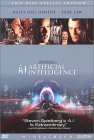
Dreamworks' DVD of Artificial Intelligence: AI Special Edition is a fine package that has a lot to offer the casual fan of the picture. The transfer itself is immaculate, as is to be expected, with a vibrant and rich soundtrack. Laurent Bouzereau was in charge of the special features, which consist mainly of ten or so episodic mini-docus on all phases of the production. As with all docus that accompany new films, they are nicely crafted expressions of the producers' views. Naturally they're dominated by behind-the-scenes video of the technical amazements employed in making the picture, and give a gee-whiz perspective on the latest techniques. All the major players get interview time, and all acquit themselves well. After his groaning host duties on AMC television, even Stan Winston's star gets a new polish - his work looks particularly brilliant.
Broken up into small chunks, the docus are easy to digest. DVD docus still have the feeling that too much footage from the film is being recycled, though, and to watch these before seeing the movie would be spoiler suicide. The fragmentation of the docu into chapters less than fifteen minutes long is apparently a measure taken to sidestep new Screen Actor's Guild contract rules about residuals. Pretending that the docus on AI are not a whole show of their own is an economic cheat - everyone wants special extras, but Studios expect them to stay within strict budgetary boundaries, even for a show as big as this one. It doesn't hurt AI because Spielberg wraps up the discussion with a nice little talk about relations between men and robots. But for older pictures the 15 minute rule will be a crippling obstacle. Unless, of course, studios decide to consider them real productions.
The Artificial Intelligence: AI Special Edition comes in an attractive normal sized-keepcase, with a dual-disc holder inside, a much nicer alternative to fatter two-disc sets.
On a scale of Excellent, Good, Fair, and Poor,
Artificial Intelligence: AI Special Edition rates:
Movie: Excellent
Video: Excellent
Sound: Excellent
Supplements: Quite a few, but no commentary. See above.
Packaging: Thin doubledisc keep case
Reviewed: February 25, 2002
| |
|



| Popular Reviews |
| Sponsored Links |
|
|
| Sponsored Links |
|
|
| Release List | Reviews | Shop | Newsletter | Forum | DVD Giveaways | Blu-Ray | Advertise |
|
Copyright 2024 DVDTalk.com All Rights Reserved. Legal Info, Privacy Policy, Terms of Use,
Manage Preferences,
Your Privacy Choices 
| |||||||