
| Reviews & Columns |
|
Reviews DVD TV on DVD Blu-ray 4K UHD International DVDs In Theaters Reviews by Studio Video Games Features Collector Series DVDs Easter Egg Database Interviews DVD Talk Radio Feature Articles Columns Anime Talk DVD Savant Horror DVDs The M.O.D. Squad Art House HD Talk Silent DVD
|
 DVD Talk Forum |
|
|
| Resources |
|
DVD Price Search Customer Service #'s RCE Info Links |
|
Columns
  


 
|
|
|
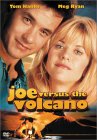
Joe Versus The Volcano
Here's a wonderful comedy that needs to be re-evaluated by as many people who can muster the imagination to give it another try, as it's the romantic equal of I Know Where I'm Going, and goes neck and neck with Groundhog Day in the Useful Philosophy department. For some mysterious reason, it was critically trounced and rejected by audiences back in 1990 - Savant's even read a 'hip' treatise on the movie industry for that year where the author made it an example of idiotic and worthless moviemaking. This reviewer has no response to that.
If the rest of this piece gets a bit enthusiastic, let's just say this is one of Savant's favorite films. I've yet to show it to anyone who didn't warm up to it mightily, and as I've got friends and family who delight in consistently rolling their eyes at my taste in pictures, that's a strong endorsement.
John Patrick Shanley is a popular playright whose scripts for Five Corners and Moonstruck earned him high praise and got him the opportunity to make this film and the disappointing The January Man. Both were perceived as dismal flops, but Joe versus the Volcano has accumulated an impressive cult (sorry, no other word applies) following. Its website was one of the first big movie fan sites, and has been on the Savant Links page since the beginning of this column. It's not just the usual pap but has a number of compelling essays analyzing the film.
And Joe versus the Volcano is extremely worthy of analysis. It's heavily stylized, composed of only a few scenes. Nothing remotely realistic happens, and the picture dotes on a mannered artificiality that apparently communicated nothing to the 'hip' audiences of 1990. The opening, with the giant doors of the American Panascope Company ("Home of the Rectal Probe") opening to admit a legion of workaday zombies, evokes Metropolis. The show starts in this expressionistic mode, with Joe's coworkers reduced to soulless Pods in a greenish half-world of bad flourescent lighting. With the logic of a fairy tale, it moves to other styles, staying off-balance all the while. Most scenes are accompanied by brilliantly chosen pop music - Ray Charles, Brasil '66, My Fair Lady, all united only by a refreshing refusal to be ordinary. Nothing we see is 'credible', yet it all makes story sense: the recurring motif of the jagged lightning bolt; the palmy island-with-a-volcano first seen on a novelty lamp; an exaggerated giant Blue Moon (shared with Moonstruck) that attests to the power of Nature, which to Shanley equals God. And then there's the Duck. 3
From its cheapo font main titles, Joe versus the Volcano is visually deceiving. Shanley sets up brilliantly composed scene shots that express just the right mood, and moves on. Coverage is for wimps. The slow zoom back outside Dr. Ellison's office to reveal the tableau of Joe hugging a passerby's giant-sized dog, is wonderful. New York as seen from the Staten Island Ferry is a fantasy wall of colored lights, and the glowing sunsets from the deck of the sailboat are equally artificial. Joe dances to music from a transistor radio while adrift on the ocean, and the screen is just an expanse of sky with this goofy, ukelele-playing guy doing The Swim for his own amusement. The details are great, too. There's a wonderful on-the-town sequence in New York that ranks among the best (especially this year). In one magical moment a woman dressed as the Statue of Liberty, totally blue, steps into a shot. LA, by contrast, is reduced to an airport, Palos Verdes ("It looks fake!"), a chi-chi restaurant, Mulholland Drive, and Santa Monica Beach.
There's sharply-observed criticism in all of this, softened by the fairy-tale approach. Perhaps 1990 audiences thought it all irrelevant for a Tom Hanks movie, and expected him to solve his problems by kissing a mermaid or running down a hall in his underwear. Instead we get little glimpses of distorted reality, like the diminished-perspective Coffee-Corner-Of-Doom, with the powdered creamer that clots instead of dissolves. This ought to have communicated something to dehumanized working folks. Maybe they just felt insulted.
The performances of the two-score characters that Joe encounters are also wonderful. They're all given excellent, unrealistic dialogue. Dan Hedeya, looking exactly like the farmer in the first animated Animal Farm, is an object lesson of what happens to defeated paper-pushers. Mr. Graynamore, all bluff and show, pitches his insane offer with the perfect assurance of business hustlers who use their persuasive talent to entrap people. Abe Vigoda is the native chief who seems to realize that he's an expendable plot mechanism. A deadpan, "I'll be going now", is his perfunctory exit line.
But Joe doesn't interact solely with users, losers and zombies. There's also the dignified goodwill of Marshall (Ossie Davis), a chauffeur who doubles as a mentor-motivator, helping to prepare Joe for his odyssey, so to speak. My favorite bit of all is Barry McGovern's marvellously intense luggage salesman, who outfits Joe like Argos getting Jason ready to go forth and conquer. "That's extremely interesting ... as a luggage problem", he intones, as if sagely figuring out a crucial chess move. 1
Even the bits are superb. Carol Kane has a one-shot smile as a hairdresser, and Amanda Plummer (Pulp Fiction) purrs nicely as the first mate on the sailboat. Finally, hiding in plain sight is Nathan Lane, disguised almost beyond recognition as the Waponis' excitable 'advance man'.
The romantic center is Meg Ryan, in three roles. Each woman Joe meets on his journey is a dead ringer for the last, but all have serious problems. Poor DeDe is simply terrorized by life - she responds to Joe's advances but folds up like a withered flower when confronted by the idea of a terminal sickness. She's too cowed to handle much of anything outside herself, and Joe lets her go. The Greynamore Sisters are more challenging, and are seemingly meant to represent polar opposite reactions to an oppressive, wealthy parent. In a society where just making it on your own is a tough row to hoe, there's a tendency to never break free from parents. Angelica, the Los Angeles Mercedes-Benz welfare case, has become the bought dog of her father, and has lost all self-respect. She's caricatured as a trend-following hollow woman, cracking crablegs and reciting pitiful poetry to snag a pitiful one-night. DeDe and Angelica fascinate Joe, but neither is the girl for him. Angelica's half-sister Patricia fits the bill - she's a rebel, and her only frustration is her uneasy relationship with her father - she hasn't sold out like Angelica, but she's acutely aware that along every handout comes with strings attached. But she's a player and a fighter, and she's just what Joe needs.
So this brings us to the island of Waponi Wu, where most viewers say they totally tuned out of the movie. I guess it was the last straw, an artificial stylistic jump they didn't want to make. To Savant it's perfect. Joe versus the Volcano is about taking responsibility for one's own life, which means having courage - courage not to be cool, courage not to be affluent. The courage to accept oneself and face life, instead of studiously avoiding possible pitfalls. Joe is a lost soul who fancies himself a helpless victim until he's liberated by a fatal diagnosis. He makes the moves and takes the chances only when he no longer has his compass affixed to the safe path. He defies the feared 'crooked road' that looms over American Panascope, Waponi Wu and his own living room, and finds his own adventure. 2
The danger is in selling out, losing one's dignity, losing one's soul. DeDe and Mr. Wa-Waturi are lost and don't even know it. Angelica is like an addict: she knows she's wasting her life and is too weak to do anything about it besides abusing potential mates like Joe, whom she patronizes and dumps on because she no longer has a grip on her own personality. The chip on Patricia's shoulder is different - she gives Joe a hard time, unconsciously testing to see if he's going to be another passive Pod, or will fight back. Ya gotta be a fighter on the personality plane - you can't just passively accept things.
The Waponis may look like over-costumed Gilligan's Island rejects, drinking huge amounts of Jump Orange Soda, but Savant thinks they're perfect. A melding of 'Polynesian, Celtic, Hebrew and Latin' influences, they're a society that's sold out entirely. Their fear is the giant volcano Wu, which instead of being a given (it either kills you or it don't), has become a cultural Moloch that determines their every move. Sam Greynamore uses the Waponis' fear to exploit them, and having a population so demoralized that nobody will sacrifice themselves to save the rest, they have to bargain for an outsider to sacrifice himself for them. As a gambit, it's vaguely similar to The Wicker Man. The Waponis are so lost, they're worshipping Gods they no longer believe in - "Joe, even the Chief doesn't want you to jump".
So, refusing to swallow Waturi's line that Life is supposed to be rotten, Joe looks for the end of his crooked road, only to find his true nature and happiness. It doesn't have to happen that way - he's indeed lucky. But even as an entire society is wiped out before his eyes, and not grieved one bit (who mourns people without souls?), Joe hasn't put it all together. He needs a romantic Other to share life with and keep him straightened out, away from hypochondriac, Bickle-ish Morbid Self-Attention.
Joe versus the Volcano is of course a Shaggy Dog story, that uses its premise as a hook to keep us wondering how in the Heck it will resolve in a satisfactory way. Most Shaggy Dogs end up evading their own premises, or just ending with their issues 'meaningfully' unresolved, as in The Birds. We say that a movie like Joe versus the Volcano is 'painting itself into a corner', and, like a Rod Serling twist, what happens at the windup takes on too much weight.
In the final judgement, the real measure of a film is whether it connects with an audience or not, and if you take the 1990 rejection as evidence, maybe Joe versus the Volcano is a failure. I find that the resolution does all the things it needs to. People remark that the volcano action at the end is silly and unrealistic, when the picture never tried to be realistic for a moment ... some fantasies you reject and some you embrace. Perhaps Tom Hanks in 1990 didn't send the right signals to get viewers ready to see something with this kind of 'heavy whimsy'. Go figure.
Other interpretations abound. One centers on the idea that Joe versus the Volcano is a child's fairy tale inspired by Joe's juvenile lamp, the one with the 'island paradise' pattern that becomes a motif. In this Invaders from Mars-like dream logic, the movie is a stylized picture book because it's being dreamed by a reader of stylized picture books, a kid. That's why the show is constructed purely of whimsical, irrational things like 'brain clouds' - It's a dream. And the dream is full of all kinds of wisdom on how to live one's life fully.
I find the philosophy in Joe versus the Volcano really useful ... for seeing the truth of things, not necessarily doing the right thing. DVD Savant isn't a life coward, but you sure tend to look back on those past decisions you were too conventional about, in a different way. 'Don't make your life decisions out of fear', would seem to be the message that coalesces from John Patrick Shanley's eccentric fable. Stop denying Death, and go out and live as if you aren't going to be around forever.
Warner's DVD of Joe versus the Volcano has been a long time a' coming, down its own crooked road. The reputation of this film being what it is, I'm grateful to see it come out at all. I've played my nicely-letterboxed laserdisc endlessly, but now it will finally be retired. TBS shows the picture frequently, pan'n scanned into meaningless two-shots. The colors are much sharper on the DVD, with the sickly greens of the flourescents that 'suck out your soul' at American Panascope, pulsing like electricity. The restaurant's scarlet hues are stable, and the amusing illustration-like views of the Volcano at the end are a lot sharper, because of DVD's ability to handle reds better.
This movie cries for extras, or anything to help place it in context. A chance to learn more about John Patrick Shanley would be welcome, but the 'cast and crew' production notes link only to more info on Hanks and Ryan, two personalities who've been done to death in the ensuing decade. I thought their You've Got Mail was a horrible stinker, a perfect example of a philosophical opposite to Joe versus the Volcano.
The 'behind the scenes documentary' turns out to be a woebegone featurette from 1990, where the actors pay lip service to the 'existential' nature of the film, and then basically give up. Shanley smiles and answers the final question, 'Who Wins, Joe or the Volcano?', with a meaningless laugh that indicates total editorial desperation. A music video for the Eric Burdon version of 16 Tons that opens the film is fairly unimpressive, and the big-faces cover art stinks, "- Like the coffee! Mr. Wa-waturi!"
According to what I've heard, Joe versus the Volcano's ending was refilmed after bad previews. The original script was once available online, where you could read the unused original ending, but it's since disappeared. Savant prefers the final, but the first, which pads out the end unnecessarily tying up some loose plot ends, has some hilarious jokes - Patrica, rescued with Joe on the deck of the sister ship Tweedledee, to her father and Dr. Ellison: "That's the most dastardly thing I've ever heard. You're both Dastards." Now, seeing that alternate ending would have been a thrill.
On a scale of Excellent, Good, Fair, and Poor,
Joe versus the Volcano rates:
Movie: Excellent
Video: Excellent
Sound: Excellent
Supplements: featurette, trailer, music video
Packaging: Amaray case
Reviewed: April 6, 2002
Footnotes:
1. It was depressing to see John Cleese as the new Q in The World is Not Enough, doing silly-ass nothing comedy business that would be too broad for Casino Royale. Too bad Barry Mcgovern is American - he'd be a terrific Q.
Return
2. The same conflict is humorously described in Albert Brooks' 1991 film, Defending Your Life, which is more bluntly about 'facing your fear!' as the key to personal advancement in a cosmic system of reincarnation. Joe versus the Volcano is more related to Brooks' picture than it is to 1993's Groundhog Day, which to Savant seems an improved, less philosophically leaky It's a Wonderful Life.
Return
3. As proposed in one of the essays on the Joe versus the Volcano site, the Duck, seen in one brief but pointed shot on Waponi Wu, might represent the Devil, as the tempter Sam Graynamore's cane handle bears the image of a duck as well. The implication is that Graynamore hasn't lost his soul, he's sold it.
Return
| |
|



| Popular Reviews |
| Sponsored Links |
|
|
| Sponsored Links |
|
|
| Release List | Reviews | Shop | Newsletter | Forum | DVD Giveaways | Blu-Ray | Advertise |
|
Copyright 2024 DVDTalk.com All Rights Reserved. Legal Info, Privacy Policy, Terms of Use,
Manage Preferences,
Your Privacy Choices 
| |||||||