
| Reviews & Columns |
|
Reviews DVD TV on DVD Blu-ray 4K UHD International DVDs In Theaters Reviews by Studio Video Games Features Collector Series DVDs Easter Egg Database Interviews DVD Talk Radio Feature Articles Columns Anime Talk DVD Savant Horror DVDs The M.O.D. Squad Art House HD Talk Silent DVD
|
 DVD Talk Forum |
|
|
| Resources |
|
DVD Price Search Customer Service #'s RCE Info Links |
|
Columns
  



 
|
|
|
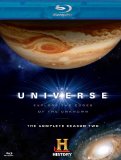
Universe: The Complete Season Two, The
A&E Video // Unrated // July 7, 2009
List Price: $79.95 [Buy now and save at Amazon]
The Series:
The History Channel has really gone down hill recently. The change of their name to just "History," a common insult for something that is dead or irrelevant, seems to be an acknowledgement from the management that their channel is in trouble. Once filled with interesting documentaries and shows that delved into the past, their schedule is now crammed with reality shows like Ice Truckers and Ax Men (I'm more interested in the 100 year old trees that are being cut down than the men doing it) and pseudoscience crap such as UFO Hunters and MonsterQuest. This is from a station that is supposed to be educational? Well they do still have one or two shows that are worth watching, and the highlight of their line up is The Universe. This excellent series looks at, well, our universe. What's in it, how it acts, and most importantly, how we know what we know. The second season of this show has just come out on Blu-ray and it's just as engrossing as the first.
While the first season mainly focused on our solar system, this set of programs takes out farther out into the galaxy and looks at some of the impressive objects that exist and looks at some of the many unsolved problems that astronomers are still struggling with. There are episodes on Nebulas, immensely huge clouds of gas where stars are formed, Supernova, where stars explode releasing as much energy as the sun does in 10 billion years, and Cosmic Holes, not only black holes but mini-, white, and wormholes that may, or may not exist.
All of the episodes were good in this season, but one of the more engrossing was the program on dark matter. If you look at the movement of another galaxy, you can calculate the mass of the object based on how it travels. Yet if you add up all of the matter you can see, the result is significantly less than the mass calculated by the movement, much greater than error could account for. Where is this missing mass? Scientists have theorized that there is dark matter; matter that doesn't glow or reflect light, and what's more it doesn't seem to interact with ordinary matter. So, if it's literally invisible and just about undetectable, how do we know it's there? Because of it has mass, and therefore gravity. Astronomers have seen light from other galaxies bending when it passed through or near large amounts of dark matter. They've actually used that property to map the sky and now have charts of where dark matter exists. Pretty impressive stuff.
The show also is up to date and includes the latest theories and findings often presented by scientists who are currently working on the problems and mysteries. Along with a narrator who holds the show together, each episode features several scientists from NASA and major universities. Very few of the experts are dull or dry, and most of them are able to express their love for their discipline in ways that really connect. That's one of the show's great assets, that it take pains to be accurate and current, but it also presents complicated theories and observed facts in a simple, down to earth manner. Yet it never seems to talk down to its audience.
While the information is great, the thing that makes this program so much fun to watch is the impressive visuals. The show is filled with state of the art CGI along with some of the most recent photos and images from telescopes, satellites and interplanetary probes. These comes together with the experts and narration to create a fascinating look at the universe we live in. Engrossing, visually stimulating, and very informative, this is a show that is not to be missed.
The Blu-ray Disc:
The second season of 18 hour long episodes arrives on four Blu-ray discs in a double width case. Two discs are housed on each side of a 'page' attached to the spine, and the other pair snap into the inner front and back leaves.
Video:
Like the first season, this set is presented with a very nice 1.78:1 1080i image. While some of the vintage footage and the older (and even more recent) interplanetary probe images are understandably not of HD quality the show overall looks wonderful. The CGI animation is especially colorful and bright but all of the video is tight and nicely detailed. There are a few minor problems. Banding is evident in more than a few scenes, mainly outer space animation which has light sources like planets surrounded by concentric rings of differing shades. There was also a touch of cross colorization in a couple of spots, but this was very minor. Overall this is a very pleasing looking set, and it comes across much better than the non-anamorphic SD DVD collection.
Audio:
Being a documentary series, I wasn't surprised to discover that the set comes with only a stereo mix. There is a fair amount of music in the show and some of the audio effects really cry out of a 5.1 mix (stars exploding, comets crashing into Earth and other planets etc.) As it is the music is full sounding and the talking heads sound clean and clear. A nice though not impressive soundtrack.
Extras:
While there is a bonus featurette, it's not that exciting. This set also includes an hour-long documentary "Backyard Astronomers." This program looks at amateurs who enjoy looking at the stars and the help that they can give professional astronomers. While it was interesting, it was only mildly so and didn't have the "WOW!" factor that many of the Universe episodes had.
Final Thoughts:
This series makes science fun and exciting and is well worth watching. It is able to take complex ideas and make them easy to grasp as well as putting a sense of wonder and mystery into out universe. The Blu-ray presentation is very good too. Anyone interested in science or the cosmos should really search out a copy. Highly Recommended.
Note: The images in this review are not from the Blu-ray disc and do not necessarily represent the image quality on the disc.
The History Channel has really gone down hill recently. The change of their name to just "History," a common insult for something that is dead or irrelevant, seems to be an acknowledgement from the management that their channel is in trouble. Once filled with interesting documentaries and shows that delved into the past, their schedule is now crammed with reality shows like Ice Truckers and Ax Men (I'm more interested in the 100 year old trees that are being cut down than the men doing it) and pseudoscience crap such as UFO Hunters and MonsterQuest. This is from a station that is supposed to be educational? Well they do still have one or two shows that are worth watching, and the highlight of their line up is The Universe. This excellent series looks at, well, our universe. What's in it, how it acts, and most importantly, how we know what we know. The second season of this show has just come out on Blu-ray and it's just as engrossing as the first.
While the first season mainly focused on our solar system, this set of programs takes out farther out into the galaxy and looks at some of the impressive objects that exist and looks at some of the many unsolved problems that astronomers are still struggling with. There are episodes on Nebulas, immensely huge clouds of gas where stars are formed, Supernova, where stars explode releasing as much energy as the sun does in 10 billion years, and Cosmic Holes, not only black holes but mini-, white, and wormholes that may, or may not exist.
All of the episodes were good in this season, but one of the more engrossing was the program on dark matter. If you look at the movement of another galaxy, you can calculate the mass of the object based on how it travels. Yet if you add up all of the matter you can see, the result is significantly less than the mass calculated by the movement, much greater than error could account for. Where is this missing mass? Scientists have theorized that there is dark matter; matter that doesn't glow or reflect light, and what's more it doesn't seem to interact with ordinary matter. So, if it's literally invisible and just about undetectable, how do we know it's there? Because of it has mass, and therefore gravity. Astronomers have seen light from other galaxies bending when it passed through or near large amounts of dark matter. They've actually used that property to map the sky and now have charts of where dark matter exists. Pretty impressive stuff.
The show also is up to date and includes the latest theories and findings often presented by scientists who are currently working on the problems and mysteries. Along with a narrator who holds the show together, each episode features several scientists from NASA and major universities. Very few of the experts are dull or dry, and most of them are able to express their love for their discipline in ways that really connect. That's one of the show's great assets, that it take pains to be accurate and current, but it also presents complicated theories and observed facts in a simple, down to earth manner. Yet it never seems to talk down to its audience.
While the information is great, the thing that makes this program so much fun to watch is the impressive visuals. The show is filled with state of the art CGI along with some of the most recent photos and images from telescopes, satellites and interplanetary probes. These comes together with the experts and narration to create a fascinating look at the universe we live in. Engrossing, visually stimulating, and very informative, this is a show that is not to be missed.
The Blu-ray Disc:
The second season of 18 hour long episodes arrives on four Blu-ray discs in a double width case. Two discs are housed on each side of a 'page' attached to the spine, and the other pair snap into the inner front and back leaves.
Video:
Like the first season, this set is presented with a very nice 1.78:1 1080i image. While some of the vintage footage and the older (and even more recent) interplanetary probe images are understandably not of HD quality the show overall looks wonderful. The CGI animation is especially colorful and bright but all of the video is tight and nicely detailed. There are a few minor problems. Banding is evident in more than a few scenes, mainly outer space animation which has light sources like planets surrounded by concentric rings of differing shades. There was also a touch of cross colorization in a couple of spots, but this was very minor. Overall this is a very pleasing looking set, and it comes across much better than the non-anamorphic SD DVD collection.
Audio:
Being a documentary series, I wasn't surprised to discover that the set comes with only a stereo mix. There is a fair amount of music in the show and some of the audio effects really cry out of a 5.1 mix (stars exploding, comets crashing into Earth and other planets etc.) As it is the music is full sounding and the talking heads sound clean and clear. A nice though not impressive soundtrack.
Extras:
While there is a bonus featurette, it's not that exciting. This set also includes an hour-long documentary "Backyard Astronomers." This program looks at amateurs who enjoy looking at the stars and the help that they can give professional astronomers. While it was interesting, it was only mildly so and didn't have the "WOW!" factor that many of the Universe episodes had.
Final Thoughts:
This series makes science fun and exciting and is well worth watching. It is able to take complex ideas and make them easy to grasp as well as putting a sense of wonder and mystery into out universe. The Blu-ray presentation is very good too. Anyone interested in science or the cosmos should really search out a copy. Highly Recommended.
Note: The images in this review are not from the Blu-ray disc and do not necessarily represent the image quality on the disc.
|



| Popular Reviews |
| Sponsored Links |
|
|
| Sponsored Links |
|
|
| Release List | Reviews | Shop | Newsletter | Forum | DVD Giveaways | Blu-Ray | Advertise |
|
Copyright 2024 DVDTalk.com All Rights Reserved. Legal Info, Privacy Policy, Terms of Use,
Manage Preferences,
Your Privacy Choices 
| |||||||