
| Reviews & Columns |
|
Reviews DVD TV on DVD Blu-ray 4K UHD International DVDs In Theaters Reviews by Studio Video Games Features Collector Series DVDs Easter Egg Database Interviews DVD Talk Radio Feature Articles Columns Anime Talk DVD Savant Horror DVDs The M.O.D. Squad Art House HD Talk Silent DVD
|
 DVD Talk Forum |
|
|
| Resources |
|
DVD Price Search Customer Service #'s RCE Info Links |
|
Columns
  



 
|
|
|
Coraline (2-Disc Collector's Edition)
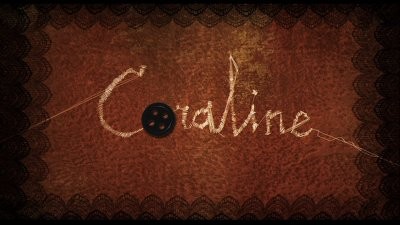
The ubiquity of computer generated imagery and digital animation has rendered practical effects and stop-motion animation increasingly obsolete. Sadly, the special effects days of Ray Harryhausen are long-gone, and while films like Up and The Incredibles are immaculately made and memorable, there is something about the tactile personal craftsmanship - not to mention the painstaking expense of blood, sweat and tears - that makes stop-motion uniquely appealing and satisfying. This technique, nearly as old as the motion picture itself, brings magical life to what are essentially high-tech toys - and in doing so, taps into one of the most deep-seated imaginative notions of childhood: making our toys move.
"Moving toys" might sound mercilessly reductive, but it's not meant to be. Every child has toys that they cherish, that they feel emotionally close to in some measure, and when they play with those toys, they see them walk and hear them talk. Stop-motion animation taps into that memory of creative development on a sub-conscious level, and in the case of Coraline, does so while telling a complex story utilizing all the cinematic tools of a live-action film.
Henry Selick's adaptation of Neil Gaiman's novella is inspired, many-layered, and vastly entertaining. The source material seems to have been made for stop-motion, and in fact, the bonus materials inform us that Selick began working on the film before the book was published.

Coraline Jones (voiced by Dakota Fanning) moves into an isolated apartment house with her parents (Teri Hatcher and John Hodgman), gardening writers who don't garden. Coraline is a lonely kid, whose parents neglect her, at least while they are hard at work writing a new gardening catalog. Desperate for stimulation, Coraline explores her new home and discovers a tiny door that opens onto a secret passageway. At the other end is...her apartment. But not quite. Living there are strange button-eyed doppelgangers of her parents. These Other Parents shower Coraline with attention, food, and goodies. But this escape route from her daily life turns out to be much more dangerous than she imagined; her Other Mother is actually a beldam, a woman intent upon consuming the souls of the children unfortunate enough to fall into her trap. Coraline finds herself struggling to escape this alternate reality and, ultimately, fighting the beldam for the lives of her true parents.
One of the central themes of Coraline has to do with the imagination; in fact, the film's tagline is, "Be careful what you wish for." Coraline is not a brat; at no point does she say anything like, "I wish I had different parents." But her desire for something more is clear. The passageway offers her an opportunity in that direction. It's odd, but also appropriate, that a film so bursting with imagination should warn of the dangers inherent in an imagination run wild. Too often are we encouraged, in the course of movie-watching, to indulge in the escape of a film that promises emotionally satisfying resolutions once we've become invested in the film's characters. But here's a rare thing: a film whose protagonist seeks an escape, too, but who is shocked by the consequences of diving deep into a deceptively fantastic reality. Through the predicament of the heroine, Coraline asks us questions about our very involvement in watching films and other forms of escapist activity (sports, work, etc.). To what extent do we immerse ourselves and how difficult is it for us to extract ourselves once we do so?
Coraline is a beautiful and creepy visual experience. The overall design and look of the film is its own - not a style associated, for example, with Tim Burton (as some might expect, since Selick directed The Nightmare Before Christmas), but belonging solely to the world of Coraline. The colors, tiny costumes and props, and backgrounds are all of a piece, portraying a strong shared vision carried out with the utmost care and precision. The character design is memorably differentiated, from Coraline's flat-topped head, to the spindly acrobatics of Mr. Bobinsky. The Other World's button-eyed characters provide an unsettling jolt every time they appear. The Other Mother's evil incarnation looks like she came straight from a Camille Rose Garcia painting - an interesting connection, given Garcia's abiding interest in the dangers of escapism.
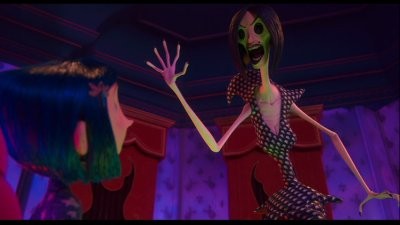
Even without a strong story, it would have been a noteworthy film. But Selick's adaptation retains the power and disturbing tones of Gaiman's source novella, while beefing up the narrative a bit for the feature-length nature of the project. While technically and visually amazing, Coraline is a rounded, fleshed-out film, marked by a focus on the aforementioned themes, and driven by real, full-bodied characters.
The DVD
The Package
This review is of the 2-Disc Collector's Edition. The discs are housed in a standard single-width keepcase, with a card slipcover. Inside the keepcase are four sets of 3D glasses wrapped in cellophane.


The Video
The first disc is a flipper, and contains two versions of the film, one in 2D and one in 3D. Both transfers are anamorphically enhanced 1.78:1 images. I regret missing the 3D version in theaters, because Coraline was shot in true stereoscopic 3D. Unfortunately, the 3D effect did not work for me on DVD. I don't know whether the problem was my eyesight, the glasses provided, my television, or the transfer - but I tried watching the 3D version for fifteen minutes and all I got was a headache. The colors were extremely muddy, images somewhat blurred, and 3D effects minimal. I applaud Universal for the effort, but it didn't work for me. I hope other viewers have better luck with this. In fact, I'd like to hear from readers about their experience with the 3D option.
The 2D option, however, is a great success. The color palette is in full bloom here, with rich detail and solid blacks. There were a few moments where I caught moiré effects and other minimal artifacts, but generally this is a lovely transfer that diligently recreates the art of the animators.
The Sound
There are three Dolby Digital 5.1 mixes: in English, French, and Spanish, each with its own set of subtitles. The English track doesn't make enormous use of surround effects, but is nonetheless very clear, with a broad, immersive soundstage. Music, effects, and dialogue are balanced extremely well, with none being lost beneath the other. The striking musical score by Bruno Coulais mixes an eclectic orchestral sound with choral vocals sung in a nonsense language, and is worth a listen on its own.
The Extras
A fair but not overwhelming group of extras has been assembled by Universal. On disc one is a commentary track featuring Henry Selick and Bruno Coulais. However, Selick speaks for the film's entirety, with Coulais relegated only to the end credits. Nonetheless, it's a good track, with Selick speaking almost nonstop, detailing every aspect of the film's production.
On the bonus disc, we have an oddly-edited selection of deleted scenes with introductions by Selick (8.50). There is also The Making of Coraline (35:56), a solid behind-the-scenes featurette that illustrates the enormous effort of a very large crew in getting Coraline to the screen. Finally, Voicing the Characters (10:46) shows how the voice actors were directed, and how their performances informed the animation process. Finally, a digital copy of the film is included for both PC and Mac users.
Final Thoughts
Coraline is a richly realized film, dense with visual detail and unusually strong characters and themes. Despite my difficulty with the 3D option on this DVD, the technical presentation is very good, and the extras are enlightening even if they are few. I will keep my fingers crossed that Coraline's success encourages other filmmakers to experiment with stop-motion. Highly recommended.
|



| Popular Reviews |
| Sponsored Links |
|
|
| Sponsored Links |
|
|
| Release List | Reviews | Shop | Newsletter | Forum | DVD Giveaways | Blu-Ray | Advertise |
|
Copyright 2024 DVDTalk.com All Rights Reserved. Legal Info, Privacy Policy, Terms of Use,
Manage Preferences,
Your Privacy Choices 
| |||||||