
| Reviews & Columns |
|
Reviews DVD TV on DVD Blu-ray 4K UHD International DVDs In Theaters Reviews by Studio Video Games Features Collector Series DVDs Easter Egg Database Interviews DVD Talk Radio Feature Articles Columns Anime Talk DVD Savant Horror DVDs The M.O.D. Squad Art House HD Talk Silent DVD
|
 DVD Talk Forum |
|
|
| Resources |
|
DVD Price Search Customer Service #'s RCE Info Links |
|
Columns
  



 
|
|
|
Foyle's War: Series 1-5 - From Dunkirk to VE-Day
Acorn Media // Unrated // September 29, 2009
List Price: $149.99 [Buy now and save at Amazon]
Milner: You don't think it was suicide, do you?
Foyle: Don't I? What do you think?
Milner: Well, a man locks himself in a room with the key in his pocket, blows himself up with a hand grenade. He has a motive. He's just bust up with his girl and he leaves behind a suicide note in his own hand writing.
After the popular and long-running series Inspector Morse came to an end in 2000, the British network ITV had a hole in their schedule. They commissioned Anthony Horowitz, who had written a number of Poirot adaptations as well as several of the early episodes of Midsomer Murders, to come up with a mystery show and the result was Foyle's War. Set in Englad over the course of WW II, the show centers around Chief Superintendent Christopher Foyle who has to keep the peace at home. Historically accurate (to a very large extent) and the show not only features intriguing mysteries but also gives viewers a glimpse at what like was like in England during the Blitz. Previously released in season sets, Acron has now collected all 19 movie-length episodes that have been made1 into a very nice collection that is a must for fans of excellent television.
The series starts in 1940 and things look bleak for
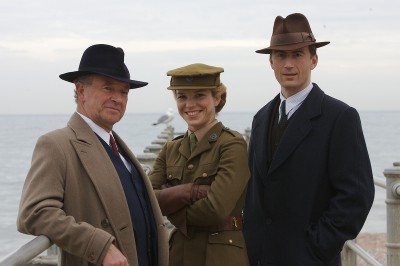
Widower Chief Superintendent Christopher Foyle (Michael Kitchen) tries to join the armed forces but his application is denied. He's needed in his home town of
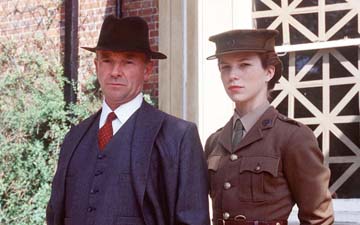
Even though the country is at war, there is still a lot of crime. Foyle spends a lot of his time chasing down black marketers and illegal profiteering, but occasionally (every episode in fact) a dead body pops up. These cases can be much more complicated due to the war. Foyle runs into trouble with officials who hide behind war time regulations to stonewall his investigation (and even allow a murderer to go free) and even the Germans themselves can complicate Foyle's life. That is the case when a house was bombed by the Luftwaffe and the owner is found dead in the rubble... with a knife sticking out of his chest. Forget about DNA and psychological profiling, techniques that haven't been invented yet. How do you find clues when the murder scene has had a bomb dropped on it? And what actions do you take when you discover someone who is vital to the war effort is guilty of a crime that he will hang for?
While this is a mystery series, the look at life in
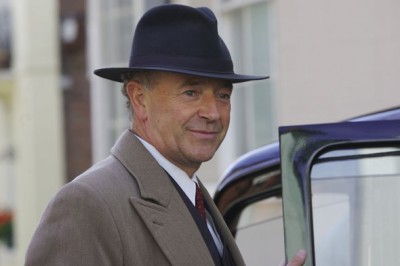
The actors all do a great job with their roles, but Michael Kitchen is outstanding. He plays Foyle as a very quite but observant man. You never really know what Foyle is thinking. The detective keeps his cards close to his chest, never revealing his theories or why he'll occasionally ask a seemingly unrelated question of a witness. The reveals are often unexpected, which makes the show quite fun too. Foyle will often let a prime suspect go and when asked why, he'll calmly and without buildup state the he knows who did it, shocking everyone in earshot.
The DVD:
This set contains all five seasons of the show that have been made so far; 19 episodes that run about 32 hours all together. Acorn wisely put one movie-length show on each disc and then packaged them in 5 single width keepcases, with one season to a case. All five are then housed in a slipcase. It's a very compact and attractive set.
Audio:
These movies come with the original stereo soundtrack. Given that there aren't many action scenes this is adequate. There are a couple of explosions scattered through the series but these were a little weak and could have used a lot more bass. Aside from that the audio is very serviceable and fits in well with the show.
The set is also closed captioned for the hearing impaired.
Video:
The 1.78:1 anamorphic widescreen image looks very good, especially for a British TV show. The picture is a little soft in places, but the colors look fine and the blacks are nice and deep. The image is free from digital defects too, thanks to Acorn resisting the temptation to squeeze two shows on each disc.
Extras:
While the extras are not abundant, the included bonus items are nice. All of the discs include either texted based production notes on the filming of the story or historical background notes that detail events in
Final Thoughts:
This is an excellent series. Michael Kitchen does a brilliant job as Chief Superintendent Foyle, a man who feels that he's not doing his part to help his country win the war, while actually fighting against corruption and crime at home. With a great supporting cast, some intriguing mysteries and featuring a wonderful look at life in
1) While each of the early seasons covers a few months of the war, the fifth season takes on more than that. The creative team got word that the series would be cancelled after the fifth season, so they wrapped up the show. Season five starts a year after season four, skipping much of 1943 and the beginning of '44, and rather than covering a few months the three episodes that make up the season span the last 13 months of the war.
Ironically, after season five wrapped up, the public outcry at the canceling of the series convinced the new Director of Television at ITV to reverse his predecessor decision and revive the show. Currently a sixth season is being filmed that takes place after the conclusion of WWII.
|




| Popular Reviews |
| Sponsored Links |
|
|
| Sponsored Links |
|
|
| Release List | Reviews | Shop | Newsletter | Forum | DVD Giveaways | Blu-Ray | Advertise |
|
Copyright 2024 DVDTalk.com All Rights Reserved. Legal Info, Privacy Policy, Terms of Use,
Manage Preferences,
Your Privacy Choices 
| |||||||