
| Reviews & Columns |
|
Reviews DVD TV on DVD Blu-ray 4K UHD International DVDs In Theaters Reviews by Studio Video Games Features Collector Series DVDs Easter Egg Database Interviews DVD Talk Radio Feature Articles Columns Anime Talk DVD Savant Horror DVDs The M.O.D. Squad Art House HD Talk Silent DVD
|
 DVD Talk Forum |
|
|
| Resources |
|
DVD Price Search Customer Service #'s RCE Info Links |
|
Columns
  


 
|
|
|
Justice League: The Complete Series
Bruce Timm's contribution to the larger canon of DC Comics' superheroes has grown from the surprise hit Batman: The Animated Series into a fully-fledged universe that has taken these characters on some fascinating adventures. After Batman: The Animated Series, Timm's most significant creation has been Justice League and Justice League: Unlimited--which are gathered here in this handsome set under the title Justice League - The Complete Series. Other "Timmverse" series and features are well worth watching, re-watching, and remembering (including Superman: The Animated Series, which I will be reviewing here shortly). But Justice League is one of the best superhero television series of all time. It has a very special charm, a sense of fun and adventure that borrows heavily from the established worlds of each of the "big seven" who make up the Justice League during its first two seasons - a set of characters that expands in unusual directions when the show morphed into Justice League: Unlimited in its third season. The original seven are: Superman, Wonder Woman, the Flash, the Green Lantern (Jon Stewart), the Martian Manhunter, Hawkgirl, and Batman. The first six are the focus of the series, with Batman joining in occasionally, or appearing at key moments to provide important information and support. (In the series' own "origin story" of the League, Batman funds the Watchtower, their base that orbits the Earth.)
Drawing from both well-known and obscure DC story arcs, Justice League combines the earnest tone of the comics with the pizzazz of earlier animated incarnations of our heroes, especially the Fleischer brothers' theatrical Superman shorts from the 1940s. The result is a fast-paced, plot-driven series that makes room for nice character moments - and pulls out all the stops in its long, spectacular action sequences. The overall tone is lighter and less moody than Batman: The Animated Series; the feel blends tones and elements from both the Golden and Silver Ages of comics, utilizing brighter colors, a focus on adventure, and stories laced with science fiction.
Justice League ran for two seasons, from November 2001 to May 2004. Almost without exception, each episode comprised a part of a two- or three-episode story arc. This format allowed for some robust storytelling, obviating the kinds of hard-to-swallow narrative shortcuts endemic to this particular genre. Drawing stories out over multiple episodes also affords character development - such as it is - that is so often abandoned in favor of action.
Season One starts off with the three-part "Secret Origins," which sets up the background of the Justice League for the purposes of this particular series. Brought together by an invasion of Earth by Martian colonists - which has special significance for J'onn J'onzz, the last of the Martian race - the seven heroes join forces and defeat the invaders. They vow to remain bound by the common purpose of the Earth's defense against harm.
Subsequent episodes tend to focus on some subset of the "big seven;" rarely are they all featured at the same time, save for the more ambitious arcs that deal with some galactic or interdimensional threat that requires all the resources the Justice League can bring to bear.
Other memorable first season arcs include the two-part "Legends," in which the League is transported to an alternate reality where humanity's safety is guaranteed by the so-called Justice Guild of America - a sort of Bizarro version of our heroes. "The Savage Time," the three-part conclusion of the first season, finds the whole League traveling through time to aide the Allies in fighting a "what if?" version of World War II. "The Savage Time" features the best action, design, and animation of the entire season. It's a Golden Age-flavored masterpiece.
Season Two maintains the style set in the prior season, while incorporating more refined (and some computer-enhanced) visuals. Particularly strong or interesting arcs include the Superman-centric "Hereafter," which takes us a back to Metropolis and the world of Superman: The Animated Series. It also takes Superman into the future for a bizarre encounter with ambivalent supervillain Vandal Savage. Also outstanding is the three-part season closer, "Starcrossed," which has Hawkgirl at the center of a battle between the League and the Gordanians.
The two seasons (well, one and a half, really) of Justice League: Unlimited (which was originally broadcast from July 2004 to May 2006) open up the League, and the show, while maintaining the visual style and overall tone of the first series. The addition of other DC characters - including the Green Arrow, Captain Atom, Supergirl, Hawk and Dove, The Question, and others - broadens the show's narrative and thematic range while challenging the heroes to work together in ways that are simultaneously global, targeted, and efficient. Episodes are written as one-offs, abandoning the multi-episode arcs of the prior series. However, the show's creators have strung ongoing story arcs across the entire series, in the same way a mainstream television drama would do. It's a smart move, and it's too bad the show did not survive long enough for all of these to be fully developed and resolved.
Justice League: Unlimited is characterized by rip-roaring adventure combined with an almost martial camaraderie. Visually, the animation incorporates more 3D modeling into the 2D style, and the blend is mostly successful. Fast-paced episodes embrace a litany of DC characters, events, and themes, effectively addressing a major swath of the DC canon in a more inclusive way than Justice League did. The first season was, I believe, intended to be the only season, as the final episode "Epilogue" seems to wrap up not only Justice League: Unlimited, but simultaneously Batman Beyond - while serving as a moving coda to Batman: The Animated Series.
Season Two of Justice League: Unlimited seems almost like an afterthought. While entirely enjoyable, it's not as carefully paced as the first; I haven't been able to confirm this, but based on the storytelling, it would appear that the producers had not intended there to be another season. "Epilogue" is such a strong episode and appropriate ending to the series that Season Two seems forced by its very nature, even though the individual episodes are as well-produced as those that went before them.
The DVD
The Package and Content
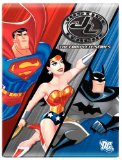
The contents here comprise a direct port of the four previously released Justice League sets (Justice League: Seasons One and Two, and Justice League: Unlimited: Seasons One and Two), along with a new bonus disc. For those who already own the prior DVD releases, the bonus disc is not going to be a selling point. The only content on this new disc is a single 16-minute featurette entitled Unlimited Reserve: A League for the Ages. Other than that, be forewarned: there is no new content here. However, the new packaging is very handsome. The fifteen discs are split between two clear, double-wide keepcases, with all Justice League episodes in "Volume One" and all the Justice League: Unlimited episodes in "Volume Two." These two cases are housed in a sturdy, well-designed tin slipcover.
The Video
As with their prior releases, Justice League: Season One is presented fullscreen; Season Two is presented in letterboxed widescreen; and Justice League: Unlimited is presented in an enhanced transfer. I am not going to be alone in expressing disappointment that this program - the subject of much aspect ratio controversy - wasn't fully remastered and presented in consistent enhanced widescreen transfers. Since the creators' intentions appear to have been for the entire series be broadcast in widescreen, why not take the opportunity to rectify the show's visual presentation? Although these transfers are all relatively strong - with sharp, bold colors and appropriate levels of contrast - it would have been gratifying to fans to have this special package bear some sign of Warner Bros' goodwill. All they've done is wrapped existing releases in good packaging and added a forgettable featurette. Fans expect more - and their willingness to spend on franchises they love merits better treatment by Warner Bros.
The Audio
The stereo soundtracks are all solid, clear, but lack spectacle. They are engaging tracks, but not reference-quality.
The Extras
As I've indicated, the extras are a direct port from the previous releases.
Disc One: Commentary on "The Enemy Below - Part Two"
Disc Two: Three featurettes
Disc Three: Commentary on "Legends - Part Two"
Disc Four: Commentary on "The Savage Time - Part Two" and a featurette
Disc Five: Commentary on "Twilight - Part Two" and two featurettes
Disc Six: Commentary on "A Better World - Part Two"
Disc Seven: One featurette
Disc Eight: Commentary on "Starcrossed - Part Three"
Disc Nine: Commentary on "This Little Piggy" and "The Return," plus a featurette
Disc Twelve: A featurette on the series' music
Disc Thirteen: One featurette
Disc Fourteen: Music-only track on "Destroyer," plus a featurette
Disc Fifteen: This new bonus disc contains a featurette and trailers
Final Thoughts
Justice League: The Complete Series contains every episode of one of the greatest animated superhero programs of all time. Immensely immersive and entertaining, there are hours of memorable fun here, packaged as an attractive set. It's regrettable that there are no new transfers here, or significant new bonus content. Those who own the previously-released season sets can safely skip this. For everyone else, it's highly recommended.
|



| Popular Reviews |
| Sponsored Links |
|
|
| Sponsored Links |
|
|
| Release List | Reviews | Shop | Newsletter | Forum | DVD Giveaways | Blu-Ray | Advertise |
|
Copyright 2024 DVDTalk.com All Rights Reserved. Legal Info, Privacy Policy, Terms of Use,
Manage Preferences,
Your Privacy Choices 
| |||||||