
| Reviews & Columns |
|
Reviews DVD TV on DVD Blu-ray 4K UHD International DVDs In Theaters Reviews by Studio Video Games Features Collector Series DVDs Easter Egg Database Interviews DVD Talk Radio Feature Articles Columns Anime Talk DVD Savant Horror DVDs The M.O.D. Squad Art House HD Talk Silent DVD
|
 DVD Talk Forum |
|
|
| Resources |
|
DVD Price Search Customer Service #'s RCE Info Links |
|
Columns
  


 
|
|
|
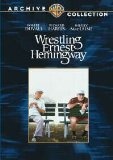
Wrestling Ernest Hemingway
Wrestling Ernest Hemingway was released at the end of 1993, with very little fanfare, despite being timed for awards season. It stars two undeniably great actors - Richard Harris and Robert Duvall - in deeply-felt roles requiring tight control, subtlety, and wit. The film's themes, however, may have been a contributing factor in Warner Bros.' lack of marketing - a lack that compounds the film's central idea, which is the way the elderly are discounted and ignored by society at large. That concept was affirmed by the studio sidelining the picture, and by the Academy, which did not award the film a single nomination.
Francis Joyce (Richard Harris) is a retired sea captain, obsessed with his physical condition, and living in a low-end apartment complex somewhere in Florida. He is ignored by his son, who skips out on Frank's birthday. His landlord, Helen (Shirley MacLaine), views him with alternating disgust and pity. Frank is a drunken lout, who dresses horrendously, curses (appropriately) like a sailor, and has both great admiration and contempt for women. Meanwhile, Walter (Robert Duvall), on the other hand, is a quiet, reserved Cuban exile who has lived in Florida for over thirty years. A retired barber and dancing enthusiast, Walter's days revolve around crossword puzzles in the park, dancing alone in his apartment, and visits to the Sweetwater Snack Shop, where the love of his life is the waitress Elaine (a pre-stardom Sandra Bullock). Walter has never married, and has slowly screwed up the courage to ask Elaine to a dance at a local men's club. When Frank and Walter meet, their tentative acquaintance blossoms into friendship upon developing a mutual understanding of their different but equally lonely lives.
While others - especially screenwriter Steve Conrad - are to be commended for their contributions here, the film is owned by Richard Harris and Robert Duvall, whose performances are beyond reproach. Harris's Frank is a loudmouthed, grotesque asshole, and at several points you want someone to punch his face. He's also a troubled old man whose family has abandoned him, or vice-versa. Either way, he's filled with regret, and he coasts through the days drinking Jameson's Irish whiskey, telling old stories about life on the sea - and about the time he wrestled Ernest Hemingway.
Duvall gives a reserved, inward performance as Walter. As usual, he relies much on his twinkling eyes, which are partly obscured behind giant but perfectly chosen Lew Wasserman-style eyeglasses. His Cuban accent comes off quite successfully, I think, but more important are the small inflections and bits of body language he invests in this quiet, tidy, well-groomed man. The moment he learns that Elaine is moving away is incredibly moving, daring men everywhere not to well up.
The other key actors here deliver performances that are perfectly tuned for the picture. Shirley MacLaine's few scenes have great impact - the slow buildup of sympathy for Frank, ultimately bordering on a kind of love, is achieved without much dialogue and great skill. Bullock's appearance predates her star-making work in A Time to Kill and Speed, and it's easy to see why she rose to such prominence; she's charming here, playing a young waitress who regards Walter affectionately although not sharing his romantic interest. Piper Laurie plays Frank's foil, an aging Southern belle who frequents the movie theater where he is briefly employed as an usher. Laurie's character tries to impart some sense of gentlemanly manners upon Frank, to no avail.
While not entirely depressing - and in fact, laced with genuine good humor - the story here is nonetheless a downbeat one. Elderly people like Frank and Walter are indeed often left alone to fend for themselves. The screenplay grapples with this issue quite realistically, portraying the solitary loneliness of these men before they become friends; Frank's grubby environment and filthy habits in particular drive home the kind of rut that an older person can fall into when not properly looked after. This is an aspect of life that is overlooked - and actively avoided - by most of us, and in some ways that's understandable. No one wants to age. But if we keep that in mind, perhaps we can obviate the solitary decline that many of our elders experience.
The DVD
The Video
The feature was released as part of the Warner Archive Collection, which is somewhat regrettable in the sense that it won't be readily available via regular retail channels. Also, as part of the Archive Collection, the technical treatment of the film is bare-bones, without any bonus features. The transfer is anamorphic, at 1.78:1, and is alternately crystal-clear and a bit noisy. I don't know what the source of the transfer is, but sometimes the visuals are so noisy as to suggest a video source, which seems unlikely. At other moments, this looks like a typically excellent Warner product. The inconsistency is distracting, and baffling.
The Audio
A 2.0 stereo track is offered, and it gets the job done. Nothing fancy here, but dialogue is at the forefront of the mix, and it's perfectly clear. The score by Michael Convertino is a bit loud at times. It's a good score even though it occasionally veers toward the saccharine, and the too-high volume unhelpfully amplifies this.
The Extras
None.
Final Thoughts
The extraordinary performances by Harris and Duvall; a thoughtful screenplay that embraces important, under-represented themes; and tender, patient direction by Randa Haines make Wrestling Ernest Hemingway a memorable, if sad, film that deserves a much wider audience. Despite its technical limitations and lack of extras, it is highly recommended.
|



| Popular Reviews |
| Sponsored Links |
|
|
| Sponsored Links |
|
|
| Release List | Reviews | Shop | Newsletter | Forum | DVD Giveaways | Blu-Ray | Advertise |
|
Copyright 2024 DVDTalk.com All Rights Reserved. Legal Info, Privacy Policy, Terms of Use,
Manage Preferences,
Your Privacy Choices 
| |||||||