
| Reviews & Columns |
|
Reviews DVD TV on DVD Blu-ray 4K UHD International DVDs In Theaters Reviews by Studio Video Games Features Collector Series DVDs Easter Egg Database Interviews DVD Talk Radio Feature Articles Columns Anime Talk DVD Savant Horror DVDs The M.O.D. Squad Art House HD Talk Silent DVD
|
 DVD Talk Forum |
|
|
| Resources |
|
DVD Price Search Customer Service #'s RCE Info Links |
|
Columns
  


 
|
|
|
Julie & Julia
Julie & Julia was marketed as a "feel-good" movie - an automatic turn-off for me. I don't go to movies in order to feel good about myself or others; I go because I'm interested in the different, diverse ways that filmmakers see the world. One might not think of Nora Ephron as a writer/director famed for probing insight into the human condition; but in Julie & Julia, she has captured the parallel stories of two women from different eras and backgrounds who sought to define themselves - and succeeded. The movie is, as the opening credits state, "based on two true stories," and the film's factual basis makes the achievements of the protagonists even more effective. More than anything else, though, the film is a testament to the allure of fine food - and it made me want to cook.
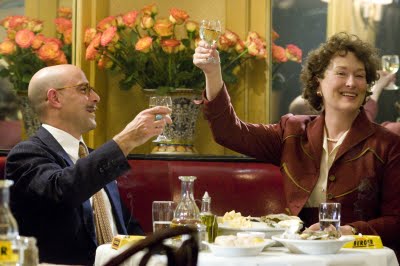
The two stories are those of Julia Child from about 1949 to 1960, and Julie Powell circa 2002-2003. Child (Meryl Streep) and her husband, Paul (Stanley Tucci), are transferred to Paris as a result of Paul's work for the US State Department. Her love of food and desire to work lead her to take courses at the famous Cordon Bleu. Child then makes the acquaintance of Simone Beck and Louisette Bertholle, whose cookbook project she rewrites and, after many false starts, is finally able to publish as Mastering the Art of French Cooking.
Half a century on, Julie Powell (Amy Adams) is a young cubicle-bound cog for the Lower Manhattan Development Corporation, taking calls from people who have been affected by the September 11th terrorist attacks. It's a depressing job, and she desperately needs a creative outlet. Julie challenges herself to cook each of the 524 recipes in Julia Child's classic book within one year, while chronicling her progress in a blog. Her blog gains a readership, she completes the project, and Julie winds up a minor media celebrity with a book deal and, ultimately, a movie.
Nora Ephron's parallel adaptations (of Powell's Julie & Julia and Child's My Life in France) highlight the similarities shared by the two women, and their need to express themselves. Although one could argue that Child's final "product" was distinguished by a sort of individual genius, and that Powell's was merely derivative, the circumstances and conditions faced by each require honest comparison, and that's something that Ephron portrays well. Child was immersed in Paris in the 1950s - an utter dreamland if there ever was one, not to mention the fact that her husband enjoyed a high-profile position with the State Department. Besides which, Child's own background was comfortable. Powell, on the other hand, was married to a magazine editor, and was herself stuck in a deadening job that was necessary to maintain a livelihood. They lived in a fair-to-middling apartment in Queens with a tiny cage-like kitchen. Ephron avoids any sermonizing about Julie and Julia's relative circumstances, but the differences are vividly portrayed and the point is made.
Alongside Ephron's steady handling of Julie & Julia's core themes, the movie is carried by the lead performances. As one would expect, Streep goes well beyond an impersonation. While there is marvelous technical work done to make 5'6" Streep appear closer to Child's larger 6'2" frame, the actress invests her performance with energy, whimsy, and a convincing love of food. Enthusiasm is hard to fake - not that Streep's work could ever be fairly called "fake" - but Streep's acting here carries a viewer along on a wave of Child-like joie de vivre.
Adams holds her own as Julie Powell, taking a character that could have easily come off as unpalatably self-absorbed and transforming her into a full-bodied human being who, despite her faults, is driven by an understandable desire to bolster her sense of self-worth. As detailed in her upcoming book, there are aspects of the real Powell's biography that, had they been included, would have utterly destroyed Adams' characterization; those bits were wisely left out of the picture's time frame.
As Paul Child, Stanley Tucci lends his dependable energy and effervescence in a subdued role that nevertheless provides important, loving, amused support for Julia's ambitions.
Julie & Julia is a testament to the power of food - its subtleties and varied richness - as embodied by Julia Child's seminal book on French cuisine. Whereas Irma Rombauer's The Joy of Cooking was more encyclopedic than instructive or artful, Child's book embraced the finer points of cooking, treating each ingredient with respect and close attention, handling recipes with finesse, as if they were each a puzzle to be unlocked by the dedicated chef. Ephron understands this, as did Child, and this film is her legacy transmitted for another generation. If nothing else, this vivacious film will spark the interest of anyone with the least interest in food to go to the kitchen and appraise its potential anew.
The DVD
The Video
A solid enhanced 1.78:1 transfer recreates the lighting and photography approaches for the film's two eras with excellent fidelity. Paris is lit glowingly, with period sets and costumes hitting the mark - they aren't too showy, not overly glamorous, just touching the right semi-romanticized note. Powell's New York is grittier and darker overall, and more realistic. Her tiny kitchen is filled with a sort of love, however, as if the glow of Child's Paris has taken up residence there. It's a very good transfer of a film with a subtle, detailed visual style.
The Audio
A good, if not terribly active 5.1 surround track is featured. There's nothing earth-shattering about it, but its clarity and solid delivery of dialogue and key sound effects can't be argued with. Unfortunately, the overly-sappy and too-loud score by Alexandre Desplat can and should be argued with. It's one of the movie's few consistent weak points.
The Extras
There are just a couple of extras here, but they are good ones. First is a commentary track with writer/director Nora Ephron, who goes into detail about all aspects of the production; it's well worth a listen for those interested in going beyond the feature. Also informative is the half-hour Special Ingredients: Creating Julie & Julia, a very good making-of piece.
Final Thoughts
Julie & Julia is an excellent film for two primary reasons. First, it's carefully written and directed, and features excellent performances. Second, it passes on the makers' enthusiasm of its subject matter to the viewer. I can't imagine anyone who likes this movie not rushing out to look up Julia Child's two-volume masterpiece - which, when all is said and done, is the beginning and end of Julie & Julia. Highly recommended.
|



| Popular Reviews |
| Sponsored Links |
|
|
| Sponsored Links |
|
|
| Release List | Reviews | Shop | Newsletter | Forum | DVD Giveaways | Blu-Ray | Advertise |
|
Copyright 2024 DVDTalk.com All Rights Reserved. Legal Info, Privacy Policy, Terms of Use,
Manage Preferences,
Your Privacy Choices 
| |||||||