
| Reviews & Columns |
|
Reviews DVD TV on DVD Blu-ray 4K UHD International DVDs In Theaters Reviews by Studio Video Games Features Collector Series DVDs Easter Egg Database Interviews DVD Talk Radio Feature Articles Columns Anime Talk DVD Savant Horror DVDs The M.O.D. Squad Art House HD Talk Silent DVD
|
 DVD Talk Forum |
|
|
| Resources |
|
DVD Price Search Customer Service #'s RCE Info Links |
|
Columns
  


 
|
|
|
Plastic Man: The Complete Collection
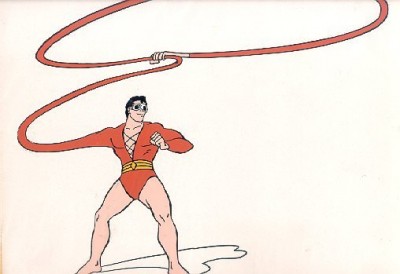
I didn't have a huge amount of choices on Saturday mornings growing up, because I was only limited to 60 minutes of television time. So I had to be choosy about which shows I watched. Ruby-Spears' Plastic Man (formally The Plastic Man Comedy/Adventure Show), which ran from 1979 to 1981, was one of the few programs I really looked forward to each weekend. When I saw Plastic Man, it was in reruns shortly after its original broadcast, and it was one of my earliest encounters with a superhero character. Although Superman (1978) was the very first feature film I ever saw, I did not really connect with superheroes as a kid. So Plastic Man represents a first exposure to a Justice League character, and even though it did not lead to a sustained interest in comic book heroes as a child, it certainly planted the seeds of the fairly deep appreciation for DC characters that I now hold as an adult.
There's no doubt that the broad humor of Plastic Man - which distinguishes it from other superhero shows, past and present - played a major part in my appreciation of the show as a child. I loved slapstick, and still have a weak spot for it; Plastic Man, more than any other DC character, presents a wonderful basis for a lot of visually-inventive gags.
In the television show, Plastic Man is provided neither origin story nor much context for his adventures - and has little to do with the original hero of the comic books. As was true in many Saturday morning cartoons, action was paramount, and characters often existed in a vacuum-like environment. Adventures started and ended, without any reference to a larger world around them. Plastic Man blithely skips from episode to episode with sidekicks Penny (a pretty blond) and Hula Hula (a Polynesian, apparently, who speaks with a vague Northeastern accent). Each show finds the group fighting a new villain bent on world domination; they pursue justice on behalf of the "chief," a woman who "Plas" has the hots for, and whose authority is never really explained.
Lack of background information on our characters is not the reason that Plastic Man fails to hold up. For one thing, it was probably never particularly good to begin with in the eyes of anyone over the age of six. More importantly, Plastic Man suffers from a dull beige-ness of the sort that befell so many cartoons of its era; like the bulk of the cartoons that populated the Hanna-Barbera stable, it plods along driven only by a very tired and routine formula. The villains are freakish, the jokes lame, and the stories rote. The only interest lies in the different shapes and forms taken by Plastic Man himself - and even those begin to seem monotonously outlandish after awhile.
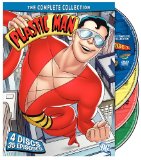
The DVD package proclaims this set is The Complete Collection. However, these discs jettison the "Baby Plas" and "Plastic Family" segments from the latter part of the series' run, after Plastic Man and Penny were married and had a kid. I'm not really complaining, because I remember being bored by those segments as a kid - which indicates that they are probably totally disposable. Still, I'm not sure why this set is called The Complete Collection when about a third of the total program content is missing.
What we do have is a four-disc set containing 35 episodes totaling almost ten hours of Plastic Man. This will be far too much Plas for almost anyone to sit through. Monotony sets in early, and does not really let up. This program was produced for kids - and I suspect it will still be entertaining for those aged perhaps five to seven. But beyond them - and the most die-hard nostalgia buffs - this show will only induce daydreams of superior animated superhero series.
The DVD
The Package
Warner Brothers has efficiently packaged the four discs within a single-width keepcase. A card slipcover slides over the container.
The Video
These full-screen shopworn transfers indicate indifference on the part of Warner Brothers. Many of the shows look like they are from video masters, and artifacts are plentiful. The main problem, though, are the faded colors, which look rather drab for a show about such a colorful and energetic character. A basic remastering job would have been nice.
The Audio
A dull mono track is included. It is in reasonably good shape. Dialogue is comprehensible. Music is broadly present, but sounds like a soggy mess on this track.
The Extras
A new retrospective featurette provides some interesting background. Perhaps more significant is the inclusion of the Cartoon Network's 2006 pilot for a re-booted Plastic Man animated series, starring Tom Kenny as Plas. This unaired pilot tries to hard to be contemporary and edgy, although it's probably more successfully entertaining than anything else on this set.
Final Thoughts
My fond memories of Plastic Man are not ruined by any stretch, but the show is dated, lazy, and repetitive. I would not discourage parents of young children from introducing them to the show, because it will probably entertain them. But everyone else, even the curious and nostalgic, should just rent it.
|



| Popular Reviews |
| Sponsored Links |
|
|
| Sponsored Links |
|
|
| Release List | Reviews | Shop | Newsletter | Forum | DVD Giveaways | Blu-Ray | Advertise |
|
Copyright 2024 DVDTalk.com All Rights Reserved. Legal Info, Privacy Policy, Terms of Use,
Manage Preferences,
Your Privacy Choices 
| |||||||