
| Reviews & Columns |
|
Reviews DVD TV on DVD Blu-ray 4K UHD International DVDs In Theaters Reviews by Studio Video Games Features Collector Series DVDs Easter Egg Database Interviews DVD Talk Radio Feature Articles Columns Anime Talk DVD Savant Horror DVDs The M.O.D. Squad Art House HD Talk Silent DVD
|
 DVD Talk Forum |
|
|
| Resources |
|
DVD Price Search Customer Service #'s RCE Info Links |
|
Columns
  


 
|
|
|
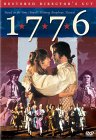
1776
Making entertainment out of two months' worth of debates and parliamentary procedures in a meeting hall doesn't sound very promising, but 1776 is bright, witty, and affectionately satirical. Writer Peter Stone (Charade, Skin Game) has a definite liberal bias that characterizes hothead John Adams as a corrosive and sour activist branded with the very negative (for 1969 and thereafter) words agitator and radical. He also included a tune called Cool, Cool Considerate Men where the smug, rich Southerners congratulate themselves for being conservatives who let others take risks, that's an obvious swipe at the Republican Party of the late 1960s. The liner notes and the commentary repeat the story that then-President Richard Nixon objected to the song both in the play and in a Patton-like White House screening, and asked buddy Jack Warner to remove it.
1776 was only partially censored by Nixon, because 25 minutes in all were dropped between the film's premiere and its theatrical run, where even at 142 minutes it seemed a bit long. 1 All the songs in 1776 are excellent - with the possible exception of the grating The Lees of Old Virgina (remembered as a show-stopper on stage), but that's a matter of taste. The conscience of the Congress, mulling over petty details while the soldier volunteers of the Continental Army fight and die, is very well stated in the song, Mama, Look Sharp, sung by Washington's courier.
There are some fine performances here. William Daniels is the stuffiest 'agitator' imaginable, but keeps John Adams the central force of the show. His letter-conversations with his far-off bride Abigail are touching for their insights into his character, and their duet 'Til Then is so powerfully plaintive, it regularly got applause in the movie house - after each of its reprises. Daniels was a well-known actor (The Graduate, TV's Captain Nice) whose first film was the liberal anti-nuke cautionary drama Ladybug, Ladybug. Howard Da Silva was a great character actor (The Lost Weekend, They Live by Night) who was the first Jud Fry in the original Oklahoma! Broadway show, but was blacklisted before the H.U.A.C. after a vicious attack by Robert Taylor, and disappeared from screens for ten years. In that context, it's strange to see him playing the jovial father of independence for the country that scorned him; when he says his most cutting lines ("Treason is a word invented by the winners as an excuse for hanging the losers") there's not a hint of bitterness. Writer Stone has fun with mild references to Franklin's gout, which doesn't prevent the elder statesman from prancing about or keeping appointments with the ladies. Da Silva brings the show to life whenever it threatens to become monotonous.
Young Ken Howard, who had just finished a pair of Otto Preminger films, is appropriately reserved and thoughtful as Jefferson. Fresh Blythe Danner provides a highlight with her He Plays the Violin song, which threatens to become a serious dance number but chickens out with a few waltz turns. She, however, is adorable.
The large cast of delegates is uniformly fine and composed mostly of Broadway actors who didn't have extensive film careers. You can spot William Hansen from Fail-Safe and John Myhers from How to Succeed in Business Without Really Trying, and several faces from early seasons of the Dark Shadows soap opera, but many are talented one-time visitors to the big screen.
Clearly, the very set-bound and talky 1776 was a challenge for the filmmakers. Efforts to open up the show go little further than the street in front of the Congress, and the vaseline-dissolved dream duets. The direction in the dialogue scenes is good, but the film seems afraid to embrace its musical numbers, which are simply recorded straight. Musical Entertainment as a staple had withered to nothing in the Hollywood of 1972, and there's a reticence to let the camera become as emotional as the performers. The trailers, in fact, stressed the witty dialogue over the songs, as if out of embarassment.
The least appealing aspect of the picture is its color design, which is pretty non-existent. The prints in 1972 looked worse than the disc - drab greyed greens and blues, again suggesting that the filmmakers were made self-conscious by the period decor and costumes. For a show with some really joyous music, 1776 looks almost as bloodless as UA's hideously designed Man of La Mancha from the same year. The early '70s were disaster years for Columbia, what with their turkey supreme Lost Horizon, and there's something about the look of this upbeat movie that doesn't entirely escape the aura of doom that surrounded the studio at that time.
Columbia's DVD of 1776 is a very peppy-looking transfer that restores the show to premiere length fairly seamlessly, and has colors much better than the original theatrical prints. Grain is kept to a minimum and overall the resolution is fine, especially considering that much of the film is in wide shots with dozens of men milling about the congress hall.
A commentary track features director Hunt and writer Stone, who eagerly recount the circumstances around the crippling cutting of the picture by Jack Warner, making it sound like Nixon personally dictated the losing of the one musical number. They proudly cover the success of the Broadway version, and fill in lots of detail on most of the actors we see.
Several amusing screen tests for the stage actors are a welcome addition (but why they tested familiar film face William Daniels is a mystery). The disc has some very helpful but unattributed liner notes, and reproductions of the dreary original theatrical posters.
On a scale of Excellent, Good, Fair, and Poor, 1776 rates:
Movie: Very Good
Video: Good
Sound: Good
Supplements: Commentary with Director Hunt and writer Stone, screen tests, trailer
Packaging: AGI case
Reviewed: June 23, 2002
Footnote:
1. Savant was an usher at the National theater in Westwood when 1776opened, cut at 142 minutes; this DVD restores the premiere version at 166, which is satisfying on disc but back then would have made an already long film tough sledding. In the early 90s, a Pioneer/Columbia laserdisc produced by Joe Caporiccio did a restoration job on the picture using b&w workprint to fill in the missing scenes and shots. It was a distracting disc for ordinary viewers but a wonderment of editing, as the b&w slugs showed how cleverly pieces of scenes and reaction shots were excised to streamline the piece, in some cases (according to Stone and Hunt on the commentary) eliminating 'controversial' snippets of dialog.
Return
| |
|



| Popular Reviews |
| Sponsored Links |
|
|
| Sponsored Links |
|
|
| Release List | Reviews | Shop | Newsletter | Forum | DVD Giveaways | Blu-Ray | Advertise |
|
Copyright 2024 DVDTalk.com All Rights Reserved. Legal Info, Privacy Policy, Terms of Use,
Manage Preferences,
Your Privacy Choices 
| |||||||