
| Reviews & Columns |
|
Reviews DVD TV on DVD Blu-ray 4K UHD International DVDs In Theaters Reviews by Studio Video Games Features Collector Series DVDs Easter Egg Database Interviews DVD Talk Radio Feature Articles Columns Anime Talk DVD Savant Horror DVDs The M.O.D. Squad Art House HD Talk Silent DVD
|
 DVD Talk Forum |
|
|
| Resources |
|
DVD Price Search Customer Service #'s RCE Info Links |
|
Columns
  


 
|
|
|
Greenberg
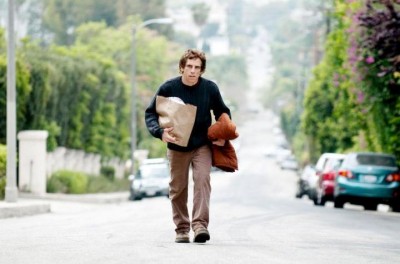
Noah Baumbach has a knack for extremely well-written portrayals of unpleasant characters who find themselves in transformative situations. Beyond his enjoyable collaborations with Wes Anderson, Baumbach's own films (The Squid and the Whale, Margot at the Wedding) are noteworthy for their novelistic approach to character and a fine understanding of interpersonal dynamics. While Baumbach's newest film, Greenberg, carries these hallmarks, but in a watered-down form, and it does not develop its characters as richly and respectfully as we have come to expect. Anchored by an outstanding performance by Ben Stiller, Greenberg succeeds as a study of a deeply flawed man, but it fails to reach beyond that to credibly and fully portray the impact of this terrifyingly off-putting person on the people around him.
Roger Greenberg (Stiller) has just been released from a stay in a New York mental hospital, and arrives in LA for some R&R at his brother's mansion while the brother and his family vacation in Vietnam. While in Los Angeles, Roger reconnects with his old friend Ivan (Rhys Ifans), with whom he once led a promising rock band, and begins a tentative, hurtful affair with his brother's assistant Florence (Greta Gerwig). Both relationships are damaged by Roger's inability to communicate directly and honestly. In a turn of events that sounds like something out of The Journey of Natty Gann, his brother's sick dog serves as the catalyst by which Roger gains at least a little understanding of the limitations of his own personality.
As usual, Baumbach excels at developing characters with fundamental flaws who may or may not be beyond redemption or rehabilitation - and who may or may not be capable of what we'd consider "healthy" relationships. With Ben Stiller's help, Roger Greenberg may be the filmmaker's most indelibly unpleasant creation - a self-hating, self-destructive, obsessive, passive-aggressive, sneaky, sad loner who thwarts his own instincts and is incapable of behaving in a manner considerate of others. Roger is a well-crafted and generally unique personage, and Stiller breathes a restrained, dryly witty life into him.
Although great care has been afforded the film's titular character, less attention has been allotted to the dynamic relationships that move the film forward and, at least ostensibly, result in the maturation of Roger's character arc. His friend Ivan is experiencing his own rough patch: he is in the middle of a trial separation from his wife, and this is a strain upon his relationship with his young son. Ifans, as Ivan, evinces a quiet suffering that serves as an effective counterpoint to Roger's obnoxious self-loathing, and in a scene toward the film's end, he forces Roger to confront the ways in which they have grown apart - and the enormous chasm that separates the ways in which they choose to deal with life's less fortunate moments. It's an effective scene, but it ends on a less-than-satisfying note, with Roger shouting a bunch of unearned, self-serving nonsense back at Ivan. I wanted Ivan's speech to have a greater impact upon Roger's perception of himself, but the script allows him to backslide into defensive justification.
More crucial to the ultimately dissatisfying experience of Greenberg is the role of Florence. Greta Gerwig has received broad acclaim for her performance, and I won't say that her portrayal is devoid of charm. It is, however, somewhat baffling. For the first half-hour or so of the movie, I thought Florence was supposed to be developmentally disabled in some way. Something about Gerwig's delivery and manner makes her seem... slow; there's also a moment early in the film when she is at a party with a friend who seems a little overly-protective, as if Florence required an extra-watchful eye. But even more confusing is why Florence is drawn, against all sane reason, to Roger, even after he repeatedly goes out of his way to render any sort of "real" relationship impossible. At one point, Florence tells Roger, "You like me so much more than you think you do," which comes across as one of the most idiotic lines of dialogue in recent memory and one that could only be written by someone who has spent way too much time in either Brooklyn or Silver Lake. In the context of the film's story, they are the words of extraordinary delusion - nobody, sane or otherwise, would want to enter into a relationship with the poisonous Roger Greenberg, and Florence's unwavering soft spot for him is never explored.
Greenberg is not a bad movie. But Noah Baumbach has made better films - and will no doubt make better ones in the future, too. Greenberg fails to live up to his key strengths as a filmmaker, however, which revolve around his strongly novelistic approach to dynamic relationships between characters. Despite an excellent and absorbing performance by Ben Stiller, Greenberg's world seems incomplete, sketchy, and unfulfilling.
The DVD
Image
The widescreen 2.40:1 transfer shines. Down-to-earth photography by Harris Savides captures the smoggy daytime LA air and the neon-tinged lights of that city at night. Blacks are solid, colors are crisp, and detail is strong. I noticed traces of digital noise, but nothing to offend the eye.
Sound
The Dolby Digital 5.1 surround track is mostly a 2.1 track when you get down to it, but there are a handful of ambient surrounds. Dialogue is up front, and the pleasant musical score by James Murphy of LCD Soundsystem fame is well-balanced.
Bonus Content
There's not much here - just a trio of very short featurettes. I'm disappointed that there is no commentary, especially since Baumbach has done them in the past. It would have been interesting to hear his - and Stiller's - take on these unusual characters.
Final Thoughts
Ben Stiller's performance deserves an Oscar nomination, despite the fact that Greenberg is an unsatisfying movie with some major credibility gaps. Still, it's a film well worth seeing, at least once. Rent it.
|



| Popular Reviews |
| Sponsored Links |
|
|
| Sponsored Links |
|
|
| Release List | Reviews | Shop | Newsletter | Forum | DVD Giveaways | Blu-Ray | Advertise |
|
Copyright 2024 DVDTalk.com All Rights Reserved. Legal Info, Privacy Policy, Terms of Use,
Manage Preferences,
Your Privacy Choices 
| |||||||