
| Reviews & Columns |
|
Reviews DVD TV on DVD Blu-ray 4K UHD International DVDs In Theaters Reviews by Studio Video Games Features Collector Series DVDs Easter Egg Database Interviews DVD Talk Radio Feature Articles Columns Anime Talk DVD Savant Horror DVDs The M.O.D. Squad Art House HD Talk Silent DVD
|
 DVD Talk Forum |
|
|
| Resources |
|
DVD Price Search Customer Service #'s RCE Info Links |
|
Columns
  


 
|
|
|
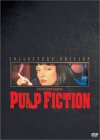
Pulp Fiction: Collector's Edition
Oliver Stone once boasted that the sixties belonged to him, but Quentin Tarantino, the boistrous boy from the video store, actually earned the nineties for himself with just two ultra-cool crime films, Reservoir Dogs and Pulp Fiction. Tarantino impressed the neo-noir crowd with his first lowbudget caper film, but put the world in his pocket with this long, brassy and breathless ode to sleazy crime fiction. With crackling dialogue, nerve-jangling violence, a brace of actors giving career-best performances, indulgent thrills, and a wonderful sense of cultural teasing, Pulp Fiction is a great movie.
A rather blurry, flat-letterboxed edition came out early after the introduction of DVDs; this new Collector's Edition actually offers a rebate for purchasers of the old copy!
It took five years for the buzz about Pulp Fiction to even begin to die down: the film inaugurated a spate of imitators churning out humorous-hip odes to criminal mayhem, as well as serving as the core inspiration for countless Tarantino wanna-bes. Savant can't begin to fully cover the phenomenon of the show or the impact of Mr. QT, the Auteur Who Can Do No Wrong. The show works not because it's so cool, but because it's so fundamentally entertaining, and like everyone, I didn't even try to 'read' it much, even on a second viewing. But I do have a few thoughts to share before evaluating the disc as a whole.
Tarantino's dialogue writing is superior because he combines a keen ear for character shadings, with a love of small-talk. None of his hired killers, dating mobsters, female taxicab drivers, pushers, and stickup punks are silent types. Everybody has an agenda to promote, a point to press home, or a yearning to express. Everyone's glib, and the hipness comes in their attitudes, not because they say clever lines. Other American kid directors raised on TV have a keen appreciation of cinematic forms, but most ape them or spoof them or snuggle up to them in the Spielberg mode; Tarantino somehow turned himself into a combo Jim Thompson and Preston Sturges. It's delicious fun to see the verbal and physical sparks fly when his characters rub together - everyone in Pulp Fiction has 'chemistry' of the kind you look for between the leads in a romantic movie. Quentin didn't find these smarts behind the counter of a video store - he's a plain brilliant writer.
Tarantino is more than willing to Walk the Walk. Pulp Fiction has some very violent material, and what he doesn't show in gross detail, such as the splattered brains hanging from Jules' hair, he suggests. 50 sophomoric imitations (Savant once had to work for a week with 8 Heads in a Duffel Bag) can't take the horror or hilarity out of the plight of 'The Gimp' locked away in Zed and Maynard's basement cage - his predicament, and the thought (shudder) of what he's been going through, are just too over the top - especially when Butch simply leaves him there after doing the honorable thing re: Marsellus.
Tarantino also dives headlong into the drug culture, downplayed by Hollywood since soon after the days of Cheech 'n Chong. The drug-users here are pretty darned glamorous, and the miraculous retrieval of Mia from OD doom is beyond funny. There's not a smidge of social responsibility here; Tarantino has taken the existential exploitation amorality of the Jack Hill potboilers he admires, and cut right through MPAA preferences.
Life is a killer short story to Tarantino, who does for cheap crime what Stephen King did for Horror. All of his people take a risk and make their play. Vince needs to be on his best behavior for his date with Marsellus' irresistable Mia, yet when he shows up, he's still strung out on Lance's Heroin. Every time Vince gets in trouble, it's because he dawdles in the bathroom. 1 The ultra-tough Butch takes the gamble that the whole underworld underestimates him as a boxer and an operator, and makes his play. He's introduced in a bizarre flashback to a life-changing episode in his childhood. Everything that happens is believable, yet infused with the high melodrama of pulp fiction conventions.
There's almost not a single moment in Pulp Fiction that's not suspenseful. The element of chance isn't avoided, and anybody seeking to criticize the story on the basis of its coincidences will find the ammo they need. But you can see the smile of the director in every scene - this is Pulp Fiction, after all, not Masterpiece Theater - and there's a diabolically clever time-twist to his storytelling. Events could have been separated into two or three free-standing episodes. Tarantino doesn't bother with a fate-driven flashback structure, but goes instead for an existentially splintered form, right from a Jim Thompson book. He even cuts a scene clean in two, returning to it over an hour later, something you don't see much this side of Alain Resnais. To our surprise, the conceit is not off-putting or confusing, because it enables Tarantino to pace and regulate his content to balance horror and humor, and to more or less bookend the forceful bibilical orations of Samuel L. Jackson. Tarantino's already had the nerve to bounce culturally from Elvis to Saturday Night Live to Travolta's Batusi Twist in the overweight nineties. Now, after two hours of amorally gleeful wickedness, he lets Jackson go moral on us, questioning all and summoning the resolve to quit the life and 'walk the Earth' seeking a higher destiny. And he gets away with it - it's exhilarating.
I've got a feeling that Tarantino will succeed at anything he truly commits himself to. Should he want to pull a stylistic reversal, and do a morally sanctimonious film, he's got what it takes to sell me on his artistic sincerity. After Pulp Fiction, we really want to see if Quentin is just kidding about Jules the Hitman's commitment to following the Lord's way. If he's not kidding, I think he owes us one uplifting masterpiece about Jules 'walking the Earth.'
Miramax left no extra unexploited in its effort to insure that their Collector's Edition of Pulp Fiction would attract the faithful. The list below isn't complete - when the (fairly resilient) card and plastic case opens, a mini-menu for Jack Rabbit Slim's falls out. Savant watched the deleted scenes, most of which are excess blab, like the extemporaneous Tarantino on-screen intros that run on and on. The very-interesting Behind the Scenes Montages are a collection of 'b' roll on the Jack Rabbit Slim set, with Quentin twisting along with his actors, and a breakdown of the action where Bruce Willis runs over pedestrian Ving Rhames. The documentary is intensely detailed on the story of Tarantino's rise to genius, and is very thorough in its documentation of the movie. Presold fans are going to eat it up.
The transfer looks really spiffy, with those true dark colors and a sharp image, as opposed to the frankly abominable earlier release. Nobody's going to be upset with anything technical about the disc. The only negative I detected was a a petty one: the layer change, freezing Christopher Walken right in the middle of his soliloquoy, was awkward in the extreme. The two-disc set has audio encoded both Dolby Digital and DTS, and added DVD-Rom features, including a trivia game and a 'screenplay viewer', which may or may not mean that the disc contains the screenplay that sold so well when published.
On a scale of Excellent, Good, Fair, and Poor, Pulp Fiction Collector's Edition rates:
Movie: Excellent
Video: Excellent
Sound: Excellent
Supplements: Production notes, Deleted Scenes, Pulp Fiction: The Facts Docu, Still Gallery, Behind-The-Scenes Montages, Production Design Featurette, Siskel & Ebert At The Movies - The Tarantino Generation, Cannes Film Festival - Palm d'Or Acceptance Speech, Charlie Rose Interview with Quentin Tarantino, Theatrical Trailers, 13 TV Spots, Reviews and Articles, rebate info, DVD Rom features
Packaging: Folding card stock & plastic case
Reviewed: August 15, 2002
Footnotes:
1. Vince is twice reading a Modesty Blaise book in the john. It's one of only two cultural references the film, outside of the wall-to-wall references in Jackrabbit Slim's. The other is a really bizarre visual link to the Great Whatzit of Kiss Me Deadly.
Return
| |
|


| Popular Reviews |
| Sponsored Links |
|
|
| Sponsored Links |
|
|
| Release List | Reviews | Shop | Newsletter | Forum | DVD Giveaways | Blu-Ray | Advertise |
|
Copyright 2024 DVDTalk.com All Rights Reserved. Legal Info, Privacy Policy, Terms of Use,
Manage Preferences,
Your Privacy Choices 
| |||||||