
| Reviews & Columns |
|
Reviews DVD TV on DVD Blu-ray 4K UHD International DVDs In Theaters Reviews by Studio Video Games Features Collector Series DVDs Easter Egg Database Interviews DVD Talk Radio Feature Articles Columns Anime Talk DVD Savant Horror DVDs The M.O.D. Squad Art House HD Talk Silent DVD
|
 DVD Talk Forum |
|
|
| Resources |
|
DVD Price Search Customer Service #'s RCE Info Links |
|
Columns
  


|
|
|
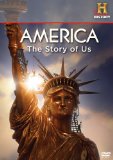
America: The Story of Us
America: The Story of Us is a bird's eye, American Exceptionalist view of our country's history. This series pushes the idea that Americans share a collective culture, born from colonialism and forged from pioneering, that makes our society unique among all countries. There is a significant amount of patriotic cheerleading, but the documentary does not gloss over shameful events such as slavery, segregation, and stealing a land from the Native Americans.
America: The Story of Us covers about 400 years worth of history in 12 episodes and includes events spanning from original Jamestown and Plymouth Rock settlements to the election of Barack Obama. It hits on the usual suspects such as the Revolutionary War, the Civil War, the Great Depression and World War II, but where it really shines is on other topics that haven't been overexposed from countless documentaries on the educational channels.
In fact, the series almost makes a point of it to avoid discussion of wars where it was feasible. Little, if any, mention is made of conflicts such as the War of 1812, Spanish-American War, World War I, and the Korean War. Instead, engineering feats like the Hoover Dam, the Erie Canal, railroads, and the interstate system are given due credit for the parts they played in accelerating the growth of the United States into an industrial powerhouse--and, therefore, a military force to be reckoned with. Lesser known subjects such as the chilling story behind Donner's Pass, the evolution of the computer from cotton loom punch cards, John Brown's terrorist/patriotic acts, the significance of barbed wire, and even the political importance of the Joe Louis vs. Max Schmeling fights are also given a considerable amount of attention.
Although it does not cover wars with exceptional depth, America: The Story of Us offers some interesting perspectives on the major wars. The documentary makes the argument that the North won the Civil War because it had superior logistics. The Union made full use of the telegraph to provide its leadership with up-to-date battlefield information and intelligence. Abraham Lincoln even had a small office equipped with a telegraph that doubled as his command center. Government-run railroads allowed the Union to quickly move supplies and troops throughout the nation. In a traditional war, the Confederates would have had the advantage; they probably had superior battlefield tactics and only had to defend their territory, whereas the Union had to invade. A reason why the Southerners lost was their failure to leverage modern technology.
The narrator, Liev Schrieber, does a masterful job of presenting each fact and telling stories in a compelling style. Schrieber plays it neutral and lets the guest speakers state their opinions on subjects. He never goes overboard to make the material entertaining, but he definitely does not dryly state facts either. The guest speakers are passionately pro-American on the topics they discuss, unless they are talking about undeniably appalling subjects such as slavery. The diverse guest speaker list includes names such as Colin Powell, Donald Trump, Sean "Diddy" Combs, Michael Douglas, Rudy Giuliani, Michael Bloomberg, Tom Brokaw, Brian Williams, Al Sharpton, Newt Gingrich, Meryl Streep, Bill Maher, Michael Strahan, and even Rick Harrison from Pawn Stars. At times their remarks are unnecessary and merely fill space, but for the most part, they offer interesting commentary throughout each episode.
The final episodes of the set recall previous themes too often. History repeats itself and the events of today certainly parallel events that have already happened. However, when the documentary flashes back to the invention of barbed wire while discussing the rise of the internet, then I have to call shenanigans. Did they run out of funding and decide to constantly replay scenes of Joseph Glidden twisting barbed wire or construction workers walking the steel beams while building a skyscraper? Surely there is enough material available from the past 70 years to fill two episodes. The producers could have easily minimized the reuse of those very loosely related scenes from the past while still emphasizing their point.
That quibble with the last few episodes aside, America: The Story of Us is a wonderfully optimistic survey of our history and the direction in which this nation is heading. It glosses over many topics that have been thoroughly examined in other documentaries and focuses instead on what normal Americans did during great events. Outside of the bizarre fixation with barbed wire, every topic, from the personal tales of ordinary citizens working in factories to the gut-wrenching story of D-Day, was captivating.
This documentary acknowledges that America has made mistakes, but it does not dwell on them. After attending numerous history courses that demonized America and harshly criticized practically every move this country has ever made, positive documentaries such as this are refreshing. This series seeks to deliver a message of hope for our future by highlighting the successes of our past. Is that so bad?
The DVD
Audio: The audio is presented in 2.0 Dolby Digital. The voices are all clear with no distortions. The music, especially the metal-ish tunes played during some war scenes, is loud and out of place. Perhaps I have been conditioned to expect a Hollywood-style, orchestra soundtrack during Revolutionary War scenes as opposed to rock music, but it definitely distracted me.
Video: I am pleased to say that The History Channel has blessed us with anamorphic 1.78:1 widescreen glory with this DVD set. However, just because The History Channel finally gave us what we have come to expect from DVD's over the past decade does not give them extra credit. The video is grainy, the colors are muted, and there are noticeable compression artifacts throughout. I watched this episode as it aired in HD and the video in this set is disappointing. But at least it's anamorphic.
Extras: There are a total of seven short videos that provide additional footage on the Revolution, the Declaration of Independence, George Washington, the Civil War, the Transcontinental Railroad, the Statue of Liberty, and the Ford Model T. If nothing else, watching Brian Williams say that we "opened up a can of whoop-ass" in his conservative news anchor voice makes these extras worth viewing.
Final Thoughts: America: The Story of Us is a good summary of the events and people that transformed the United States from a set of loosely affiliated colonies into a world superpower. History buffs will likely be frustrated by the lack of depth given to many subjects, but it does provide coverage to many topics that are typically an afterthought in other documentaries. The series is unabashedly pro-American and delivers an optimistic glance at our past. If you enjoy American history documentaries, then there is no reason that you would not enjoy this set. Recommended.
Bobby is a programmer by trade and a wannabe writer. Check out his other reviews here. You can also check out his blog about harmless nonsense or follow him on Twitter
|



| Popular Reviews |
| Sponsored Links |
|
|
| Sponsored Links |
|
|
| Release List | Reviews | Shop | Newsletter | Forum | DVD Giveaways | Blu-Ray | Advertise |
|
Copyright 2024 DVDTalk.com All Rights Reserved. Legal Info, Privacy Policy, Terms of Use,
Manage Preferences,
Your Privacy Choices 
| |||||||