
| Reviews & Columns |
|
Reviews DVD TV on DVD Blu-ray 4K UHD International DVDs In Theaters Reviews by Studio Video Games Features Collector Series DVDs Easter Egg Database Interviews DVD Talk Radio Feature Articles Columns Anime Talk DVD Savant Horror DVDs The M.O.D. Squad Art House HD Talk Silent DVD
|
 DVD Talk Forum |
|
|
| Resources |
|
DVD Price Search Customer Service #'s RCE Info Links |
|
Columns
  


 
|
|
|
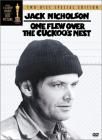
One Flew Over The Cuckoo's Nest : SE
THE STRAIGHT DOPE:
There are some films that just have an aura. They are accepted as part of the firmament, loved by everyone. One Flew Over the Cuckoo's Nest is one of them. Appearing right in the middle of the decade of The Godfather, Taxi Driver, The Deer Hunter and Chinatown, it was met with enormous adoration and won every award out there. (Cuckoo's Nest is one of only three films to sweep the top five Oscars.) After years of being part of pop culture vocabulary, however, does the film have a place in the world of Vin Deisel?
The answer is that now, more than ever, One Flew Over the Cuckoo's Nest is a heartbreaking masterpiece. Perfect in nearly every way, this deceptively simple film features the finest work in many of the distinguished careers among its enormous talent. Director Milos Forman had been making lyrical, personal films like The Fireman's Ball and Loves of a Blonde in his native Czechoslovakia before being tapped to direct Cuckoo's Nest. Jack Nicholson, whose Chinatown hadn't come out yet, was known mostly for playing nice guys and hippies. Supporting players Louise Fletcher, Danny DeVito, Christopher Lloyd and Brad Dourif weren't known at all.
Ken Kesey's book, however, had been in circulation for over a decade when the film was made. The story remained largely intact from page to screen, testament to the perfection of Kesey's work. Set in a mental institution, One Flew Over the Cuckoo's Nest creates an insular world where the citizens have little say in their own lives and never experience the outside. These men live on a ward in a state-run mental hospital and are under the control of Nurse Ratched (Fletcher), a complex character that mixes good intentions and vicious controlling tendencies. She's the film's villain but that label overly simplifies her position in the world of the film. She's all responsible people in positions of power: politicians, parents, teachers and bosses, and her power corrupts.
Into this rigidly-defined society comes R.P. McMurphy, one of film history's finest characters. McMurphy is a rebel, a petty criminal looking to subvert any system he can. He's short (with only a matter of months to go on his sentence) but he's gotten himself sent to the loony bin by actin' crazy. He longs for the plush life out of the pen. An unapologetic non-conformist, he's the least crazy person in the film, but he's also exactly what Ratched's strict society can't stand.
McMurphy intends to just hide out in the ward but he can't help but have an affect on the other patients. Whether it's teaching them to play basketball or poker or introducing a democratic voice to the men, he shows them a little bit of what the tough, messy world outside is like, in all its unpredictable, unplanned glory.
But even here the film doesn't deliver easy answers. On the one hand the men are transformed by their interactions with McMurphy. There are moments when these "poor sons of bitches," as McMurphy often calls them, actually seem to be standing up for themselves. However, they also seem hardly prepared for the McMurphy culture-shock. In scenes both humorous and tragic it becomes evident that the influence of McMurphy's free-spiritedness harms the patients as much as it helps them.
McMurphy himself is no bland vehicle. As played by Nicholson, he's a wild, unpredictable individual. Unmistakably real and painfully flawed, this is a character of depth and nuance that Hollywood would never venture to create today. Standing alongside the great characters of the Seventies (Travis Bickle, Michael Corleone, Network's Howard Beale), R.P. McMurphy is an angry young man, trapped in a world he didn't create and bristling under its rules. The tragedy of One Flew Over the Cuckoo's Nest is that exactly what makes McMurphy so strong (his ability to maintain his individuality under extreme pressure) is what causes his undoing, finally resulting in one of the most memorable endings in all of film.
Given his foreignness to American film, Forman seems like he might have been a risky choice to direct the film. In fact, he was the perfect choice. His Czech films display tremendous interest in human feelings, especially among inarticulate regular folks. His decision to remove any kind of prescient self-important voices from the film helps make it so powerful. No one ever expresses unnatural amounts of self-analysis or self-awareness. The dialog is seemingly pedestrian. They characters in Bo Goldman's screenplay all have their own voices but they never project the kind of purposefully poetic language that plagues even many good films. Just imagine this bit of dialog:
Inmate: My pop was real big. He did like he pleased. That's why everybody worked on him. The last time I seen my father, he was blind and diseased from drinking. And every time he put the bottle to his mouth, he don't suck out of it, it sucks out of him until he shrunk so wrinkled and yellow even the dogs didn't know him.
McMurphy: Killed him, huh?
Inmate: I'm not saying they killed him. They just worked on him. The way they're working on you.
VIDEO:
The new anamorphic widescreen looks very good. The colors are muted and the film has the look of a film that's over a quarter century old, but it has been nicely cleaned up here and looks reasonably sharp without distracting edge enhancement.
AUDIO:
The Dolby Digital 5.1 soundtrack is subtle and simple but it does somewhat reveal the limitations of the source. Location recording techniques have advanced a great deal in the decades since Cuckoo's Nest was filmed and some of the dialog is a bit thin sounding. The use of rear speakers in the mix is very limited. A French track is also available, as are English, French and Spanish subtitles.
EXTRAS:
This two-disc set includes a few very nice extra features. A feature-length commentary track includes comments from director Forman as well as producers Michael Douglas and Saul Zaentz. Considering that Douglas' father, Kirk, starred in the stage version of Cuckoo's Nest and attempted to mount the first film production (it never happened), Douglas has a lot of history with the piece. The comments are insightful and contain a lot of information. Forman's discussion on his techniques in working with the actors are fascinating. It would have been nice, however, if Nicholson could have contributed as well.
A half-hour making-of documentary is included on the second disc. This piece includes interviews with the producers, director, writer, and much of the cast (although, again, no Nicholson) and covers some of the same material as the commentary, but is a fine piece nonetheless.
Also included is a selection of eight deleted scenes. These scenes display what a fine director Forman is. They are all excellent scenes but it's often said that the ability to cut good material in order to make a better total picture is a hard-learned skill. Scenes included here play fine on their own but the film is so right as it is that they aren't needed. Of particular note is a scene where McMurphy has the various behavior altering punishments utilized by the hospital explained to him. One note, however: The deleted scenes appear to have been incorrectly formatted for anamorphic video. They are squeezed too far and give everyone a noticeable "fat" look. Not tragic, but a flaw that may be corrected in future printings.
A trailer is also included.
FINAL THOUGHTS:
One Flew Over the Cuckoo's Nest is a classic example of the finest work to come out of Hollywood during one of its best decades. Every element is in place here for a powerful, moving film, and the new DVD set does the film justice.
|



| Popular Reviews |
| Sponsored Links |
|
|
| Sponsored Links |
|
|
| Release List | Reviews | Shop | Newsletter | Forum | DVD Giveaways | Blu-Ray | Advertise |
|
Copyright 2024 DVDTalk.com All Rights Reserved. Legal Info, Privacy Policy, Terms of Use,
Manage Preferences,
Your Privacy Choices 
| |||||||