
| Reviews & Columns |
|
Reviews DVD TV on DVD Blu-ray 4K UHD International DVDs In Theaters Reviews by Studio Video Games Features Collector Series DVDs Easter Egg Database Interviews DVD Talk Radio Feature Articles Columns Anime Talk DVD Savant Horror DVDs The M.O.D. Squad Art House HD Talk Silent DVD
|
 DVD Talk Forum |
|
|
| Resources |
|
DVD Price Search Customer Service #'s RCE Info Links |
|
Columns
  



 
|
|
|
Jean-Michel Basquiat: The Radiant Child
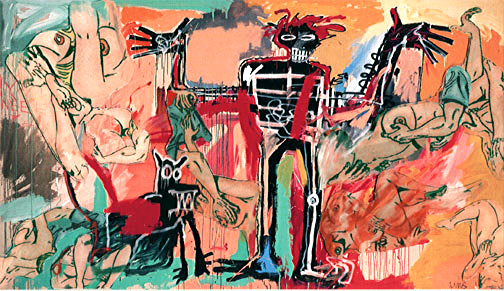
In just seven years as a practicing artist, Jean-Michel Basquiat produced over 2,000 works and made himself enormous amounts of money, gaining praise and notoriety as the defining artist of the early to mid-1980s. In Tamra Davis's absorbing new documentary, the layers of his legacy are examined and carefully demystified, from his shadowy beginnings as a graffiti artist known only (at that time) as "SAMO" to the height of his fame as a painter whose gallery sales commanded huge sums, through his final sad years, marked by drug use, paranoia, and withdrawal from public life. Basquiat emerges as a fascinating and complicated human being, somewhat de-romanticized by Davis, and made difficult through discussion of his less charming qualities, but whose accomplishments as an artist continue to bloom as new angles of interest and significance in his work come to light.
Davis opens her film with never-before-seen interview footage of Basquiat that she and a friend shot about two years before the artist's death. In this footage, Basquiat speaks openly and frankly about himself, his work, his peers, and his critics. He comes off as mildly uncomfortable, even though this was essentially a private video made with friends. He doesn't relish discussing his work, and betrays a certain amount of bitterness about his position in the art world. Although a success - even a sensation - in his own time, there was a sense amid the media frenzy over the artist and his work that Basquiat was an oddity, a "special case," coddled by the liberal art world establishment, a situation specifically highlighted by the otherwise clueless Hilton Kramer in archival interview footage. But Basquiat seemed aware of this, and that, beyond the perceived value of his art itself, there were those around him who benefitted socially and financially from turning him into a celebrity.
More than two decades after his death, Basquiat is broadly regarded as one of the most influential artists in recent memory, if not the entire twentieth century. His colorful, semi-abstract expressionist paintings feature recurring, recognizable motifs that stem from Basquiat's interest in politics, social justice, jazz music, Black American history, and human anatomy, all interwoven with painted text. Basquiat is famous for having become close with Andy Warhol during the Pop Art pioneer's final years; Warhol died at a time when their relationship had become strained over the famous failure of their collaborative exhibition. Warhol's unexpected death prevented Basquiat from reconnecting with his dear friend and was a contributing factor in Basquiat's own decline immediately thereafter.
Davis does an excellent job of untangling Basquiat's considerable legacy from the distancing threads of mythologizing, politicizing, hype-making, and romanticizing that occurred both during the artist's life and afterward. Davis shows us Basquiat at work in his studio, a precocious and intelligent artist capable of tapping into deep mental and emotional resources, a keen awareness of history, and a voracious consumption of cultural produce. His paintings are far removed from the crass, commercially-minded hoopla orchestrated to "sell" the artist to the public by his handlers and the media; the irony is that the prices fetched by his paintings are far more a result of this "inside sales" work by gallerists and dealers than they are a product of the artist's own self-promotion, and yet those prices are exactly the evidence used by Basquiat's critics to discredit him as a mere media celebrity. But Basquiat worked alone and was furiously productive; he worked to sell, it's true, but his paintings are remarkably consistent. His vision rarely falters into simplicity or bears any other traces of having been compromised for the sake of speed and income.
Davis includes new interviews with many of Basquiat's contemporaries, including artists Julian Schnabel, Kenny Scharf, and Al Diaz (Basquiat's SAMO partner); gallerists and dealers like Gagosian and Bischofberger; museum curators, musicians, and a few former girlfriends. Each interviewee provides a slightly different perspective, and there is a clear divide in the tone of the comments by those who had a professional interest in the artist and those whose interest was simply personal. Davis's own interview footage from 1986 shows that the artist was well aware that he meant something different to many different people. (That footage also affords a new level of appreciation for Jeffrey Wright's performance as the artist in Schnabel's 1998 biopic; it's pitch-perfect mimicry operating at a very deep level of comprehension.)
The DVD
Image
New Video's Arthouse Films label continues to distribute compelling, unique films with good presentation. The enhanced 1.78:1 transfer is very strong, with excellent contrast and solidity. Digital artifacts are minimal, even in the older footage, some of which has been carefully cropped to retain some sense of compositional integrity. Colors are rich and dense. A good transfer all around.
Sound
The stereo soundtrack is about what you would expect. It's perfectly competent work that makes good use of period music, including a track or two by the band Basquiat joined in the early part of his career, Gray. Other well-chosen songs by The Velvet Underground, Dizzy Gillespie, and Charlie Parker are highlighted pleasantly and given room to breathe on the soundtrack.
Bonus Content
The only bonus feature is a half-hour interview with filmmaker Tamra Davis, who first met Basquiat while he was in residence at the LA studio obtained for him by Larry Gagosian, and while Davis was still in film school. She shares a lot of personal memories as well as some thoughts as to what compelled her to make the documentary. It's well worth a look.
Final Thoughts
Tamra Davis does an outstanding job separating the man from the hype in Jean-Michel Basquiat: The Radiant Child. This immersive portrait of the American art scene during the 1980s is necessary viewing, particularly for anyone interested in the creative arts. Highly recommended.
|




| Popular Reviews |
| Sponsored Links |
|
|
| Sponsored Links |
|
|
| Release List | Reviews | Shop | Newsletter | Forum | DVD Giveaways | Blu-Ray | Advertise |
|
Copyright 2024 DVDTalk.com All Rights Reserved. Legal Info, Privacy Policy, Terms of Use,
Manage Preferences,
Your Privacy Choices 
| |||||||