
| Reviews & Columns |
|
Reviews DVD TV on DVD Blu-ray 4K UHD International DVDs In Theaters Reviews by Studio Video Games Features Collector Series DVDs Easter Egg Database Interviews DVD Talk Radio Feature Articles Columns Anime Talk DVD Savant Horror DVDs The M.O.D. Squad Art House HD Talk Silent DVD
|
 DVD Talk Forum |
|
|
| Resources |
|
DVD Price Search Customer Service #'s RCE Info Links |
|
Columns
  


 
|
|
|
Mademoiselle Chambon
Lorber // Unrated // December 7, 2010
List Price: $29.95 [Buy now and save at Amazon]
From the very beginning of this film you become almost instantly aware that you are about to view something slowly paced. We find our lead character, Jean, (who is a builder who works on constructing houses) drilling away while working his seemingly dull and repetitive job. The camera stays with this for several minutes. I wanted to mention this right off the bat because knowing this could make you want to avoid this film, which could probably be viewed, at least on some basic level, as an antithesis to works from Michael Bay (the master of films that lack in subtlety). Mademoiselle Chambon is certainly lacking in adrenaline (i.e. explosions) or even sweeping camera movements.
However, while this film is rich in subtlety, the story you'll find is a simple one. Perhaps it is even too simple. Jean (Vincent Lindon) is an average man who works to provide for his family. He is married and has one young son. In an early scene we see him struggle to understand some homework given to his child so we know from that moment forward that he is not simply working construction because of a love for it. He seems depressed in most scenes, but also seemingly happy enough in others when in the company of his family. Then one day he meets Mademoiselle Chambon (Sandrine Kiberlain), who is a new teacher at the school his son attends. She converses with him as he picks up his child and they begin a slight flirtation. The rest of the film focuses primarily on that flirtation, its growth and continuation, and in looking at the psyche of these two characters, without letting us in on what they are specifically thinking in any given moment. Can a relationship brew between them? If so, wouldn't that be going against the conventions of what we can accept as a society? The movie asks us to look at the possibility of a possible romance brewing between these two people. We know that they should not be together based upon things like career backgrounds, personality differences, and the fact that the man in this scenario already has a family. Yet the film wants us to pause and ask "What if they could be together?"
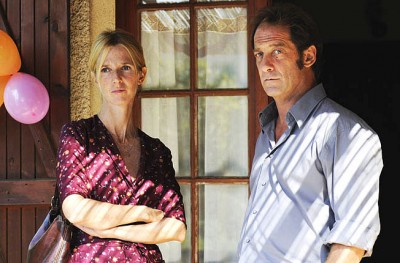
With a weaker cast this movie would self-collapse almost instantaneously. We are expected to sympathize with characters who want a romantic bond to flourish between one another despite issues that should easily prevent such a thing from ever happening. As an audience member, it can sometimes be hard to accept such behavior when one considers the family background of Jean, and it leaves no small task to the actors to make us connect emotionally to the story being told. This is where I left the film feeling somewhat disappointed. It was beautifully filmed. The actors did a good job of trying to portray the complexity of their emotions. The foundations of the story provoked a wide range of thoughts, leaving room for discussion, and encouraging interpretation. I just could not connect to these characters, which is an important point, and a huge detractor.
While the pacing was slow, it was the result of a film-maker working with a genuine artistic passion to capture the emotional complexities of Jean and Mademoiselle Chambon. This correlates with one thing I did also appreciate about the film: it was willing to take chances with its style and hope that the audience would still be there to appreciate those risks.
None of these superior qualities can quite guarantee enjoyment of this film though. By the time the final frame flashed before my eyes I simply felt a cold sense of detachment from the conclusion I had just witnessed. I never did connect to these characters. I never felt as though I had an opportunity to truly get to know them. The most I learned was that they are sad and lonely people living separate lives, and who both shared a bond over music while cautiously flirting and leaving important things left unsaid. Their bond was a silent one. It was as though words were not necessary to express their love. Or was it love from both of them?
It's just too bad that I felt coldness as the credits rolled. I can hardly suspect the film-maker's intent was for that.
The DVD:
The film is presented in its original French language with a 5.1 Dolby Digital surround track. The clarity was strong and there were some good uses of the surrounds for the music in the film. Just remember that this was a low budget drama and keep your expectations in check. There are few uses of the surrounds for special effects, but the audio is somewhat enveloping. Certainly, this was more impressive than I was necessarily expecting. The English subtitles are optional and can be turned on or off.
Video:
Presented in its original theatrical exhibition ratio of 2:35:1, viewers will be glad to know the DVD transfer does not disappoint. It is a strong transfer that manages to capture the somewhat bleak yet beautiful photography employed with the film. It does not appear to have any noticeable video manipulations, and is all the better for it. This film never gives off the impression of being a high budget production. However, it should be true to the source and not much better could be done with that without viewing the Blu-ray edition (also available by Lorber Films).
Extras:
 | I must admit to being even more impressed by the included extras than by the film itself. While you won't find any extensive making of materials or even an audio commentary track, the material that is included is very informative and for anyone who viewed this film, it should be fascinating to fully explore. Regardless of one's opinion on the movie itself, the director will make you interested in his thought process behind putting it all together. In the Interview with Director Stephane Brize, an unseen interviewer questions many of his stylistic and content choices made in the film. Brize answers these questions with grace and surprising honesty. I learned a lot about the history of how the film came into existence, and what specifically inspired its creation and how this relates to his motivation. The book the film is based upon is also discussed in relation to the differences between the two versions and the author's response to the screenplay. If you ever were annoyed by a director who wasn't willing to say he had some regrets, you won't find that kind of man on display here. We learn what he is proud of and what he may have regretted doing with the editing and narrative force of the film, and it gave me a greater appreciation for the work put into Mademoiselle Chambon. Some interesting facts about the success of the film are also shared. Another good extra is a re-edited and compiled series of deleted scenes the director wanted to rearrange and mix together into a sort of "short film". It's not really sound in narrative, but in the context of viewing the film and this bonus it does give a better grasp on some of the ideas he had considered pursing as a filmmaker. This extra has a special introduction by film critic Stephane Goudet. Lastly, to round up the extras we get some stills from the film that can be clicked through, the theatrical trailer and a handful of trailers for other Lorber Films releases. |
Neil Lumbard is a lifelong fan of cinema. He aspires to make movies and has written two screenplays on spec. He loves writing, and currently does in Texas.
|



| Popular Reviews |
| Sponsored Links |
|
|
| Sponsored Links |
|
|
| Release List | Reviews | Shop | Newsletter | Forum | DVD Giveaways | Blu-Ray | Advertise |
|
Copyright 2024 DVDTalk.com All Rights Reserved. Legal Info, Privacy Policy, Terms of Use,
Manage Preferences,
Your Privacy Choices 
| |||||||