
| Reviews & Columns |
|
Reviews DVD TV on DVD Blu-ray 4K UHD International DVDs In Theaters Reviews by Studio Video Games Features Collector Series DVDs Easter Egg Database Interviews DVD Talk Radio Feature Articles Columns Anime Talk DVD Savant Horror DVDs The M.O.D. Squad Art House HD Talk Silent DVD
|
 DVD Talk Forum |
|
|
| Resources |
|
DVD Price Search Customer Service #'s RCE Info Links |
|
Columns
  


 
|
|
|
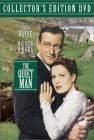
Quiet Man - Collector's Edition, The
This time out, John Ford creates his Irish fantasy world not within an American Cavalry framework, but back in the real Irish countryside. The longish film is a short story opened up to take in much more than a narrative, celebrating an idealized vision of rural Ireland that only the real Irish would know how to criticize.
Mysterious boxer Sean Thornton is revealed to be a reborn-by-conscience pacifist in the film's big flashback reveal, but the real mystery is how such a sweet & civilized John Wayne could ever have fought in the ring. Even in the stunningly-filmed flashbacks, he seems too much of a softie. The film, of course, gets its basic tension by making all the kids in the audience wait for the Duke to finally stop acting so prissy and hit somebody. It's a cheap device, that works 100%. John Wayne is often listed as giving his best performance here, and it's possibly true, as his Sean is smooth, thoughtful, and restrained in a way Wayne characters seldom were. He's also the patient straight man for a couple of dozen colorful characters, and handles the job with disctinction.
Maureen O'Hara is still the great beauty and has energy and personality to spare. An authentic Irish Colleen, she was always the perfect movie mate for Wayne, and played with him often enough for America to assume they were married. She's a sexy, argumentative mule, forcing Sean to prove her love to him by fulfilling a ritual-like Dowry arrangement that to her represents the institution of marriage. It's a credible-enough device, even though it does put her love for Sean on a strange footing, rite first, and mate second. It nicely represents any cultural barrier between mates of different backgrounds.
What Ford obviously had the time of life doing, was taking a huge vacation in the land of his ancestry and filling a movie with the broadest, most endearing stereotypes of Irishmen ever seen. I'd think real Irish people wouldn't know whether to be flattered or offended by the film. There's Ward Bond's earthy Father Lonergan, fanatic about his fishing and solicitous in his attentions to everyone's private problems - even Mrs. Thornton brings her bedroom predicaments to him, which in essence is like telling them to the whole village. Lonergan, knowing the protestants have a practically non-existent congregation in this Catholic parish, gets all the locals to form a parade route when the protestant churchman's superior visits, as a friendly gesture. If only real life in Ireland were like this.
Barry Fitzgerald's Michaleen Flynn is wonderfully funny as a guide and a chaperone ("No, pitty-pat, if you please!"), and his astonishment at the sight of the Thornton's broken bed is priceless. More in line with Ford's usual knockabout slapstick drinkin' & brawlin' M.O. is Victor McLaglen's broad Red Danaher, who might as well be the villain in a Charlie Chaplin film. I'm amused by his boorish antics, but they're the basic strain in Ford that's pooh-poohed by critics who accuse the director of populist pandering.
Ford's semi-comic sagas of fighting and boozing were just comedy to him, but as a kid we took it all as how you were supposed to behave when you grew up, at least until we discovered that alchohol was basically poison, and getting hit hurt. Having a chair broken over your head, or even being punched a few times, is more likely to kill a person than make them make funny Popeye faces. Ford's drinkers weren't any more irresponsible than anybody else's films in Hollywood, but the carefree way the actors sling those shot-glasses around while spilling whiskey all over the bar is mighty attractive, manly-behavior wise. In the bar where people are always singing, getting drunk and threatening to fight, Ford's slyest joke is to have two English gentlemen quietly reading, oblivious to all the life & excitement around them.
In the cast, I like to see the little-known but marvelous Jack MacGowran (Lord Jim, Cul-de-Sac, The Fearless Vampire Killers, The Exorcist) as Red Danahaer's sniveling cohort. That said, all the bits appear to be filled by relatives of Ford, Wayne, and O'Hara. O'Hara's brother, Charles FitzSimons, later became notorious for producing Sam Peckinpah's semi-lost (at least in a decent version) first western, The Deadly Companions. If I'm not mistaken, the screenwriter is Ford's son in law - since he later wrote The Searchers, I suppose we have Ford's daughter to thank for not falling in love with a talentless hack, and spoiling film history.
Many people take Ford's straight-on directing style, with scenes composed in masters and coverage that often resembles a silent film, as evidence of his petrification. Baloney. He's just direct and unfussy, isn't afraid to let the scene be what it is. He likes to see acting play out in uninterrupted wider masters, as opposed to bits of closeup coverage that rob the scene of context. He doesn't mind letting his exteriors embrace postcard-pretty scenics either. When he's after a strong cinematic effect, he gets it. If he'd been bouncing the camera all over the place looking for dynamic ways to shoot each scene (like many of today's showoffs), he not only would be getting his camera in the way of the story, but when he wanted to make a stylistic change, as with the boxing flashback, there'd be no contrast. Closeups in Ford count for something; even a showy director like Orson Welles admired Ford's restraint and economy.
Perhaps Ford was a big cornball, but critics often don't realize that the comedy in shows like The Quiet Man were meant to be tongue-in-cheek. Taken as a Popeye cartoon, the setpiece where Sean finally cuts loose and drags his wife back from the train station, to begin a cross-country marathon donnybrook with his ox-like brother-in-law, is extremely effective, and very funny. Everybody gets what they want: Mary Kate her dowry and self-respect, Red a brother-in-law (punch somebody out, you're an okay guy, it's a Hollywood law), and Sean finally gets to sleep with his wife. It's a fairly sexy ending, for this family film to be so cute (too cute?) about the couple rushing back to their cottage. The film ends with Ford's multiple farewell filmic curtain call, something he repeated in many of his emotional pictures, not just the ones in Blarney-Rama. Critics who think he's corny should lighten up; he's just acknowledging the theatrical artifice of his style.
Artisan's DVD of The Quiet Man is going to be a disappointment to many Ford fans. The picture quality is only mediocre, not because the DVD producers encoded it poorly, but because the title really needs an expensive major restoration. Shot in 3-strip Technicolor, the technology exists to remaster the three original strips (assuming they exist in acceptable shape) and recomposite them either on film, the old way, or digitally, as is slowy being done with a few prestigious titles at studios like Fox or Turner. Instead (I'm partially guessing here) the best available previously-combined, composite Eastman negative of the film was used. Transferred to tape, it isn't terrible, but the colors are all a bit bleary, and the image looks soft, with frequent slight misregistration errors that futz-up many shots.
This wouldn't be such a major disappointment if The Quiet Man weren't so dependent on astonishing color for its effect. The saturated greens are part of the film's appeal, the equal of the reddish deserts in Lawrence of Arabia. Back in film school (here we go again) cinematographer Winton Hoch came to UCLA to show us an original Tech print, which was so gorgeous that any reservations we had about the content of the picture became secondary. Unfortunately, the economics of so-called restoration don't do much good for hundreds of interesting color movies, not just classics like The Quiet Man, that can't be seen in their true beauty any more, and may never be.
Artisan's Collectors Edition DVD has a long list of extras, including the requisite Leonard Maltin docu. Maltin has become the most visible host for classic films from Disney and others, but his comments are so 'safe' and generalized that he's in danger of losing his identity as a critic. Maltin's opinions in print are usually interesting - here he's just a paid spokesman for the corporation. The Quiet Man has enough interesting facts to relate, that an adequate picture of the show is painted for casual interest.
The second docu, The Joy of Ireland, is dominated by a very forceful Maureen O'Hara, who clearly has a prideful stake in the film and covers much of the same ground from her personal point of view. She tells several anecdotes that allow us to glean the idea that Ford was a cantankerous, manipulative and emotionally sadistic director who chose people on the set to ridicule and demean, and was the absolute command center of a huge family-business-artistic enterprise. It's hard to know who would have fun spending a summer in Ireland under such a domineering boss, and who wouldn't. I'm not making any case that Ford was a monster, it's just that there's so much reverence toward him, it's impossible to put together any kind of picture of the man, who must have been a private guy with a business persona like any other important director.
O'Hara is charming, but her show is allowed to go on too long, even letting her re-recite all her Gaelic lines in the film. It's not bad, exactly, but there is an issue of editorial control. If Ms. O'Hara herself were editing a transcript of her recollections, I think even she would cut her remarks down some.
Artisan has very generously included a mono original audio track, in addition to a remastered 'enhanced' track.
On a scale of Excellent, Good, Fair, and Poor, The Quiet Man rates:
Movie: Excellent
Video: Fair
Sound: Good
Supplements: docus, remastered audio tracks, trailers
Packaging: Keep case inside identically-printed outer card sleeve.
Reviewed: October 28, 2002
| |
|



| Popular Reviews |
| Sponsored Links |
|
|
| Sponsored Links |
|
|
| Release List | Reviews | Shop | Newsletter | Forum | DVD Giveaways | Blu-Ray | Advertise |
|
Copyright 2024 DVDTalk.com All Rights Reserved. Legal Info, Privacy Policy, Terms of Use,
Manage Preferences,
Your Privacy Choices 
| |||||||