
| Reviews & Columns |
|
Reviews DVD TV on DVD Blu-ray 4K UHD International DVDs In Theaters Reviews by Studio Video Games Features Collector Series DVDs Easter Egg Database Interviews DVD Talk Radio Feature Articles Columns Anime Talk DVD Savant Horror DVDs The M.O.D. Squad Art House HD Talk Silent DVD
|
 DVD Talk Forum |
|
|
| Resources |
|
DVD Price Search Customer Service #'s RCE Info Links |
|
Columns
  


 
|
|
|
Agatha Christie's Poirot - Movie Collection Set 6
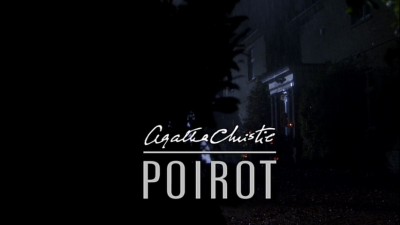
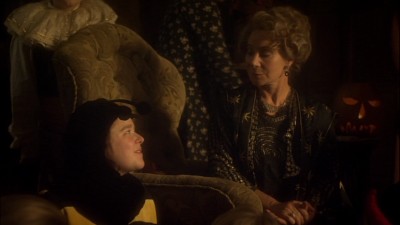
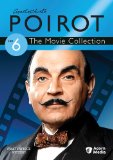
Agatha Christie's Poirot began production as a series in 1989 and there has been to this day a combination of over 60 episodes and TV movies. This represents a major accomplishment. Poirot has been one of the most popular detectives of all time in literature and it makes a great degree of sense that he should be successfully adapted by gifted film-makers as well. For Hercule Poirot is truly a great detective! The Movie Collection: Set 6, herein reviewed, contains the following three films: Three Act Tragedy, The Clocks, and Hallowe'en Party.
Agatha Christie is highly regarded as one of the greatest mystery writers our world has ever been blessed to know and her writing has a massive following to this day. All around the world there is an audience still waiting to discover the mystery gems she delivered again and again. The best option to discover her brilliance may be to pick up one of her books with a willingness and readiness to absorb her words as brilliant poetry.
Another option might be to watch some of these wonderful adaptations that have appeared on Masterpiece Mystery! (which is an ongoing series that collects various mystery programs to air on PBS). One of the greatest things about these stories is that they tend to work on such an exquisite standalone level that the films presented on this box-set release represent a great place for newcomers to get started. Each film could definitely be enjoyed by those who are unfamiliar with other Poirot mysteries. Certain details may be left untouched, such as the reappearance and shifting friendship - if one can truly call it that -- between crime novelist Ariadne Oliver (Zoe Wanamaker) and Poirot in the Hallowe'en Party. For the most part these are the kinds of details that won't even negatively affect the experience (if one isn't familiar). The standalone mysteries themselves and the incredible wit and skill of Poirot keep the stories interesting without fail.
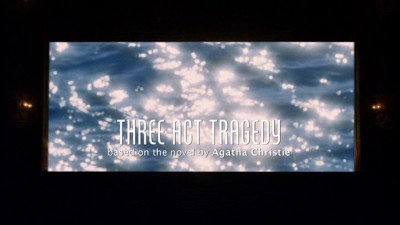
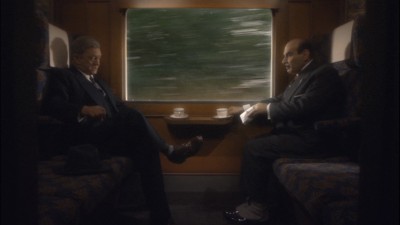
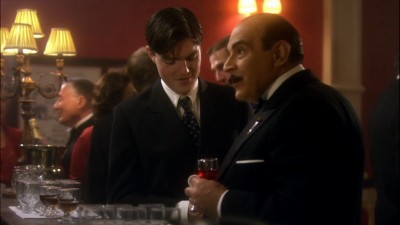
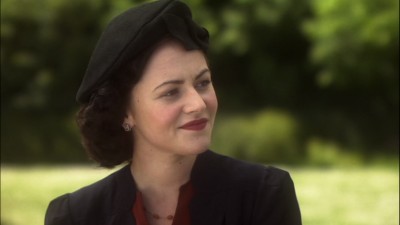
Three Act Tragedy begins by focusing on the seemingly strange death of a guest at a dinner party. The guest who died was elderly and many of the other guests assumed the death was a result of age. Evidence also suggested that the guest had simply passed away untimely. Yet when another person dies similarly (with the same group of guests at a different party) Poirot then agrees to help Sir Charles Cartwright (Martin Shaw) in solving the mystery and uncovering the truth. This was perhaps the greatest of the three mysteries. It was certainly the one I found the most "fun" to try and solve. There is also a nice little twist of sorts at the end (which is surprisingly well done). The twist won't be easy to spot either (so viewers might not want to even try - but I'm betting most will want to anyway as mystery fans).
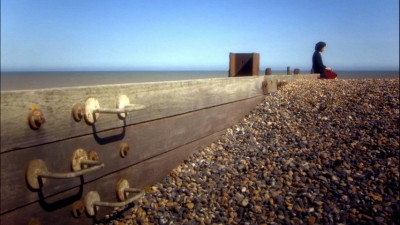
The Clocks was the most lavishly presented production of the three movies. It focuses on a mystery surrounding an unknown person found dead in the home of a blind woman. The top suspect is a young woman seen fleeing from the house (but in apparent surprise of finding the body). There is also a strange connection to four clocks that were stopped with identical times. Poirot must make a visit to Dover to question the neighbors and suspect, but he thinks there might be an easier way to solve the mystery of the crime. This is one of the more complicated mysteries of the films included on this release (not necessarily because of solving it but in the way in which the story and plot-threads weave together).
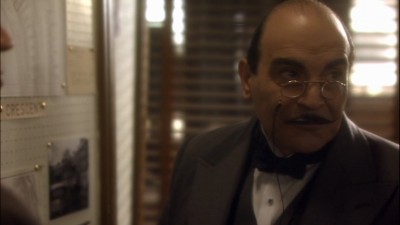
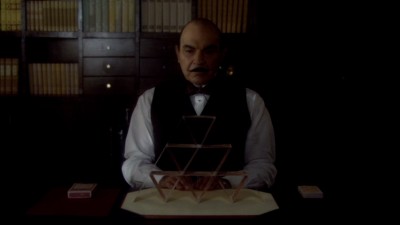
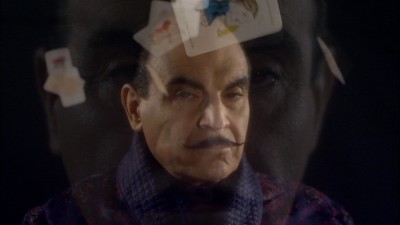
The best thing about these television episodes and movies is the perfection that is David Suchet as Hercule Poirot. This gifted actor can fully embody the character by presenting those various quirks and mannerisms that are so distinctly true to the character Poirot. Indeed, it is difficult to even imagine other performers in the role now to some extent (despite the fact that there have been other interpretations from performers).
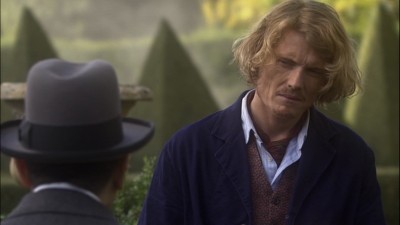
The production elements that represent each film are surprisingly impressive and exceeded my expectations. Early episodes of the Poirot series look less vivid in cinematography which prevented some of the finer elements on display from feeling quite as thoroughly realized. Productions in recent years almost seem to go above and beyond. The make-up, costumes, sets, and locations may be typically well done and never fail to impress and yet the added benefit of greater camerawork with stronger (more lively) cinematography makes all the difference. These elements seem much more visually impressive and it ultimately comes down to the way in which the series is now filmed and presented. It's significantly more fulfilling to experience these stories that way. The direction and screenwriting remains a gloriously satisfying part of the equation.
Please note that the three included made-for-TV films are presented out of order on this release as the films premiered in a different sequence. Viewing them out of order won't make any difference in the experience storytelling-wise but I'm sure this information will still be useful to those who would rather experience them in the order in which they aired on television.
The correct viewing order is: The Clocks, Three Act Tragedy, Hallowe'en Party.
The DVD:
Video:
The picture quality is impressive enough that the often stunning production elements are able to shine through on this fine release. Each film is presented in the original broadcast aspect ratio 1:78:1 (with anamorphic widescreen enhancement). The often lush sceneries and detailed sets or costumes look appropriately beautiful. The set isn't perfect though as the productions tend to appear somewhat soft. It appears as though this is likely due to the original source. The black levels featured on these productions are pretty strong as well. Not perfect -- but certainly complimentary to the rest of the color palette.
Audio:
The included audio is presented in stereo for this English language British series. The series presents the dialogue with crisp and clear clarity that is easy to distinguish and serves the series presentation well enough. The musical score also sounds rather lovely on these discs and manages to make an impression despite the 2.0 audio. This is not a series where a 5.1 surround sound track would seem entirely necessary. English subtitles are provided for the deaf and hard of hearing.
Extras:
It remains a mystery as to why this Agatha Christie Poirot: Movie Collection set doesn't include any extras at all. Bummer!
Final Thoughts:
This DVD collection of three Poirot films (as aired on PBS's Masterpiece Mystery!) is worth a look for longtime devotee and newcomers alike. Each mystery is considerably engaging and the films are extremely well made. David Suchet remains a perfect Poirot. The PQ/AQ is solid (if never stellar) but the lack of any bonus materials is certainly a disappointment. Despite a few minor release shortcomings this is an amazing collection due to the high quality of the films included. Highly Recommended.
Neil Lumbard is a lifelong fan of cinema. He aspires to make movies and has written two screenplays on spec. He loves writing, and currently does in Texas.
|



| Popular Reviews |
| Sponsored Links |
|
|
| Sponsored Links |
|
|
| Release List | Reviews | Shop | Newsletter | Forum | DVD Giveaways | Blu-Ray | Advertise |
|
Copyright 2024 DVDTalk.com All Rights Reserved. Legal Info, Privacy Policy, Terms of Use,
Manage Preferences,
Your Privacy Choices 
| |||||||