
| Reviews & Columns |
|
Reviews DVD TV on DVD Blu-ray 4K UHD International DVDs In Theaters Reviews by Studio Video Games Features Collector Series DVDs Easter Egg Database Interviews DVD Talk Radio Feature Articles Columns Anime Talk DVD Savant Horror DVDs The M.O.D. Squad Art House HD Talk Silent DVD
|
 DVD Talk Forum |
|
|
| Resources |
|
DVD Price Search Customer Service #'s RCE Info Links |
|
Columns
  


 
|
|
|
Wild and Weird - The Alloy Orchestra Plays 14 Fascinating and Innovative Films 1902 - 1965
Flicker Alley // PG // July 5, 2011
List Price: $29.95 [Buy now and save at Amazon]
The Shorts:
Over the last decade or so, there have been several very talented people and musical groups who have revitalized the art of making music for silent films. One of my favorites, the Mont Alto Motion Picture Orchestra, uses antique cue sheets to recreate the music that could have been played nearly a century ago in theaters while pianist Steven Horne creates new pieces that are incredibly entertaining. On the other end of the spectrum are The Alloy Orchestra, a group of musicians who eschew the classic methods and instruments and creates original compositions that are synthesizer-heavy and feature 'found junk' percussion. Flicker Alley, a company that continues to put out high quality DVDs of silent films, has just released a disc that showcases just what the Alloy Orchestra can do to a film on Wild and Weird: The Alloy Orchestra plays 14 Fascinating and Innovative Films. This 2 hour + DVD features some great shorts, and fans of the Alloy Orchestra's approach will surely enjoy the entire presentation.
First off, I have to admit that I'm not a huge fan of the Alloy Orchestra's scores. I've seen them perform live on two occasions and have heard their scores on DVDs, and I'll be the first to admit that the performers in this trio are all very talented musicians. The problem I have with their approach is that hearing a synthesizer while a film from the 1920's pulls me out of the moment. I start thinking "those are sounds that the director and actors couldn't have imagined would ever be played over this movie" and that lessen the whole experience. To my mind, the perfect silent movie score is one that accents the emotion and action on the screen, without being overbearing and intrusive. I don't feel that the Alloy Orchestra pulls this off on some of their scores.
They work best on experimental or surrealist films (I also heard them accompany Metropolis, and their music for the underground scenes that showed the masses laboring was phenomenal) and that's largely what this collection contains, and consequently I was very happy with the presentation as a whole. While there were a few shorts that didn't work as well as the others, in general their accompaniment wasn't bad.
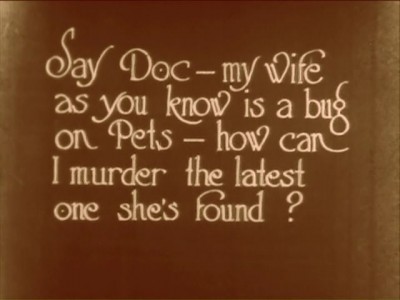
One thing that really adds a sense of fun to this disc is the slides. In between the shorts there are hand-colors glass slides that were originally shown in the silent era. They admonish women to take off their hats and men not to spit on the floor, as well as thank the patrons for coming.
The movies themselves are excellent, and I'll start with some of the high points. The film that works best with the Alloy Orchestras style is easily Filmstudie (1926) created by the Dadaist filmmaker Hans Richter. The film is a series of images; moving shapes and angles. It doesn't try to tell a story or have a narrative; rather it is a work of abstract art. The Alloy Orchestra's score is equally abstract with poetry by fellow Dadaist Hugo Ball being read in the background in some parts and odd sounds melding with the strange images on the screen. This is one example where the music really compliments the visuals.
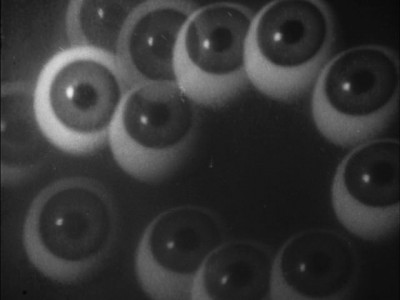
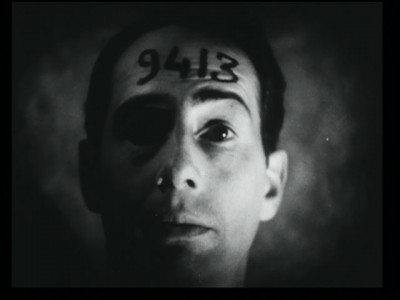
The Life and Death of 9413, a
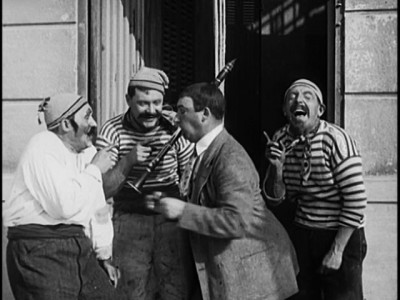
Other fun shorts include Dream of a Rarebit Fiend: The Pet (1921) made by Windsor McCay from his comic strip of the same name, The Thieving Hand (1908) a surrealist romp about a man who gets a used arm that causes him trouble, and Artheme Swallows His Clarinet (1912) a bizarre comedy that is presented here in its complete form (for the first time I believe a second copy was found not too long ago with included the ending).
The collection includes the following shorts:
Those Awful Hats
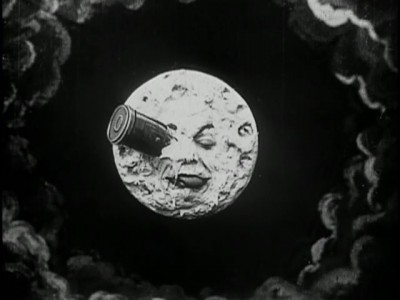
A Trip to the Moon
Dream of a Rarebit Fiend (Edwin S. Porter)
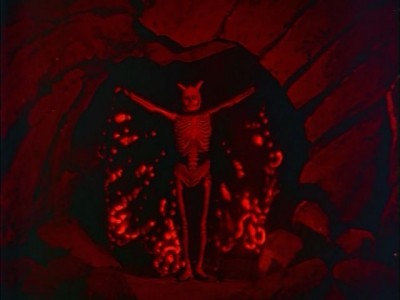
Red Spectre
The Acrobatic Fly
The Thieving Hand
Princess Nicotine, or The Smoke Fairy
Artheme Swallows His Clarinet
The Cameraman's Revenge
Dream of a Rarebit Fiend: The Pet (Winsor McCay)
The Playhouse
Filmstudie
The Life and Death of 9413, a
Clay, or the Origin of Species (Eliot Noyes, Jr.) - this last film is a student movie from 1965 that was nominated for an Academy Award. The short was originally released with a nonsyched jazz score. That is replaced on this disc with new music created by the Alloy Orchestra. I wish the original score had also been included, but it wasn't.
The DVD:
All fourteen films arrive on one DVD.
Audio:
The sound quality is excellent. Being recently recorded there isn't any background noise or other flaws found in older scores.
Video:
The full frame video varies quite a bit. Some films are excellent, like The Play House, while others are showing their age (McCay's The Pet comes to mind... it's faded and heavily scratched in parts.) Overall the films look like nice copies of unrestored movies from the 20's. Most of them have some scratchs and dirt, and the image can be a little soft at times, but they are all watchable and many shorts look very good.
Extras:
There's a 10 minute featurette included, Alloy Plays Filmstudie. This short docu shows the group recording the soundtrack to the Richter film and has the members of the group discussing how they approached the film how the score was created.
Final Thoughts:
While I'm not the Alloy Orchestra's biggest fan, I have to admit that their accompaniments worked more often than they didn't in this collection. The films themselves are great, and those a few have been released several times on DVD it's nice to have these unique and decidedly of-kilter films all in one place. This set gets a strong Recommendation.
|



| Popular Reviews |
| Sponsored Links |
|
|
| Sponsored Links |
|
|
| Release List | Reviews | Shop | Newsletter | Forum | DVD Giveaways | Blu-Ray | Advertise |
|
Copyright 2024 DVDTalk.com All Rights Reserved. Legal Info, Privacy Policy, Terms of Use,
Manage Preferences,
Your Privacy Choices 
| |||||||