
| Reviews & Columns |
|
Reviews DVD TV on DVD Blu-ray 4K UHD International DVDs In Theaters Reviews by Studio Video Games Features Collector Series DVDs Easter Egg Database Interviews DVD Talk Radio Feature Articles Columns Anime Talk DVD Savant Horror DVDs The M.O.D. Squad Art House HD Talk Silent DVD
|
 DVD Talk Forum |
|
|
| Resources |
|
DVD Price Search Customer Service #'s RCE Info Links |
|
Columns
  


 
|
|
|
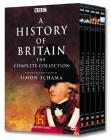
History of Britain - The Complete Collection, A
History: it's the "story" of past events, and in the right hands, it becomes a story indeed, a rich pageant of fascinating characters, tense situations, intrigue, and conflict, all with the added spark that this "story" has its end in the here-and-now. The study of history is more than a list of dates and events: it gives us a look at cultures that in some ways are completely alien and yet are made by human beings just like ourselves, and it shows how key events and people shaped the way the world is today. Simon Schama's A History of Britain offers an exceptional tour of the story of British history from 3000 BC to World War II.
A History of Britain is in many ways the Cosmos of British history; written and narrated by historian Simon Schama, it offers us a guided tour of the subject led by an expert who, like Carl Sagan in Cosmos, is both enthusiastic about his topic and able to talk about it in a captivating manner. The fact that Schama himself is both writer and narrator adds a considerable level of authenticity to the presentation. When a documentary is narrated by an actor, it's always in doubt whether the content has been tinkered with for dramatic effect. With Schama on-screen narrating, he's putting himself and his knowledge of the subject in the premiere spot. Apart from the additional confidence this inspires in the accuracy of the material, it also opens the way for the program to have more personality; Schama brings a warm, genuine enthusiasm to the topic. And Schama is excellent as a narrator, with an interesting voice as well as a gift for nice turns of phrase that allow the modern viewer to connect in a meaningful way to the Britons of centuries past.
The fifteen episodes of A History of Britain progress chronologically through British history, but the episodes are more than just slices of the timeline; each has an overall theme, articulated in general terms by Schama in the opening segment and elaborated on over the course of the hour. For instance, "Dynasty" (1087-1216) focuses on the internecine struggle among the Norman conquerors of Britain to determine who would rule, resulting in the kingships of Henry II, Richard I (the Lionheart), and John. "Nations" shows how the people of Scotland, Ireland, and Wales voiced Britain's first statements of nationalism and dissent in the face of Edward I's attempts to forge a monolithic English state. "The British Wars" (1603-1649) chronicles the struggle between Charles I and Parliament. "Forces of Nature" (1780-1832) explores the political ideas in the air, and the potential for revolution. "The Empire of Good Intentions" (1830-1925) takes a look at England's ideal of enlightened rule over its subject nations, and how class struggle as well as cultural differences made good intentions turn sour.
Schama centers his narrative on the most important and most interesting elements of each historical period he's talking about; most often this involves focusing on one or two key individuals and the way their reactions and interactions shaped the course of events at that time. More than that, however, Schama teases out the significance of the events he describes, such as "King Death" he explains how the dramatic depopulation of Britain following the Black Death changed the relationship between landlord and workers. History comes to life with multiple facets: what it meant to the people of the time, and what it means for us, today, as the heirs of their society.
A History of Britain is presented in a characteristic style throughout all fifteen episodes. The narrative is accompanied by a wide array of images that support and enrich the content that's being presented: paintings, manuscript pages, archaeological finds, and photographs are used extensively throughout all the ages of British history. From the stone tools of Neolithic Britain to the rose gardens of the English sahibs in 19th-century India, these objects give a tangible sense of the reality and substance of the past. Architecture in particular has a starring role, with many examples of buildings from ordinary houses to the palaces of kings; in addition to serving as a visual backdrop, the architecture offers important insights into the symbolism and culture of the period. Re-enactments are used as well, generally in fairly small segments to give flavor rather than to represent an entire event. Often the visual presentation of the reenactments is slightly stylized, which somehow makes it easier to see the scene as a real snippet of history rather than a fiction presented by actors.
More often than using reenactments with live actors, A History of Britain supports the narration with a series of still images from the historical period itself. Tapestries, paintings, monuments, and later photographs show us the key players on the stage of history, and the depiction of "current events" in the media of cloth, stone, and paint let us see these events through the perception of the moment. One of my favorite sequences in A History of Britain appears in "Conquest!", in which the Norman Conquest of 1066 is brought to stunning life with the aid of images from the Bayeaux Tapestry.
A History of Britain is both gloriously ambitious and marvelously successful in reaching its ambitions. Despite the vast span of time covered by the series, it's very well paced. The first episode covers the broadest span of time, a stunning four thousand years; after that, the episodes settle down to a consistent pace of fifty to a hundred years per episode. It's an excellent balance between the larger historical picture and the detail of any given time; at the conclusion of an episode, I found myself feeling both entirely satisfied with what I'd learned and eager to move on to the next to find out what would happen next.
The DVD
Video
A History of Britain isn't a production where high video quality is truly essential, as the central appeal is in the fantastic content. Nonetheless, the video quality is quite good overall. A History of Britain offers an attractive image, with robust colors and a clean print. Some noise and grain appears in the image at times, depending on the source material that's being used, but on the whole it's quite clean and certainly will be pleasing to viewers of the series.
However, there is one distressing problem with the transfer: it's not in the original aspect ratio. Though it doesn't say so anywhere on the packaging, the DVD's 1.33:1 aspect ratio is cut down from the original 1.78:1 widescreen aspect ratio of the series as filmed for BBC. Because it was shown in the 1.33:1 format on U.S. television, the Region 1 DVD edition evidently used the same transfer as for the History Channel broadcast, without bothering to go back for the originals. The framing is well-done, with nothing obviously pan and scanned, but there's no excuse for releasing a film in anything other than its original aspect ratio, and certainly it would have looked better in its original widescreen presentation.
Audio
The audio requirements for A History of Britain are fairly straightforward: above all, clear and distinct presentation of Schama's narration. The DVD handles this responsibility well with its Dolby 2.0 track, presenting Schama's voice, along with the other voiceovers used in the programs, with excellent clarity. The sound is clean and faithful, free of background noise or distortion.
Extras
A History of Britain's fifteen one-hour episodes are spread across five DVDs, which are packaged in individual keepcases inside a sturdy paper slipcase. The menus feature attractively themed background images and easy-to-navigate menus.
The bonus content is fairly limited: biographical and bibliographical information on Simon Schama as well as text biographies on each DVD of key historical figures mentioned in the episodes.
Final thoughts
A History of Britain is a serious documentary, one that assumes an interest on the part of its viewers. Its style is a fundamentally straightforward one; you won't find any flashy MTV-style tricks or hyperbole to "capture" the interest of those who don't care about the subject... which means that it's perfectly suited to a genuinely interested viewer. Schama focuses on the most interesting and significant aspects of each era of Britain's history, and does an outstanding job of both introducing and developing the topics he discusses. For those with little or no familiarity with British history, he provides ample context for the material, fitting each event into the larger picture, and for viewers with some previous knowledge of the subject, Schama's insightful narration brings depth and meaning to these events. Though it is disappointingly not presented in its original widescreen aspect ratio, A History of Britain is a stellar example of documentary filmmaking, and should be in the collection of any viewer with an interest in history or simply an interest in learning new things.
Note: This DVD originally earned a "DVDTalk Collector Series" rating, until I learned that its 1.33:1 aspect ratio is a crop of the original 1.78:1 widescreen image (as seen on British television and the Region 2 DVD). I don't believe that any DVD should receive DVDTalk's highest rating if it's not in its original aspect ratio, so I've reduced the rating to "Highly Recommended." The content is still fantastic, but the transfer was not handled the way it should have been.
|



| Popular Reviews |
| Sponsored Links |
|
|
| Sponsored Links |
|
|
| Release List | Reviews | Shop | Newsletter | Forum | DVD Giveaways | Blu-Ray | Advertise |
|
Copyright 2024 DVDTalk.com All Rights Reserved. Legal Info, Privacy Policy, Terms of Use,
Manage Preferences,
Your Privacy Choices 
| |||||||