
| Reviews & Columns |
|
Reviews DVD TV on DVD Blu-ray 4K UHD International DVDs In Theaters Reviews by Studio Video Games Features Collector Series DVDs Easter Egg Database Interviews DVD Talk Radio Feature Articles Columns Anime Talk DVD Savant Horror DVDs The M.O.D. Squad Art House HD Talk Silent DVD
|
 DVD Talk Forum |
|
|
| Resources |
|
DVD Price Search Customer Service #'s RCE Info Links |
|
Columns
  



 
|
|
|
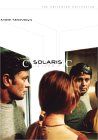
Solaris - Criterion
The Movie
Solaris, directed by Andrei Tarkovsky, is a unusual piece of science fiction that will require multiple viewings and an open mind to understand all that it has to offer. A moody expression of the 1961 work by novelist Stainslaw Lem, a master of the philosophical, moves us carefully in and about the issues of life and death.
Strange happenings have been reported by three scientists onboard a space station orbiting Solaris, a distant planet. Psychologist Kris Kelvin (Donatas Banionis), is sent to investigate. The opening of the nearly 3 hour film is quite slow, setting some groundwork for the rest of the film by establishing its roots on Earth, something not present in the novel. The earth setting is in and about the home of Kelvins father played by Nikolai Grinko. It is here that he learns from his fathers friend Burton (Vladislav Dvorzhetsky) of the mystery surrounding Solaris. Burton, a cosmonaut that orbited the planet years earlier, gives an indication that there is more to the planet than just being covered by water, but the details are left intentionally vague so they can be flush out later in the film.
Kelvin leaves Earth and arrives at the space station to find it in a state of disrepair, a crewman dead that was a personal friend and the remaining two occupants in a state of paranoia. Soon after Kelvin experiences what has been afflicting the crew when a vision of his wife Hari appears. This is quite odd considering she has been dead for over 10 years, but he can talk to her and touch her and she seems real. She knows who she is but does not remember anything about the details of her death. In actuality, Kelvin's wife died by committing suicide and now he is placed in the position of either reliving that horror or being able to do something to prevent it. Is it an illusion or does he really have a chance to change the past?
But as it turns out, Hari is not really Hari, but rather a physical reincarnation of his memory of her. The film is quite deep and moving when she finally realizes what she really is and how she and the crew handle her realization and their own understanding of who they are.
The film was made in the Soviet Union like Tarkovsky's previous two films, but unlike them doesn't deal with the restrictions on the freedoms of his country's people. Instead it deals with the morality of ones feelings and the science that surrounds them. Not tied to any country or culture it explores the nostalgia of earlier times prior to technological achievements expanding our horizons.
DVD
2 disc, RSDL dual-layer.
Video
2.35:1 (Anamorphic).
A beautiful high definition transfer from the folks at Criterion. The transfer is from the 35mm low-contrast print of the original negative. Clean and clear throughout with only a hint of speckling. The colors are solid and strong compared to previous releases on tape with good detail even though the original was soft on purpose. The MTI Digital Restoration System was used to remove thousands of instances of dirt, debris and scratches.
Sound
Dolby Digital 1.0 Mono, Russian with subtitles.
One channel track from a 35mm optical positive track digitally restored. A clean soundtrack results that is very effective and is on par to how the work was originally presented. Mastered at 24-bit, audio restoration tools were used to reduce clicks, pops, hiss and crackle.
Static menu.
Extras
Audio commentary by Tarkovsky scholars Vida Johnson and Graham Petrie.
The walk-through audio commentary by Vida Johnson and Graham Petrie, co-authors of the 1994 book The Films of Andrei Tarkovsky: A Visual Fugue, is a good listen for anyone that wants to really understand the inner workings of Solaris. They know much about the director, the details of the films and the cultural environment in which he worked.
Nine deleted and alternate scenes.
Tarkovsky did some edits, most of which were thought lost. These edits were done before his submission to the Cannes festival. Amazingly, a complete pre-Cannes print of the film was found in the Mosfilm archive, and Criterion presents us with all 9 variations. These pre-edit scenes are not quite the quality of the final edit.
Video Interviews with lead actress Natalya Bondarchuk, cinematographer Vadim Yusov, art director Mikhail Romadin and composer Eduard Artemyev.
A 32-minute interview with Natalya Bondarchuk, who played Hari and was only 19 at the time. She speaks on how she secured the role, what it was like working with Tarkovsky, and the details of her death scene. A 34-minute interview with Vadim Yusov, the film's cinematographer who also worked with Tarkovsky on prior works. Yusov discusses his relationship with Tarkovsky and some thoughts on the films limited special effects. A 17-minute interview with art director Mikhail Romadin, who explains how they wanted to make a science fiction epic. Finally, a 21-minute interview with composer Eduard Artemyev, who discusses his musical score and sound effects. All four interviews are in non-anamorphic 1.33:1.
Documentary excerpt on Stanislaw Lem.
A 5-minute segment from a Polish TV documentary on novelist Stanislaw Lem. It features interviews with Lem and scholars who discuss the novel Solaris and Lem's dislike of Tarkovsky's cinematic version of it.
12-page booklet with essays
Also included is a 12-page insert booklet with liner notes by essayist and novelist Phillip Lopate and a reprint of a 1977 newspaper article titled "Tarkovsky and Solaris" written by Japanese director Akira Kurosawa, who was a great admirer of the film and visited the set during production. It also lists chapters and credits, menu instructions, transfer information and acknowledgments.
Final Thoughts
A complex piece that will show it's true brilliance after repeated viewings to gain the full meaning of what it has to offer. Tarkovsky was a gifted filmmaker that was able to break free of the limitations imposed by the Soviet bureaucracy and create masterpieces that are enjoyed all over the world. If you have the time and patience to pull the full meaning from this work, it will certainly be worth it.
|



| Popular Reviews |
| Sponsored Links |
|
|
| Sponsored Links |
|
|
| Release List | Reviews | Shop | Newsletter | Forum | DVD Giveaways | Blu-Ray | Advertise |
|
Copyright 2024 DVDTalk.com All Rights Reserved. Legal Info, Privacy Policy, Terms of Use,
Manage Preferences,
Your Privacy Choices 
| |||||||