
| Reviews & Columns |
|
Reviews DVD TV on DVD Blu-ray 4K UHD International DVDs In Theaters Reviews by Studio Video Games Features Collector Series DVDs Easter Egg Database Interviews DVD Talk Radio Feature Articles Columns Anime Talk DVD Savant Horror DVDs The M.O.D. Squad Art House HD Talk Silent DVD
|
 DVD Talk Forum |
|
|
| Resources |
|
DVD Price Search Customer Service #'s RCE Info Links |
|
Columns
  


 
|
|
|
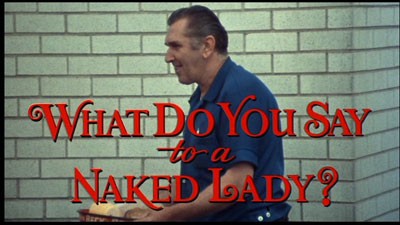
What Do You Say To A Naked Lady?
Shocking cinéma vérité, but not for the reasons you think
Reviewer's Bias*
Loves: The Candid Camera concept
Likes: Allen Funt, Playboy's Candid Camera
Dislikes: So-called reality TV
Hates: Confronting our unenlightened past
The Movie
I remember, in my younger days, sneaking a peek at the Playboy Channel whenever I could. In those days before the invention of always-on pornography, the late-night thrill of Hugh Hefner's TV offerings was a filthy holy grail, full of airbrushed, heavily made-up goddesses who wandered around hazy settings in the nude to soft jazz or light rock, doing exciting things like playing with hoses or stretching. But every now and then, there was something special, a show that mixed two of my favorite things in the world: comedy and naked ladies. It was Allen Funt's Candid Candid Camera and it was very, very good. Men would be shocked to run into beautiful women in the altogether, in otherwise everyday situations, which made the laughs that much more interesting. It's been a long time since I've seen even a clip of the show but my memories of it remain quite vivid.
Little did I know that before gracing my TV in the wee hours of the night, years before I ever graced the Earth, Funt had made a film with this very same concept, the quite literally-named What Do You Say to a Naked Lady? But once I knew, I had to see it, to revisit those memories of yesteryear, and to see where it all started. Yet, surprisingly, this would not turn out to be just some dirty little treasure hunt. Instead, Funt managed to take his interest in the human condition and the reality of how we act when we think no one is looking, and take it to its natural extreme, exploring the most basic part of human life, namely sex. Forcing people to confront an uncomfortable blend of sexuality and public life in front of his camera, he had a perfect draw to put people in the seats.
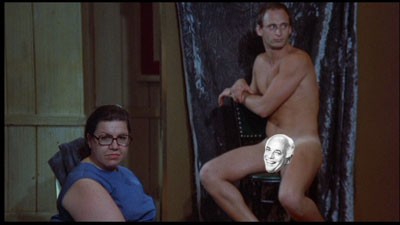
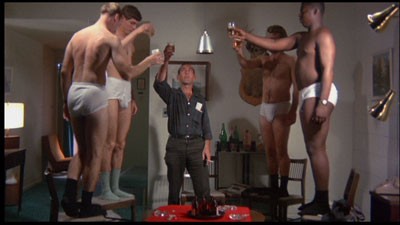
Allen Funt was added simply to allow us to show this picture, which is hilarious to me. He does not appear in this scene in this way, - FR
Things get started with really simple set-ups, like a man waiting for an elevator being confronted by a naked woman when the doors open, or a nude hitchhiker. These are amusing, as the reactions can be great fun, however Funt isn't content with just putting naked women (and men) in front of people and seeing what happens. He continues on, conducting interviews about sex with the young, old and everyone in between, acting like a sociologist with a camera. There are some intriguing experiments, like putting men in a room with four other guys to see how far they will go to fit in, when the other four start stripping without explanation. He also conducts several interviews as well, chatting with a sexually-open woman, teens who brag about their bedroom exploits and (through an intermediary) a bisexual man. Honestly, these more intellectual material ends up more memorable than that based around nudity (though there's plenty to enjoy there as well, including a nude male model who attempts to make women feel uncomfortable with his "presence.")
None of the scenes are as unforgettable though as the two scenes for which WTF was invented far too late. One features Funt as an info-desk worker who asks people what they think when an interracial couple kiss nearby. I'm not naive enough to act like racism doesn't exist or wasn't much worse back in the day, but to see it expressed so freely a) is really disturbing and b) points out how different the world is today (where we keep our racism close to the vest.) The other WTF moment comes courtesy of jingle superstar Steve Karmen, who acts as a musical narrator, throwing in a number of silly songs relating to the scenes. None of them though, are as out there as the old-timey song that accompanies a section titled "A Few Thoughts About Rape." Strap in, kids...this one's a doozy. Here are a few choice lines:
"Rape...is not as easy as it looks,Is it supposed to be sarcastic or ironic? No clue, especially when there's no explanation of the footage it goes with, including men leering at women, a man attempting to rape a woman on a bed with a camera crew or a little person pretending to be a doll in a toy store. Seriously...WTF?
The way you read about in books...from the library."
"Rape...is not as pleasant as it seems,
like all those little childhood dreams...which have long since flown."
In one of the more creative, meta elements of the film, Funt screened the scenes for a private audience, featuring a number of older, highly-opinionated immigrant women, along with a few younger folk, and then braided their reactions into the film. Combine these scenes of old ladies complaining about the film with an old woman trying to separate "dirty" and "clean" words and scenes contrasting how a group of older women and a class of young people react to a nude professor, and it is pretty obvious that Funt is making a point about the generation gap, a major issue of the late '60s, which is part of why the film is such a product of its time. It would be great to have someone try this again and see how things change, but one expects, following Sacha Baron Cohen's exploits, that the lawsuits would prevent us from ever seeing the results.
The DVD
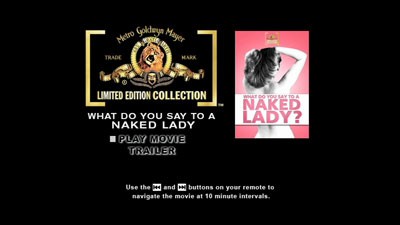
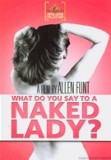
Offered as part of MGM's Limited Edition Collection, this on-demand disc is packed in a standard keepcase, with non-descript disc art and a similar cover art. The DVD has a static, mostly generic menu with options to watch the film and watch the extra. There are no audio options, no subtitles and no closed caption, nor are there any scene selections, with chapter stops every 10 minutes.
The Quality
When the movie starts with a screen saying that the presentation comes from the best possible sources, one's expectations tend to drop like a rock tied to a brick. But there was no need to apologize in this case, as the anamorphic widescreen transfer on this 42-year-old film looks extremely good, full of the kind of saturated color that was a hallmark of this era of movies. Yes, many of the scenes are a bit dark (due to the lack of lighting) and some segments, mainly the darker black-and-white screening room footage, are a bit grainy, but overall, the film is sharp and clean, with no real noticeable issues with digital artifacts and just some occasional dirt and scratches.
Though the visuals may be a bit of an eye-opener, the audio isn't going to surprise anyone, with a very straightforward Dolby Digital 2.0 track that gives you nothing to complain about, as the sound stays clear and distortion-free, especially when it comes to Kamden's melodic music. But don't expect any kind of mixing in this center-focused delivery, nor should you. It's not that kind of movie.
The Extras
The only extra included is the film's theatrical trailer, which looks a bit rough, but it's a welcome inclusion=. If today's trailers leave nothing to the imagination, they learned how to do it here, as you get a full-run down of the film's key points, saving basically only the nudity for the paying customers. Still, it's interesting to see how they tried to sell such a unique and certainly controversial film.
The Bottom Line
As an admitted sucker for hidden-camera hijinks and admirer of the female form, there was a good chance I would enjoy this film, but it's the less-obvious and far more unexpected elements that make it so entertaining to watch, as Funt's interest in societal norms make what could have been exploitative into something genuinely insightful (even if he can get a bit heavy-handed at times. The presentation is mainly no-frills, as one tends to expect from an on-demand release, but the quality is rather high, making it a worthy pick-up for fans of Funt's other work or old-school curiosities.
Francis Rizzo III is a native Long Islander, where he works in academia. In his spare time, he enjoys watching hockey, writing and spending time with his wife, daughter and puppy.Follow him on Twitter
*The Reviewer's Bias section is an attempt to help readers use the review to its best effect. By knowing where the reviewer's biases lie on the film's subject matter, one can read the review with the right mindset.
|



| Popular Reviews |
| Sponsored Links |
|
|
| Sponsored Links |
|
|
| Release List | Reviews | Shop | Newsletter | Forum | DVD Giveaways | Blu-Ray | Advertise |
|
Copyright 2024 DVDTalk.com All Rights Reserved. Legal Info, Privacy Policy, Terms of Use,
Manage Preferences,
Your Privacy Choices 
| |||||||