
| Reviews & Columns |
|
Reviews DVD TV on DVD Blu-ray 4K UHD International DVDs In Theaters Reviews by Studio Video Games Features Collector Series DVDs Easter Egg Database Interviews DVD Talk Radio Feature Articles Columns Anime Talk DVD Savant Horror DVDs The M.O.D. Squad Art House HD Talk Silent DVD
|
 DVD Talk Forum |
|
|
| Resources |
|
DVD Price Search Customer Service #'s RCE Info Links |
|
Columns
  


 
|
|
|
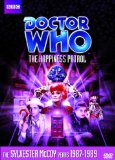
Doctor Who: The Happiness Patrol
BBC Worldwide // Unrated // May 8, 2012
List Price: $24.98 [Buy now and save at Amazon]
The Show:
Why do I watch classic Doctor Who? The special effects are bad, the stories are sometimes silly, and the villains can over act something awful. On top of that, it's a kid's show. Then a story like The Happiness Patrol comes along and I remember why I like the program: when you're least expecting it, the show can be absolutely brilliant. This ironic adventure hits all the right notes with some social commentary that's definitely present but not so overt as to ruin the story, a creature that's so absurd as to be wonderful, and a chance for star Sylverster McCoy to act like a clown and have it fit in perfectly. Going in I wasn't expecting much, but this is a minor masterpiece.
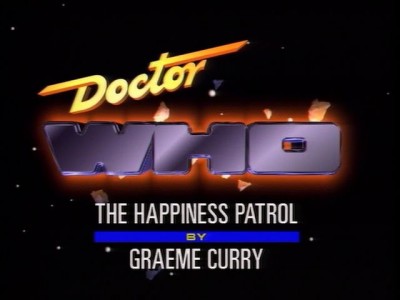
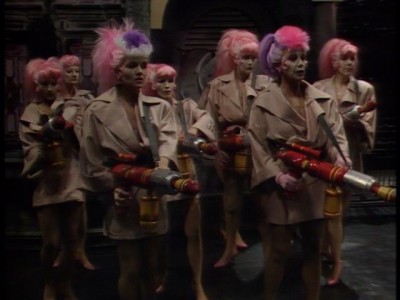
The Doctor and Ace travel to the planet Terra Alpha since the Time Lord has heard some disturbing things about the Earth colony and decided it was time to check them out. They discover a bizarre place, where elevator music (or "lift music" at they refer to it in the show) is playing constantly, piped throughout the capital city by speakers placed on all the buildings. The people seem to only eat candy, and groups of women (it's a matriarchal society) armed with guns search the streets at night looking for "Killjoys" and arrest them. These groups are the Happiness Patrols, and once you've been taken into their custody, it's rare that you're ever seen or heard from again. What is a Killjoy? Someone who is unhappy. On Terra Alpha it's against the law to be sad.
The Doctor soon realizes what's wrong and decides that he and Ace are going to sort things out that very evening. Of course the quickest way to do that is to talk to the leader of the planet, Helen A, but that's not an easy thing to do. He has to avoid the Happiness Patrol first of all, and then there's Helen A's main enforcer, the Kandy Man, a robot made out of candy that is both the head confectioner and the state executioner.
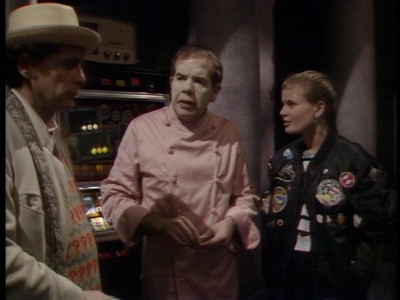
While running around the city and dodging the Happiness Patrol, The Doctor does manage to meet some people who help him on his mission. Chief among them are Earl Sigma, a visiting psychology grad student who was earning money for school by playing the Blues on his harmonica when he got stuck on Terra Alpha, and a bureaucratic galactic census-taker, Trevor Sigma. Together can they really take down the government in one evening?
This is an excellent serial. They were going for something different and it worked magnificently. The social commentary is so relevant that this story is almost subversive. Helen A, who was patterned after Margaret Thatcher, is a leader who will kill her own people and rationalize it because "it's for their own good." She gives them everything they could want, she's built 1000 factories that make candy and pipes music through the city, and all she asks is that they always be happy. I loved the way that cheap music, goods, and entertainment, what we're largely feed today, is supposed to make people not only content but joyful.
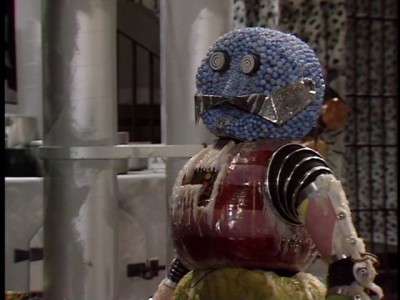
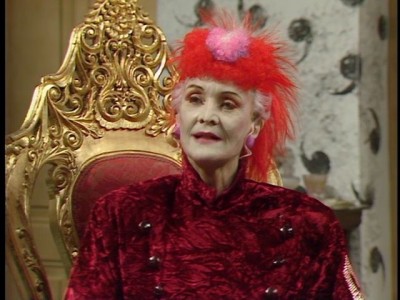
The story is wonderfully ironic too, that's probably what I liked about it the most. Here, for the first time, The Doctor comes to a planet where the people are largely happy and after he's done he's allowed them to be miserable. It's a wonderful turnabout.
I haven't seen all of Sylvester McCoy's tenure as The Doctor, and I've been underwhelmed by what I have seen. Up until now. He did an outstanding job this time around, really bringing the Time Lord to life and making him brilliant and dangerous but still charming and goofy. One of the best scenes occurs in the third episode when The Doctor comes across a pair of snipers that Helen A has sent to kill some protesters. They're talking about guns, and which one is the best, when The Doctor pops up. He's not afraid of them, even though one is pointing his weapon at his chest from only a couple of feet away. As a mater of fact, it's the sniper who is scared. The Doctor isn't resisting or fearful. Instead he's talking about how hard it is to kill someone when they're right in front of you; taking their life when you can see them up close. He finally orders the sniper to look him in the eye and shoot him, and instead the man hands over his gun. It's a powerful scene that McCoy plays wonderfully.
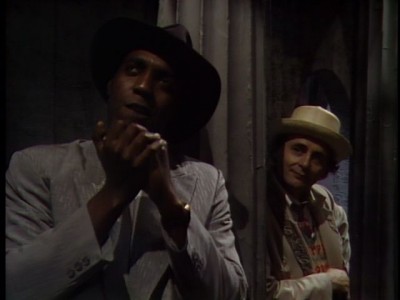
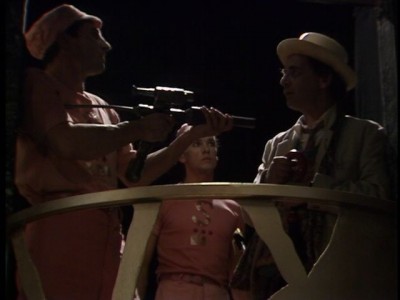
The show was filmed nicely too, well a lot of it was. The 'exterior' scenes were supposed to be at night (the whole serial was filmed on a sound stage) so the lighting was low for once. The director made good use of the shadows and the beginning of the first episode is even filmed in the style of film noir movies. It's too bad that the suits didn't like the effect and told him to stop it. Even so, The Happiness Patrol is a wonderful unexpected treat.
The DVD:
This three-part series arrives on a single DVD.
Audio:
The mono soundtrack is very good. It's clean and clear with no hiss or background noise to take away from the story. The dialog is easy to discern and the background music and effects are never overpowering. Being a mono track, there's really not much more to say about it.
Video:
The full frame video has been cleaned up by the Restoration Team and looks fine. Some scenes are a bit soft, but generally the image is clean and the colors are fine. If you've seen the other restored McCoy era stories, then you'll know what to expect.
Extras:
The BBC does a great job with their releases of classic Doctor Who. What other studio lavishes so much attention on each individual story? Having said that, I do wish that this disc contained a little bit more in the way of bonus features. What's here is good, and more than I would have hoped for had this been any other series besides Doctor Who, but this adventure deserves a two-disc release.
The extras start off with a commentary track with actor Sophie Aldred, writer Graeme Curry, script editor Andrew Cartmel, composer Dominic Glynn and director Chris Clough. The group is moderated by Toby Hadoke, who has the coolest job in the world. It's a nice and lively discussion that covers a lot of topics including the relatively recent uproar about this serial in the
The making-of documentary, Happiness Will Prevail, runs 23 minutes and features the same people who contributed to the commentary track. They discuss the filming and ideas behind the story. It's quite good and I particularly enjoyed hearing writer Graeme Curry discussing how his idea for the Kandy Man changed going from script to screen.
When Worlds Collide is a 45-minute look at the political subtext in Doctor Who and how that's changed over the years. One commentator makes a very astute observation when he points out that the speech Patrick Troughton makes at the end of the Krotons where he chastises a race for being pacifists would have come across very differently if the older William Hartnell had given the same lines as the rumpled counter culture-looking Troughton. There's also an assortment of deleted and extended scenes, running an amazing 23-minutes in all. These weren't all that interesting, unfortunatly. A lot of them were just an extra second or two at the end of a take that didn't make it to the final cut, which doesn't really count in my book. These are worth watching though. There are some extra scenes with Trevor Sigma that add a bit to his story.
The disc also comes with an optional pop up trivia tracks that's filled with information. Some of it is minutia, the date the episodes were filmed and ever the time that the shoots wrapped, but also background info on the supporting and incidental characters and it points out on screen gaffs. These are wonderful. There's also a photo gallery, the Radio Times listings (in .pdf format) and an alternate music track too.
Final Thoughts:
This story is magnificent, a true work of art. But, being art it's subjective and I'm sure a lot of people will dislike it. It's just not the type of entertainment that mainstream audiences enjoy, but I found it amazing. If you're open for something a bit different, I'd really suggest that you give it a try. Highly Recommended.
|



| Popular Reviews |
| Sponsored Links |
|
|
| Sponsored Links |
|
|
| Release List | Reviews | Shop | Newsletter | Forum | DVD Giveaways | Blu-Ray | Advertise |
|
Copyright 2024 DVDTalk.com All Rights Reserved. Legal Info, Privacy Policy, Terms of Use,
Manage Preferences,
Your Privacy Choices 
| |||||||