
| Reviews & Columns |
|
Reviews DVD TV on DVD Blu-ray 4K UHD International DVDs In Theaters Reviews by Studio Video Games Features Collector Series DVDs Easter Egg Database Interviews DVD Talk Radio Feature Articles Columns Anime Talk DVD Savant Horror DVDs The M.O.D. Squad Art House HD Talk Silent DVD
|
 DVD Talk Forum |
|
|
| Resources |
|
DVD Price Search Customer Service #'s RCE Info Links |
|
Columns
  


|
|
|
Star Trek Deep Space Nine - Season 1
Star Trek: Deep Space Nine represented somewhat of a departure for the Star Trek franchise: while Next Generation was a fairly straightforward "update" or sequel to the original show, Deep Space Nine was clearly a horse of a different color. Would fans accept Star Trek without the Enterprise? With a crew staying put on a space station, not boldly exploring new horizons? With an eventual run of seven years, the answer turned out to be "yes."
As for myself, I'd been an avid viewer of Next Generation from day one, and managed to follow it pretty much consistently all the way to the end, but despite finding the idea interesting, somehow I only caught a few episodes of Deep Space Nine when it was originally on the air. Now that I had the chance to watch the first season from the beginning, I'm pleased to report that it's very entertaining.
Watching Deep Space Nine: Season 1, it's apparent to my eye that the creators of the series thought long and hard about how to make DS9 a success, and came up with some excellent answers. It goes in a new direction so as to avoid being the same old thing, but it also captures the essential elements that make Trek worth watching.
DS9 deliberately opens up the possibility of challenging some of the deep-held tenets of the earlier Star Trek shows. With the original and Next Generation series, the dynamic of the plot is essentially that the Enterprise goes where the action is: either through exploration ("Let's see what's on the other side of that nebula!") or as part of Starfleet's diplomatic/military staff ("The Romulans are up to something. Quick – to the Neutral Zone!"). Problems are identified and resolved, and the Enterprise moves on to its next assignment. In contrast, Deep Space Nine sets up a planetary focus and sticks with developing it, exploring the sometimes conflicting loyalties and priorities of the characters involved. DS9's Bajor is a planet wracked with internal divides. The Bajoran provisional government barely holds the reins of power, and both Cardassians and anti-Cardassian Bajoran terrorists are likely to cause trouble for the station. And to top it all off, the Bajorans don't particularly even like the Federation... but find it necessary to ask for their protection and support. This different perspective offers a new avenue for DS9's stories.
But as I said, DS9 also takes care to establish itself as Star Trek, to its benefit. The first season of DS9 ran during the second half of Next Generation's sixth season, allowing for a sense of continuity to develop between the two shows, to the benefit of both. First of all, DS9 draws extensively on the well-developed background of races and cultures that we've seen in Next Generation. The Bajorans and the Cardassians were introduced in earlier years, starting with Ensign Ro in Next Generation's fifth season and continuing with some great Cardassian episodes the following season. These are people with interesting stories and a lot of conflict... and DS9 benefits greatly by picking up on these story threads rather than inventing new aliens out of whole cloth. Similarly, one of the main secondary characters, Quark, is a Ferengi... and most viewers will have a well-developed idea of what the Ferengi are like, and can enjoy the development of Quark's character from there.
The pilot episode, "Emissary," makes it even clearer that a graceful transition was desired; the Enterprise and Captain Picard make an appearance to drop off Chief O'Brien, whose promotion makes the amiable transporter expert into the chief engineer for the new station. It's quite logical, and it feels natural to at last see characters having normal careers... unlike Next Generation's Riker, O'Brien takes the opportunity to become a bigger fish even in a smaller pond.
DS9 also adopts Star Trek's ethical awareness, with episodes that show us that good people can do bad things for what they believe are good reasons; that conflicts of interest can run deep and be impossible to resolve; that there are many shades of gray between black and white; that some problems just don't have tidy solutions. I'm pleased to see in episodes like "Captive Pursuit" that the writers explore ideas of alien culture in a consistent way and avoid the temptation of a "and they all lived happily ever after in the Federation" ending.
So how does Deep Space Nine stack up as an enjoyable science fiction show? Very well. The episodes draw on the background that's been established, offering stories that develop and expand the story ideas that the series begins with. To be sure, there are some fairy generic "emergency of the week" episodes, but the series starts out on a good footing with the pilot "Emissary" and establishes a trend of strong storytelling thereafter.
Like its predecessors, DS9 is very much a character-centered show, and for the most part, the cast of characters here is quite interesting. I'll admit to never liking Commander Sisko (Avery Brooks), but Major Kira (Nana Visitor), the Bajoran liaison, is great; O'Brien (Colm Meany) is a worthy addition as a main character; Odo (Rene Auberjonois) is an intriguing figure with definite potential for interesting stories down the line; Jadzia Dax (Terry Farrell) and Dr. Bashir (Siddig El Fadil) are also fun to watch.
Deep Space Nine: Season 1 includes all nineteen episodes from the first season, in the order they were originally aired. Air dates as well as episode numbers are provided.
The DVD
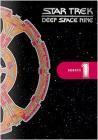
Kudos should go to the Paramount design team: the DVD packaging is fantastic. Gone are the user-unfriendly "gift boxes" that we saw with Next Generation: instead, we get a very snazzy multi-DVD holder and slipcase that are made entirely of flexible plastic decorated with the station's floor plans. The result is a very attractive and also extremely durable set: this one won't be getting dents and scratches on the shelf, and even if you drool on it in anticipation of watching the episodes, it'll be easy to wipe clean.
The six DVDs in the set are packaged with each disc resting on its spindle on an individual hard plastic "page", with the "pages" bound into a "book" format. It's far easier to get to individual discs than the foldout-style holders of Next Generation, and it looks very spiffy to boot. To put the icing on the cake, the entire boxed set is very compact, measuring barely an inch wide. All in all, from a purely aesthetic standpoint, Deep Space Nine is a very handsome set.
Video
Deep Space Nine is presented in its original television aspect ratio of 1.33:1. Image quality is excellent overall. Colors have a very slightly muted look, which was characteristic of Next Generation as well to a certain extent, but they are uniformly natural-looking, clean, and attractive. Edge enhancement is kept to a minimum, and the print is very clean and free of noise. Contrast is the one area that could use some improvement: black levels tend to be too dark, and especially with the largely black-uniformed crew, some darker scenes lose their detail in overly dark black tones. All in all, Deep Space Nine has gotten a very nice transfer from Paramount, and fans should be pleased.
Audio
The audio track for Deep Space Nine has been remastered to a Dolby 5.1; the original Dolby 2.0 track is offered as well. I enjoyed the remastered track quite a bit; though it doesn't do anything mind-blowing with its additional channels, the overall audio experience is very satisfying. The sound is well balanced, and dialogue is crystal clear in all scenes.
The one exception to the otherwise excellent sound quality is in the pilot episode, where in one scene (with Sisko and Picard talking) there is a noticeable buzzing distortion to the actors' speech. Fortunately, this seems to be an isolated problem.
Extras
The bonus materials for Deep Space Nine are included on the sixth disc of the set. The first, and most substantial, featurette is titled "Deep Space Nine: A Bold Beginning," and details the idea behind the show and the process of getting it on its feet. This featurette focuses on interviews with the filmmakers and producers, and runs eighteen minutes. The next featurette is a fourteen-minute "Crew Dossier" on Kira Nerys, which incorporates a number of interview segments with actor Nana Visitor. Some of the interview segments date from the show's run, and others were filmed later.
Other, shorter featurettes include the ten-minute "Michael Westmore's Aliens," an interesting look at the makeup involved in creating DS9's wide variety of alien species; "Secrets of Quark's Bar," a four-minute piece focusing on the props used for this set; "Alien Artifacts," a three-minute interview with the show's prop master; and "DS9 Sketchbook," a five-minute interview with an illustrator for the show, combining his original drawings with clips showing the actual props created from those sketches. A photo gallery is also included. All in all, the special features are interesting and show a commitment to getting a variety of perspectives on the making of the series, from behind the scenes as well as in front of the camera.
The episode menus show the same thoughtfulness as the packaging design. They are easy to navigate, and are decorated with space-station designs... no more spoiler clips to avoid! The one problem I had with the menus was on the final disc, of special features: it doesn't show all the featurette titles on the screen at once, and instead forces you to select different areas on the space station to see the title of the associated bonus material.
Final thoughts
Fans of science fiction will definitely want to take a look at Deep Space Nine: Season 1. With an excellent audio and video transfer, good special features, and amazingly well-designed packaging, it's enough to tempt even viewers who didn't follow the show when it was originally aired. I certainly enjoyed it, and I recommend it.
|



| Popular Reviews |
| Sponsored Links |
|
|
| Sponsored Links |
|
|
| Release List | Reviews | Shop | Newsletter | Forum | DVD Giveaways | Blu-Ray | Advertise |
|
Copyright 2024 DVDTalk.com All Rights Reserved. Legal Info, Privacy Policy, Terms of Use,
Manage Preferences,
Your Privacy Choices 
| |||||||