
| Reviews & Columns |
|
Reviews DVD TV on DVD Blu-ray 4K UHD International DVDs In Theaters Reviews by Studio Video Games Features Collector Series DVDs Easter Egg Database Interviews DVD Talk Radio Feature Articles Columns Anime Talk DVD Savant Horror DVDs The M.O.D. Squad Art House HD Talk Silent DVD
|
 DVD Talk Forum |
|
|
| Resources |
|
DVD Price Search Customer Service #'s RCE Info Links |
|
Columns
  



 
|
|
|
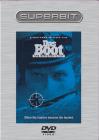
Das Boot - Superbit
American submarine movies have been around since the silent days, and they've always had a great appeal for producers. The sets are so limited, that any studio that could muster adequate effects for the cutaways to the action outside, could make one reasonably cheaply. Visuals of submarines underwater are so generic, that as late as the 80's, the same 1943 Warners tank shots of torpedoes bubbling their way across the water were still being re-used. There have been some rather good submarine movies made - Run Silent, Run Deep (out from MGM) and The Enemy Below (coming soon from Fox) come to mind - but for dramatic intensity and claustrophobic realism, none can hold a periscope to the German film, Das Boot.
Originally filmed (and sometimes revived on cable TV) as 6 or seven hour miniseries, Das Boot was a big success in the U.S. in an excellently dubbed version 1 that was taken as a super-war film that really made one feel how cramped and uncomfortable it would be to ship out on one of those old 'pig boats'. It led to an impressive career for director Wolfgang Petersen.
With the first DVD, Columbia did the extraordinary - it released an adapted version of the film, which stayed in feature form but added in almost 65 minutes of content not seen in America. Das Boot plays so well in any form, that it somehow never seems long, and this version is a pleasure to watch. The original DVD was a flipper with extras, and now Columbia has added the title to its Superbit collection - spreading the show across two extra-free discs.
Americans expect certain things from their war movies. Even when the historical facts are reasonably accurate, they want to know who the good guys and the bad guys are. It doesn't matter whether the bad guys are the enemy or our own side. It's always easy to sell the idea that good soldiers are betrayed by corrupt generals and politicians, and there are 'anti-war' classics that are just as guilty of peddling combat thrills as the cheapest propaganda of the past.
Wolfgang Petersen's concentrated story of the forty or so crewmembers of a U-boat sees the war from the viewpoint of the wolfpack hunters - German sailors in subs built solely to sink relief supplies to Great Britain. Reviled since their attack on the Lusitania in WW1, they've always been pictured in American war films as vicious sadists, chortling and Heiling Hitler as they dispatched innocent maritime victims to the bottom of the Atlantic. 2 In Das Boot, we see what remains of the U-Boat fleet after the course of the war turned against Germany. Only a year before, Allied shipping was being sunk wholesale; now a pitiful 12 U-boats are trying to make a dent in unending convoys protected by a well-organized screen of destroyers and air patrols.
The action is more than credible - the waiting, the frustration of having no target, and then the panic when the enemy comes out of nowhere to get the advantage - this is a far cry from clean-shaven Cary Grant surfacing in Tokyo bay to blithely sink everything in sight. Prochnow's crewmen spends most of their time living in their own stink and sweat, braving storms that toss the sub around like a toy, and wondering who is hunting who.
The Bavaria studios' special effects are excellent. They were still using large miniatures at that time, but the artistry of the angles chosen, and the water and front-projection effects are excellent. There's a wildness to the water that excites the men, and the angles of the sub surfacing and cruising are very impressive, making the standard effects in older Fox films like Hell and High Water look like over-lit toys in a wading pool. The later benchmark for sub pictures, The Hunt for Red October, largely uses CGI imagery to the usual excess - optimized images with the camera chasing torpedoes underwater, and impossible views of cartoony vessels abound. The miniature second-unit in Das Boot shoots its models with such artistry and taste.
For the first time, the claustrophobia of a sub interior was properly communicated. No more four-foot-wide passageways and spacious control rooms: if someone wants to move in this boat, it means somebody else has to get out of the way. For camera-trick freaks, there are some breathtaking POV shots chasing sailors down the ship at breakneck speed, diving through portholes and bulkheads barely big enough for a man to pass. They're both thrilling and technically impressive.
Petersen's taut screenplay elevates the so-called Hawksian professional group to a higher plane of reality. Each man has left a life back on shore, and there's no joyous mythical fraternal military camaraderie to compensate. The opening debauch of drunken seamen and officers 'letting off steam' steers the story toward Paul Verhoeven territory. The idle chatter of the bored sailors is filled with casual obscenities and grossout humor. It doesn't make them less admirable, however, when they function so well as a fighting unit. The captain calls them green but the dedication of these men is complete, and it's not just because they're in the same boat, to coin a phrase. Prochnow's captain is a leader, and his men follow him out of pride and love. The Chief engineer (Klaus Wennemann) is in a constant state of depression, worrying about his wife back home. The war correspondent is terrified to see his illusions of gallantry and unstoppable German might, crushed. A poor slob of a kid wonders how his secret French fiancee back in port, when she has his baby, is going to explain things to her anti-German countrymen.
From the POV of war movie precedent, the most interesting character is the first officer, the ex-Hitler youth ideologue. He hasn't been put there to spy on the others, as the party officer is in Red October; he's a loyal crewmember who just happens to be a Nazi fundamentalist. When he hears the drunken Captain Thomsen (Otto Sander, of Wim Wenders' Angels movies) criticize Hitler, you can see the blood drain from his face and his eyes start to narrow. Later on, his impeccable manners and personal grooming make him stick out from his comrades, and even the Captain makes fun of him. But he doesn't go all to pieces, and quite the contrary is a stand-up guy when the chips are down - being a Nazi doesn't make him non-functional. Not that you'd want to sit down and listen to an hour of his opinions, however.
Das Boot has its share of slow, grueling scenes of waiting and terrible bombardments with depth charges, etc. It's remarkable how we get to share the crew's feelings about their sub - when the Chief engineer fights poison gas and electrical short circuits to get the sub running again, we're reminded of our fathers' generation who fought that war, and how they related to the technology of the day - mechanics all. 3 Petersen reserves a special sentiment for Johann (Erwin Leder), the engine room mechanic who has a constant look of unintelligence about him, and who panics when things go wrong. Later, when he saves the day with a miraculous technical fix, we witness an atonement and a healing of the Captain-crew relationship. It's really inspiring, and better than the majority of similar gambits in Howard Hawks movies.
(spoiler)The luck that the Captain had thought deserted his ship comes back to enable them to somehow sneak back to their base in Southern France. But just as the film is coming to a sense of rest, a grim fate closes in to remind us of how many seamen lost their lives in these death-ships. Perhaps if the command hadn't scheduled a showy welcome home for the newsreels, the ship wouldn't have docked outside in the sunshine, instead of under the concrete protection of the Sub pen. Either way, the end is brutal and definitive, with Prochnow sinking along with his boat, almost like Joel McCrea at the end of Ride the High Country.
After this spectacular downer of an ending, pacifists will applaud Das Boot for demonstrating the fact that valor and heroism are as much a part of the losing, 'wrong' side as they are of the righteous winners. Unthinking war buffs will just relish the drama & violence of it all. If the author's intention was to make us appreciate the unique horror of serving in a wartime submarine, they've succeeded.
Columbia TriStar's DVD of Das Boot is a SuperBit followup to their fine earlier disc. The previous release was a flipper, and contained some nice extras, but this version of course has nothing but the movie and the generic Superbit menus. Since the show is so long, it's been arrayed on two discs.
Is the quality better? I played one disc, then the other, and then the first one again on my large Mitsubishi rear projection monitor, and after a bit of study, the finer detailing and slightly better colors - in some shots - became apparent. Perhaps on some more exotic DVD player the difference might be even more acute, but all in all, I don't think my eyes really appreciate the improvement enough to warrant buying the new disc, unless you are a total quality tech freak.
I can't decode the fancy audio 100%, but buyers concerned with such details should note that the old disc had both English and German 5.1 Dolby Digital tracks. On the new Superbit, the German track is in 5.1 and DTS, but the English is only recorded in Dolby Surround. The old disc has only English, Spanish and French subs; the new disc adds Portuguese, Chinese, Korean and Thai.
On a scale of Excellent, Good, Fair, and Poor, Das Boot rates:
Movie: Excellent
Video: Excellent
Sound: Excellent
Supplements: none
Packaging: Keep case in paper sleeve
Reviewed: April 6, 2003
Footnotes:
1. I remember having a discussion with an employer who said, if the dubbing was that good, why did I want to hear it in German and read all those subtitles? Sorry, but the whole point of foreign history, foreigners, and foreign points of view, is that they don't speak English, Bub.
Return
2. It's strange how our old propaganda films posited the enemy submariners as murdering swine, while characterizing our (larger and even deadlier) WW2 submarine fleet as heroic daredevils accomplishing the impossible against high odds.
Return
3. My dad was first and foremost an airplane mechanic and he hated cars, but when one broke down he could make it run practically with a dirty look - he was amazing with a set of tools. Those skills were so ingrained, they were part of his subconscious; he couldn't teach me any of it.
Return
| |
|



| Popular Reviews |
| Sponsored Links |
|
|
| Sponsored Links |
|
|
| Release List | Reviews | Shop | Newsletter | Forum | DVD Giveaways | Blu-Ray | Advertise |
|
Copyright 2024 DVDTalk.com All Rights Reserved. Legal Info, Privacy Policy, Terms of Use,
Manage Preferences,
Your Privacy Choices 
| |||||||