
| Reviews & Columns |
|
Reviews DVD TV on DVD Blu-ray 4K UHD International DVDs In Theaters Reviews by Studio Video Games Features Collector Series DVDs Easter Egg Database Interviews DVD Talk Radio Feature Articles Columns Anime Talk DVD Savant Horror DVDs The M.O.D. Squad Art House HD Talk Silent DVD
|
 DVD Talk Forum |
|
|
| Resources |
|
DVD Price Search Customer Service #'s RCE Info Links |
|
Columns
  


|
|
|
Star Trek Deep Space Nine - Season 2
Star Trek: Deep Space Nine got off to a solid start in Season 1, thanks in large part to a well-thought-out setting that offered distinctly different storytelling possibilities than a traveling starship. With Season 2, DS9 shows that it can produce satisfactory episodic science fiction, and even that it's willing to dip its toes into the scarier (and more thrilling) waters of extended story arcs.
Season 2 sees the return of all the characters from Season 1, including Commander Sisko (Avery Brooks), Kira Neriss (Nana Visitor), Jadzia Dax (Terry Farrell), and Odo (Rene Auberjonois). Dr. Bashir (Siddig El Fadil), whose characterization fluctuated quite a bit in Season 1, here seems to have firmed up into a good-intentioned but slightly over-idealistic (and over-imaginative) figure. Fortunately, the character of Sisko's son Jake is handled reasonably naturally, with no Wesley Crusher-style "save the station with my science project" hijinks; in the context of a space station rather than a starship, his character fits in reasonably well. Quark (Armin Shimmerman) continues to have a substantial role and makes the most of it; I'd never have foreseen that one of my favorite characters on the show would be a Ferengi, but there you go. Miles O'Brien (Colm Meaney) also gets a substantial chunk of screen time in episodes like "Whispers" and "Tribunal."
DS9 Season 2 continues to have a different feel than either the original Star Trek series or Next Generation. One of the most intriguing aspects of this different feel is the new perspective it offers on the Federation. For perhaps the first time, we really start to see the Federation in a critical light. They're one of the superpowers of the galaxy, and while they always claim to be benevolent and guided by the Prime Directive, when push comes to shove, they have imperialistic designs just as much as the Cardassians or Klingons do. We see the Federation as the Bajorans do, as potentially being an iron hand of domination inside a velvet glove of cooperation. For the Bajorans, appreciating their first taste of freedom after the end of the Cardassian war, the Federation's eagerness to draw Bajor into itself, and to control access to the wormhole, make them worthwhile but slightly dangerous allies.
Season 2 starts off with a three-part episode arc involving the politically unstable situation on Bajor. These opening episodes ("The Homecoming," "The Circle," and "The Siege") actually don't feel like Star Trek much at all; they're clearly opening up new, productive territory for the series. While this mini-arc wasn't quite as involving as I think it was intended to be, it's certainly very satisfying to see DS9 work with the narrative threads established in the first season. Several interesting secondary characters recur in these episodes, including Vedek Winn (Louise Fletcher) and Vedek Bareil (Philip Angim), competing members of the religious establishment on Bajor.
But DS9 isn't ready quite yet to take up the reins of full-blown continuous storytelling; the fourth episode reverts back to the stand-alone episode style with a "reset button" pushed at the end. Actually, "Invasive Procedures" is a very peculiar episode indeed, in terms of story continuity. Some elements in the episode's premise echo events that took place in just the previous episode, down to specific details like a reference to Quark not getting a seat on an outgoing shuttle due to his reluctance to leave behind a suitcase full of latinum, but the rationale behind these events is entirely different, which leads me to wonder what was going on with the scriptwriters.
The remainder of Season 2 is mostly made up of stand-alone episodes that don't really change the status quo on Deep Space Nine. "Cardassians" is a good example of a solid DS9 stand-alone episode. It draws on the backstory of Bajor and the Cardassian war, and while the opening setup threatens a high pathos level, the episode actually turns out to be a decent story of intrigue with a not-quite-predictable ending. Midway through the season, "The Alternate" picks up on the story thread of Odo's origins, as begun in Season 1. Many of the episodes in Season 2, however, are completely unrelated to the ongoing loose story arc concerning Bajor; along these lines we get fairly standard fare such as "Second Sight," "Rivals," and "Paradise." The great thing about DS9, though, is that even the stand-alone episodes are well done and lots of fun to watch, like the highly entertaining "Rules of Acquisition," in which Quark and the other Ferengi take center stage.
Toward the end of the season, however, inklings of better things to come begin to surface. A two-part episode, "The Maquis," again brings the Cardassians into the picture, this time involving the Federation as well. And, first in "Rules of Acquisition" and then in the final episode, "The Jem'Hadar," we start getting some hints about the Dominion... perhaps the most interesting and compelling adversary that DS9 ever came up with. It's a great way to end the season, and it's a definite reason to continue the story in Season 3.
The DVD
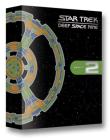
As with Season 1, DS9: Season 2 is packaged in a very attractive and user-friendly case. The full complement of 26 episodes is spread across seven discs, with the final DVD also including the special features. The discs are held in clear hard plastic "pages" that are bound into a "book": a very nice setup that allows easy access to the discs without having to unfold a long accordion of pages as in the Next Generation sets. The covers of the "book" as well as the set's slipcase are all a tough, durable plastic that's sure to hold up well over time. The case as a whole is the same design as Season 1, with an attractive station cross-section design gracing the cover, but with accents in green this time.
Video
Deep Space Nine is presented in its original television aspect ratio of 1.33:1. The image looks outstanding, better than Season 1 and better even than the best of the Next Generation transfers. Colors look exactly as they should, with bright colors being appropriately vibrant, neutral colors and skin tones looking natural, and black levels nicely rich and dark. Contrast is handled very well also. The image is sharp and clean, with nary a hint of noise and no print flaws in evidence. It's hard to see how this transfer could look any better.
Audio
DS9's remastered Dolby 5.1 soundtrack offers excellent audio quality, with all the actors' voices consistently clear and natural-sounding. There's no hint of background noise or distortion, so the overall track is very clean. Music, effects, and dialogue are consistently well balanced. Surround effects are limited, but the overall sound experience is quite pleasing.
The default soundtrack is the Dolby 5.1, but the original Dolby 2.0 track is also available. English subtitles are available as well.
Extras
I have to admit it; the special features menu really rubbed me the wrong way. The menu is in the form of the DS9 station, and only the title of the currently selected special feature shows up; the rest are not shown. A straightforward listing of the features would have been much more user-friendly.
What's worse is that the DVD designers decided to get cute and put "hidden files" into the menu. These are a series of short interviews, each a separate menu choice, that can only be found by hunting around with the arrow keys on the menu; when you do find one, it lights up a small segment of the station, but doesn't put a title. Sorry, Paramount, but I don't find it entertaining to hunt for easter eggs on a DVD. Special features should be readily accessible, not require frustrating fiddling with the remote control.
The bonus material for Season 2 is included on the seventh disc of the set. About an hour's worth of special features are readily accessible through the menu. "New Frontiers: The Story of Deep Space Nine" is a fifteen-minute featurette in which creators Rick Berman and Michael Piller along with writers Ira Behr and Robert Hewitt Wolfe discuss the origins and early development of the series. The twelve-minute "Aliens" featurette has makeup artist Michael Westmore discussing more of his designs for Season 2's aliens, while the eleven-minute "Deep Space Nine Sketchbook" offers a look at the art design of the show, with senior illustrator Rick Sternbach. "Crew Dossier: Jadzia Dax" is an eighteen-minute interview with actor Terry Farrell. "New Station, New Ships" is a shorter (five and a half minute) featurette showing the designs and models for the station as well as the space ships used in various episodes.
There are also ten "hidden files": five in the first special features menu and five on the second menu, adding up to a total of about 25 minutes of interviews. Scenic art supervisor Michael Okuda, actors Armin Shimmerman (Quark) and Siddig El Fadil (Dr. Bashir), director David Livingston, and executive producer Michael Piller get one interview each, while writer Robert Hewitt Wolfe and actor Terry Farrell (Jadzia Dax) get three each. I found the interviews to be interesting but the experience of finding them irritating.
Final thoughts
While Deep Space Nine is cautious about breaking further new ground in Season 2, it does a good job of maintaining the level of storytelling established in the entertaining Season 1 as well as adding some material to the ongoing story arc related to Bajor's political situation. The introduction of the Dominion, which is hinted at quite effectively over several episodes, also bodes well for future story development. All in all, DS9: Season 2 continues to offer an entertaining viewing experience that is sure to please both Star Trek fans and any viewers who enjoy solid science fiction television. With great video and audio quality, as well as some interesting special features, it's definitely recommended.
|



| Popular Reviews |
| Sponsored Links |
|
|
| Sponsored Links |
|
|
| Release List | Reviews | Shop | Newsletter | Forum | DVD Giveaways | Blu-Ray | Advertise |
|
Copyright 2024 DVDTalk.com All Rights Reserved. Legal Info, Privacy Policy, Terms of Use,
Manage Preferences,
Your Privacy Choices 
| |||||||