
| Reviews & Columns |
|
Reviews DVD TV on DVD Blu-ray 4K UHD International DVDs In Theaters Reviews by Studio Video Games Features Collector Series DVDs Easter Egg Database Interviews DVD Talk Radio Feature Articles Columns Anime Talk DVD Savant Horror DVDs The M.O.D. Squad Art House HD Talk Silent DVD
|
 DVD Talk Forum |
|
|
| Resources |
|
DVD Price Search Customer Service #'s RCE Info Links |
|
Columns
  


 
|
|
|
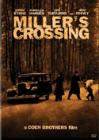
Miller's Crossing
WHAT'S IT ALL ABOUT?
Miller's Crossing begins with a lengthy nod to the quintessential gangster flick The Godfather—which is appropriate, because this almost-forgotten Coen Brothers masterpiece is right at home among the genre greats. Miller's Crossing may be Joel and Ethan Coen's most rewarding film, and that's saying quite a bit.
The film kicks off with a classic soliloquy by an Italian mobster (Jon Polito, the dry cleaner from The Man Who Wasn't There) as the city's Irish mobster kingpin, Leo (Albert Finney), calmly listens. "It's getting so a businessman can't expect no return from a fixed fight," he moans, going on to speak ironically about ethics. The scene not only sets the film's story in motion, it also establishes the film's look—a gorgeous, genre-deconstructive richness—as well as a major theme: How does a man do what's right in a world so clouded by deception--even self-deception? That theme is encapsulated further, this time symbolically, by the dream shot that follows, of an empty black hat blowing forlornly through the titular forest, foreshadowing loneliness and despair.
The setting is an amalgam of the settings of past gangster flicks, but it appears to be 1920s Chicago. Violence and bloodshed reign. Nobody trusts anybody—for good reason. Double-crossing is the name of the game. On the surface, Miller's Crossing is about a gang war between Leo and that Irish mobster, all because of Bernie Birnbaum (John Turturro), a crooked bookie who happens to be the brother of Leo's girlfriend Verna (Marcia Gay Harden). To protect her brother, Verna is playing Leo like a violin, and she's also engaging in an illicit fling with Leo's trusted advisor, Tom Reagan (Gabriel Byrne), who is Miller's Crossing's main protagonist. The film's characters are a nasty, headstrong, selfish lot, but at the same time they're all grasping at humanity, as if defying the type of movie they're in. Ringing through the film is the sound of Tom's voice, offering some sound advice to his boss, Leo: This is business. It ain't personal. As the movie progresses, he will find himself needing that very advice, and his decision whether to follow it will teach him a great lesson about his world and his character.
Miller's Crossing is an elegant film, a loving film, that spends an uncommon amount of energy on its characters. True to the Coens' filmography, it's exquisitely detailed and brimming with subtle humor. It's got rattling guns, sultry sex, vicious betrayal, snappy dialog, and all the rest of the gangster conventions. But it's also a film that responds to your moods, giving you a different experience each time you watch it. At any given moment, I'll find it either hilarious or unforgivingly somber or beautifully heartbreaking.
HOW'S IT LOOK?
Fox presents Miller's Crossing in a surprisingly fine anamorphic-widescreen transfer of the film's original 1.85:1 theatrical presentation. I was pleasantly surprised by the level of detail and richness of color in this effort, given the 13 years since it ran in theaters. Detail reaches into backgrounds, with only occasional but probably intentional softness in evidence. The film's color palette manages to be rich while also hinting at a nostalgic sepia look. The transfer vividly brings this feeling across, proving to be a revelation to this reviewer, who previously owned only a thoroughly used VHS tape of the film. Black levels are solid, and shadow detail is more than acceptable.
On the minus side, I noticed minor flecks and dirt here and there. It's not a completely pristine print, but it's not dirty enough to be a major nuisance. Still, the blemishes are noticeable. You'll also notice some mosquito noise in the print's brighter areas, as well as some minor edge enhancement, which appears to take away—just a little bit—from the film's sharpness. Finally, the transfer seems just the slightest bit unstable, looking a bit jittery, as if the film were weaving a little in the sprockets. Or it could be a digital jumpiness. It's minor but ever-present.
HOW'S IT SOUND?
The DVD contains the film's original Dolby Digital 4.0 audio track, which places the soundtrack across the front soundstage quite nicely. The soundstage has an open feel, with directional effects coming through often and effortlessly. Dialog is clean and true, never giving in to stridence at the high end. Fidelity remains strong. The surrounds are mute, but frankly, the film doesn't need anything more. The low end isn't terribly deep.
WHAT ELSE IS THERE?
The supplement you'll probably turn to first is a 16-minute featurette titled Shooting Miller's Crossing: A Conversation with Barry Sonnenfeld. This piece offers more that it promises, on one hand providing a substantial interview with Director of Photography Sonnenfeld but on the other offering some interesting behind-the-scene anecdotes about the Coens and the actors. One bit about Albert Finney will have you curled up on the ground, laughing. There's also some fascinating stuff about Sonnenfeld's background and about his approach to filming Blood Simple (his first major assignment), Raising Arizona, and Miller's Crossing. You'll get all giddy when you see this featurette's inclusion of beautiful anamorphic-widescreen footage from Raising Arizona.
You get brief Interview Soundbites from the principal cast members (Gabriel Byrne, Marci Gay Harden, and John Turturro) as they talk about their characters and motivations. The disc also offers a modest Still Gallery of behind-the-scenes photos (most, strangely, featuring Sonnenfeld), and Theatrical Trailers for Miller's Crossing, Barton Fink, and Raising Arizona.
WHAT'S LEFT TO SAY?
Miller's Crossing is a terrific film, one of the Coen Brothers' finest. This DVD gives you a fantastic transfer and good—if not great—supplements. Don't miss this one.
|



| Popular Reviews |
| Sponsored Links |
|
|
| Sponsored Links |
|
|
| Release List | Reviews | Shop | Newsletter | Forum | DVD Giveaways | Blu-Ray | Advertise |
|
Copyright 2024 DVDTalk.com All Rights Reserved. Legal Info, Privacy Policy, Terms of Use,
Manage Preferences,
Your Privacy Choices 
| |||||||