
| Reviews & Columns |
|
Reviews DVD TV on DVD Blu-ray 4K UHD International DVDs In Theaters Reviews by Studio Video Games Features Collector Series DVDs Easter Egg Database Interviews DVD Talk Radio Feature Articles Columns Anime Talk DVD Savant Horror DVDs The M.O.D. Squad Art House HD Talk Silent DVD
|
 DVD Talk Forum |
|
|
| Resources |
|
DVD Price Search Customer Service #'s RCE Info Links |
|
Columns
  


 
|
|
|
Stargate SG-1 - Season 3
Deep below Cheyenne Mountain, a top-secret Air Force facility holds a mysterious alien artifact: the Stargate. But it's not really the Stargate itself that's a mystery, but rather the vast and dangerous galaxy that has been opened up by the discovery of how to travel through the Stargate. Earth, it seems, was once the domain of the Goa'uld System Lords, powerful beings whose drive for power leads them to enslave other planets and peoples... including the Earth once again, if they can. In the face of both danger and opportunity, the Stargate teams use the gate to explore other planets and to seek out ways to defend the Earth against the Goa'uld. SG-1 is the first and justifiably the most famous of the teams, the ones who have faced the most danger and adventure together; in this third season of Stargate SG-1, the adventure continues.
Season 3 opens on a strong note, with one episode after another delivering on the kind of well-paced action-adventure that Stargate SG-1 does best. Stargate doesn't have lofty aims, but it does accomplish in excellent style exactly what it sets out to do, which is to tell fun, entertaining, exciting science fiction adventure stories.
This isn't necessarily as easy as it sounds. Take a show like Andromeda, for instance, as a counter-example: that show tries for somewhat the same effect (action, adventure, excitement in a galaxy-spanning setting) and falls flat. How does Stargate succeed where another show fails? One major element in its success is its balance of different story elements. While "action" is certainly something we see a reasonable amount of, it's never for its own sake. When there's a shoot-out between SG teams and the Goa'uld, it's for a good reason, and the stakes are high. The SG-1 team is ready for trouble, but they don't seek it out for its own sake, which makes any sticky situation that they're in doubly interesting. Another factor in a balanced "adventure" feel is the "puzzle" elements: in many episodes, there is something to be figured out, whether it's how to approach a tricky negotiation or deciphering an ancient inscription.
In Season 3, the characters also start to add some depth to the show. All of them seem more three-dimensional; instead of being the cardboard figures of the first two seasons (the Tough Colonel, the Geeky Archaeologist, the Obligatory Woman Scientist, the Wise Alien), the characters of Jack O'Neill (Richard Dean Anderson), Daniel Jackson (Michael Shanks), Samantha Carter (Amanda Tapping), and Teal'c (Christopher Judge) actually seem like interesting, real people. This in turn benefits the stories, because it feels like the scriptwriters are now incorporating the characters and their abilities into the story more naturally. Even Col. O'Neill's wisecracks (which irritated me to no end in Season 2) somehow seem better: more a function of the kind of person he is (a smart-aleck) rather than a forced character gimmick. And sometimes they're even funny, I have to admit...
Stargate SG-1 is unique among science-fiction shows in that its "visit the planet of the week" premise actually makes logical sense in the story universe: doing reconnaissance missions of newly discovered planets via the Stargate is, after all, the job of the SG-1 team. Season 3, like the earlier seasons, has a majority of stand-alone episodes, in which the team encounters some problem or threat and resolves it by the end of the episode. Because of the way that the episodes are written and developed, however, the story never becomes stale.
First of all, we know that things can happen in one episode that will affect later ones on down the line; this makes the individual episodes take on more excitement and significance. Even something that doesn't seem at first to have great significance beyond that episode can sometimes crop up later on down the line. Whereas in another show, the scriptwriters might yield to the temptation to just invent a new character or device whenever the story demands it, Stargate seems to follow the dictum that if something that has been introduced in the earlier episodes fits the bill, use it. Thus in an episode like "Legacy" an alien device is discovered that is traced back to an inventor that the team encountered in an earlier season. For viewers who missed that episode, "Legacy" works perfectly fine without knowing that piece of backstory... but for those who have been following the show, it really adds nicely to the sense of the SGC as a realistic organization and the SG-1 team as real people, who would actually remember and refer back to what they've learned in previous missions.
In addition to continuing to use the background laid down in the first two seasons, one of the things I'm really pleased to see in Season 3 is that the series is moving forward in terms of the larger story, picking up on the plot threads and characters of the second season as well as well as developing new characters and plots that are evidently more than one-shot deals. The Goa'uld threat remains present, but not static: the team manages to take out certain of the System Lords, but they also learn more about the larger picture of galactic politics. Rivalries among the Goa'uld System Lords becoming more significant, highlighting the fact that the Goa'uld are far from a monolithic enemy. "Fair Game" brings in the Asgard and opens up hints of even larger problems on the horizon; since this is an early episode in the set, it does a good job of setting a "hook" for continued viewing.
The DVD
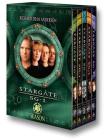
Stargate SG-1 Season 3 is packaged in five individual keepcases enclosed in a very classy-looking cardboard slipcase. The slipcase is much sturdier than the typical paperboard case with boxed sets, and should stand up to a lot of wear. While the set takes up a bit more shelf space than some of the more tightly-packed season sets on a single foldout case, the individual keepcases make it very convenient to watch the series. The overall case design is very attractive as well.
Video
Stargate SG-1 is presented in anamorphic widescreen, at the original aspect ratio of 1.78:1. While the series may have appeared in 4:3 format in most households on its initial run, the episodes were in fact filmed with the widescreen aspect ratio in mind, so the wider ratio looks great.
The overall image quality is excellent, and is a slight step forward from the already decent Season 2 transfer. Colors are excellent, and contrast is generally pretty solid, though at times some darker scenes look a bit too dark. I noted in Season 2 that there was a fairly large amount of noise in the image; it looks like it has been cleaned up more in Season 3. Some scenes do show a moderate amount of noise, but much less so than in the earlier seasons; for the most part, the image is nicely clean and clear. Edge enhancement is minimal, with the result that the picture is pleasingly sharp.
Audio
The Dolby 5.1 soundtrack is really put to good use in this set, much more so than in the earlier seasons. The surround effects are extremely well done, with the side channels used for fantastic surround and directional effects. One scene with a Goa'uld flyer in combat will have you believing that the fight is taking place in your actual living room, with the way the sound of the aircraft convincingly roars from one side of the room to the other and then back to center stage.
What's even better is that the full surround experience is used not just in special-effects-heavy scenes, but also throughout the episodes; the music is nicely spread out for an immersive experience, along with smaller environmental effects. The dialogue is always sharp and clear, and in general the soundtrack sounds great. Stargate SG-1 is at its heart an action-adventure show, and here we get the audio experience to match the on-screen excitement.
Extras
Three short featurettes are included in the set; each features an "in-character" introduction by Don S. Davis (General Hammond) and Teryl Rothery (Dr. Fraiser). The introductions are actually incredibly cheesy; it's incredible how two actors who perform quite competently day in and day out in the actual series can turn in painfully terrible hammed-up performances here.
The first featurette is a 12-minute interview with Richard Dean Anderson, discussing topics such as his character and his role as executive producer. 15-minute pieces called "The Stargate Universe" and "Personnel Files" offer a look into the making of the series, with interview clips from various people involved with the show, from writers to the main actors. All three featurettes are reasonably interesting, but the trouble with them is that they include a substantial number of clips from the episodes, including from episodes later in the season that the viewer has most likely not seen yet, given that the featurettes are in volumes 1, 3, and 5. Since it's logical that viewers would watch each featurette after finishing the episodes on that volume, it's annoying to have spoilers for later episodes.
Menus are well designed on the whole, and are straightforward and clear. Sometimes it's a bit hard to tell what's selected in the menu, due to the choice of a tiny arrow symbol rather than highlighting to show what option is selected. The menu screen for each individual episode does show an image from that episode that could be construed as a spoiler, but usually the images are general enough not to give anything away.
Final thoughts
I had never watched Stargate SG-1 on television before encountering it for the first time in Season 2 on DVD, but it soon hooked me. Season 3 continues in the same vein, offering a very entertaining adventure with every episode. In a nutshell, Stargate SG-1 is fun: it's light, but not too fluffy, and it offers an intriguing larger story as well as engaging individual episodes. With the excellent widescreen anamorphic transfer and knockout sound on this set to round out the entertaining content, Stargate SG-1 Season 3 is highly recommended.
|



| Popular Reviews |
| Sponsored Links |
|
|
| Sponsored Links |
|
|
| Release List | Reviews | Shop | Newsletter | Forum | DVD Giveaways | Blu-Ray | Advertise |
|
Copyright 2024 DVDTalk.com All Rights Reserved. Legal Info, Privacy Policy, Terms of Use,
Manage Preferences,
Your Privacy Choices 
| |||||||