
| Reviews & Columns |
|
Reviews DVD TV on DVD Blu-ray 4K UHD International DVDs In Theaters Reviews by Studio Video Games Features Collector Series DVDs Easter Egg Database Interviews DVD Talk Radio Feature Articles Columns Anime Talk DVD Savant Horror DVDs The M.O.D. Squad Art House HD Talk Silent DVD
|
 DVD Talk Forum |
|
|
| Resources |
|
DVD Price Search Customer Service #'s RCE Info Links |
|
Columns
  


 
|
|
|
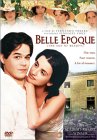
Belle Epoque
In Belle Epoque, as Spain enters into the turbulent years of its Civil War, a young man named Fernando (Jorge Sanz) deserts from the army and sets off to nowhere in particular. Along the way, he is befriended by Manolo (Fernando Fernán Gómez), an artist with four beautiful daughters (played by Miriam Díaz Aroca, Maribel Verdú, Ariadna Gil, and Penélope Cruz). Welcomed into their home, the sex-starved Fernando is alternately dazzled and bewildered by the attentions of each of the women in turn.
There's certainly a lot of potentially strong material in the era that the film is set in, at the start of the vicious Civil War during the 1930s that would set the country against itself and eventually install Franco as dictator. Watching the film, the viewer is put in the position of seeing the quiet, enjoyable lives of the characters while knowing that the country would soon be consumed with a fratricidal war. This foreknowledge can cut in two ways: to make the simple pleasures of life seem sweeter, more innocent, or to taint those pleasures with the knowledge that they will soon be cut short. A film like the outstanding Butterfly (La lengua de las mariposas) cuts right to the heart of this bittersweet feeling, capturing both the beauty and the pain of this difficult era. Belle Epoque, in contrast, doesn't even seem to notice that there's anything important going on, let alone tries to deal with it.
But it's not even that Belle Epoque simply ignores the darker side of the era in its attention to the joys of the flesh; the film has a curiously mixed tone that suggests that it's trying, unsuccessfully, to balance dark and light. The opening scene, for instance, starts off as a basically slapstick routine as Fernando is detained by a pair of Guardia Civil officers who end up disagreeing with what to do with him, but the scene abruptly turns oddly gruesome and pathetic. What is going on here? The film soon shifts back into "happy" mode, but late in the story, another scene interjects the tragic into the idyllic. But these intrusions remain just that, intrusions: undigested and unincorporated into the overall structure of the film, they stand out as clashing tones that don't add any thematic depth.
When we come down to business, what is Belle Epoque about, anyway? The film meanders along, following Fernando in a series of rather contrived incidents as he ends up getting involved (in one way or another) with each daughter in turn. The theme of "free love" isn't even adequately explored, if that is indeed the theme of the film; it's interesting to see how open and free Spanish culture was before the "dark ages" of Franco's dictatorship, but all of this seems to happen on the surface. The various people in the film dance in and out of the scenes, each on his or her own trajectory, rarely intersecting with any of the others. There's no sense that anything actually matters in this film in terms of the characters' personal relationships.
In fact, the lack of a realistic feel permeates the film as a whole. Every scene has the feeling of a set piece in a theatrical performance, with the other actors waiting in the wings to step into the scene on cue. There's certainly no sense that the characters have any life beyond what we see on the screen, and as the film develops and new characters are introduced, such as Manolo's wife, the new characters are further and further toward pure caricature. Even little details are handled carelessly: we're repeatedly told that this is winter and that it's cold out, but the characters prance around in summer dresses. Possibly the film is intended to be a complete farce, but in that case, it's just not funny enough... because, really, Belle Epoque doesn't have much by way of real humor.
The DVD
Video
The transfer is presented in its original 2.35:1 widescreen aspect ratio, and is anamorphically enhanced. Overall, it looks good. Colors are strong and look natural, and contrast is satisfactory as well. The print is clean, with only a few small flaws that I saw, apart from one peculiar one: at the very top of the image, a horizontal line runs all the way across the screen, and is visible during the entire film. One problem with the transfer is the presence of substantial edge enhancement, with distinct haloing effects visible in some scenes. There's also a general lack of clarity in the middle- and longer-distance shots, and I noticed a touch of artifacting in a few scenes.
I was pleased to note that the English subtitles are optional.
Audio
The Spanish Dolby 2.0 soundtrack is adequate, but it doesn't really shine. Dialogue across the board is a bit soft, and is sometimes slightly flat. The sound is focused to the front, with no particular sense of depth. An English Dolby 2.0 dubbed track is also provided, as are optional English subtitles, in nicely visible yellow.
Extras
The main special feature is a director's commentary from Fernando Trueba. However, I was disappointed to find that he does the commentary in English; while his command of English is adequate, I imagine that he would have been able to express himself better in his native Spanish, and the track could have been subtitled.
Trailers for All About My Mother (Todo sobre mi madre), Sense and Sensibility, and Age of Innocence are also included.
Final thoughts
Somehow, Belle Epoque won the 1993 Academy Award for Best Foreign Language Film; I can only conclude that there was really nothing much competing against it that year, or that the judges were mostly male and were dazzled by seeing the female characters prance around in their underwear. Apart from the minor interest of seeing Penélope Cruz in an early role, there's nothing really worthwhile here. It wasn't completely horrible, so I'll barely let it get by with a "rent it," but only if there's nothing much else worth checking out.
|



| Popular Reviews |
| Sponsored Links |
|
|
| Sponsored Links |
|
|
| Release List | Reviews | Shop | Newsletter | Forum | DVD Giveaways | Blu-Ray | Advertise |
|
Copyright 2024 DVDTalk.com All Rights Reserved. Legal Info, Privacy Policy, Terms of Use,
Manage Preferences,
Your Privacy Choices 
| |||||||