
| Reviews & Columns |
|
Reviews DVD TV on DVD Blu-ray 4K UHD International DVDs In Theaters Reviews by Studio Video Games Features Collector Series DVDs Easter Egg Database Interviews DVD Talk Radio Feature Articles Columns Anime Talk DVD Savant Horror DVDs The M.O.D. Squad Art House HD Talk Silent DVD
|
 DVD Talk Forum |
|
|
| Resources |
|
DVD Price Search Customer Service #'s RCE Info Links |
|
Columns


 
|
|
|
Once Upon a Time in the West
A modern classic that's grown in stature steadily since its 1968 debut, Once Upon a Time In the West (affectionately known to Leone fans as OUATITW) is a Western like no other. It's been described as sagebrush Kabuki, as Grand Opera, and by detractors as Sergio Leone telling a 40 minute story in 160 minutes.
Few Spaghetti Westerns are particularly good movies, and few besides those of Sergio Leone approach anyone's idea of Art. After the Dollars trilogy, Il Maestro moved from comedic cynicism to a serious posture that would be pretentious if not held aloft by all the magic cinema can offer - wonderful faces, beautiful cinematography, rapturous music. Once Upon a Time In the West is like a valentine to the American Western, made by an outsider who couldn't speak English. If you're already a Leone convert, you've perhaps seen it too many times already. For those who haven't seen it, it will either be a frustrating exercise in slow cinema, or an opportunity for a revelation.
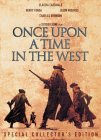
Paramount's Special Collector's Edition has extras produced in England for a recent Region 2 release. The English love and revere both our Westerns and those of the Italian persuasion, and the disc set presents Once Upon a Time In the West with as much respect as they would Citzen Kane.
It's true that Sergio Leone took himself and his movies extremely seriously after the snowballing success of his first three Clint Eastwood picures, and OUATITW departs from the half-joking rakishness and nonchalant violence of those films. This time we get a serious saga told with a delicacy one would expect in a Visconti film. Leone still infuses the proceedings with his visual acumen, but this time he stretches to achieve different effects. This time the picture centers on a woman, and the gundowns are more mythic and ritualized than ever before. Clint Eastwood strolled through his pictures like a bulletproof bill collector, wiping out everyone he met with a wry sense of humor provided by screenwriter Luciano Vincenzoni. Here, there's almost a touch of Alain Resnais self-consciousness - all the cowboys and gunmen walk and move as if they were in a dream. Is this a Zen Western?
Henry Fonda is the most abstract of the exalted gunslingers. He'd previously played a villain in the minor film Firecreek, but nothing prepared fans for the sight of his blue eyes staring over a sneering mouth here. He's a villain as black hearted as they come. He moves carefully, calculating in everything he says and does. He's tall, dark, sunburned and magnificent whether riding a horse or just holstering his gun. In the film's central flashback, Fonda is made to look not only younger but more feral and wild, like Gian-Maria Volonté in the first two Dollars films - totally different than the calm, almost angelic Henry of Drums Along the Mohawk or The Grapes of Wrath.
Cast against type, Jason Robards is supposed to be Mexican in the script but comes off as a bandit-philosopher. He's easily the most talkative of the bunch, but much of his speechifying doesn't seem to be addressed exactly to the person he's talking to - they're dream words as well.
As the patented Leone Man With No Name type, Charles Bronson would seem an expressionless brick - until his green-eyed gaze soaks in. His dry, squinting face looks like an unfinished clay sculpture, a Golem wearing a cowboy hat. Relatively short in height, he nonetheless convinces as tougher than the rest of the cast put together. Bronson's the least talkative character in the Leone canon - he'll stare for thirty seconds before returning a three-syllable answer.
Modern movies are so afraid of losing their audience they fill in every moment with action and empty 'activity'. With this film, Leone began staging his action in terms of drawn-out, ritualized set pieces. Just the act of handing a person a gun, and that person placing it on a table, becomes a careful 30-second event that's less stage business and more like motions rehearsed since the beginning of time. The style emphasizes staring eyes, constant closeups of faces and eyes that tell stories of their own. It's a different kind of storytelling.
The plot follows the basic situation of Johnny Guitar, with Spaghetti trappings added. A full twelve minutes passes in an amusing title sequence that exists for its own sake, a static observance of gunslingers waiting in 'High Noon' mode for Bronson to arrive at Cattle Corner. Leone cast recognizable American stars to get gunned down, Woody Strode and Jack Elam, and gave them a third henchman for bad luck, Al Mulock, the fool that Eli Wallach blasts from his bathtub in GBU. 2 Italians Paolo Stoppa and Gabrielle Ferzetti are on hand for serious roles, with Ferzetti playing the complicated character of a powerful man who grows physically weaker as he gets richer.
Some critics think that Leone's storytelling style broke down with OUATITW. The Good, The Bad and the Ugly (GBU) already ran so long that its continuity suffered in shorter versions; even at full length, OUATITW has some gaping story holes that can frustrate a simple desire to 'read' the plot. Leone will let characters stare at one another for what seems minutes at a time, but can't be bothered to clarify major character relationships. How exactly Henry Fonda ends up in bed with Claudia Cardinale is more than a bit muffled. Is it an all-out rape, or what? The scene at the cave dwelling, and the one where Bronson and Robards start building the Sweetwater station appear to be radically out of sequence.
We're looking at a style that can be economical one moment but opaque the next, as a great deal of relevant action happens off screen. Jason Robards is constantly being caught and rescued, and we frequently wonder if something was left out because we see almost none of it. Ellipsis is a good thing, as when Henry Fonda discovers the remains of a couple dozen gunmen next to Morton's idle train. Are we supposed to divine that Cheyenne's men had a battle with Morton's gunfighters? Did everyone get killed or mortally shot, down to the last man? That Cheyenne escaped from his train ride to Yuma, organized an attack, had a big battle, and rode away to the McBain homestead seriously wounded? It's a lot of content to be skipped over, and we can't escape the feeling that more story was intended but the film just got too darn long. 1
If Robards didn't clock in so much good character time, we'd think him shortchanged for action scenes. I'm not sure he ever shoots a gun except in the train-roof scene. What's mostly missed is the confrontation with Morton that would lead up to the battle between two outlaw bands. We wouldn't want to see the actual battle (the reveal of Fonda finding the aftermath is excellent in itself) but Robards is robbed of a standoff all his own, for us to see how he measures up to the other, more stoic gunfighter heroes. The odd effect of this elision is that at the end when Cheyenne prepares to draw his gun, not knowing whether Frank or Harmonica will come through the door, we've practically forgotten that he's a fancy pistolero and not just a talker.
OUATITW works best in the present tense, in sequences conceived to make men move in the landscape like gods in a ritualized pageant. The pace is set by the glorious Ennio Morricone score which cues movements and moods with sweep and majesty. After the frantic cutting at the end of GBU, the showdown here might as well be something out of a Noh play. Bronson and especially Fonda move and face-off in slow motion, striking poses that look like they belong in an Italian fashion magazine. Here is Western cool that has more to do with Milanese design than the real West. But it is as powerful as Dimitri Tiomkin's 'Russian' music for American Westerns.
The final showdown is one of the purest in film. With Fonda no longer on the Morton payroll, he's reduced from an arch-villain back down to the level of an honest samurai-like gunfighter. He and Bronson meet as equals, following through on a pact carved in stone.
The music is organized into leitmotifs, and if any complaint can be legit, it's that each theme is repeated at least two times more than it should. It's easy to understand why Paramount (Bob Evans, I guess) lopped off the ending scene of Cheyenne's surprise revelation - it's slow-paced, seems an extra climax that wasn't needed, and starts with the meandering Cheyenne theme starting up for what must be the tenth time. John Carpenter is trying to de-intellectualize when he describes the tone of the film as Opera, but ends up elevating the film. It is like Opera in that the music drives the visuals more than anything that was written on paper. Leone's direction is musically inspired, and in this dreamlike situation that's not a bad thing. For Morricone fans, it's like dying and going to heaven.
Savant saw OUATITW when it was brand new on a double bill with The Green Slime, which might tell you how much respect it got from distributors. I can't claim to have been one of the enlightened few who appreciated it on first sight. Even cut by 20 minutes, it seemed uncontrollably slow and confusing, especially the flashback structure. Most fans now agree that OUATITW has the best-engineered, most compelling flashbacks in any Leone film. He started with a tale told by a musical watch in For a Few Dollars More, and the one here is threaded beautifully into the narrative, wordlessly explaining a huge chunk of the story and making the final gunfight one of the most unforgettable in Western history. 3
Somewhere about 1980, a restored print surfaced and was showcased in LA at places like the Nuart and the Vista theater, but I was in a periodic unemployed state and missed it. I didn't really catch up with it until home video, and a Paramount laser disc of exceptional quality.
Once Upon a Time In the West's epic approach to pulp has had a lot of influence; there's definitely a change in 1970s Japanese Samurai films (especially the Sword of Vengeance series) that seems touched by Leone, even though Leone's architecturally stoic standoffs were originally inspired by Kurosawa. At Cannon we groaned when Albert Pyun ripped off entire scenes and dialogue for his abominable Cyborg. Real exploitation cognoscenti may know better, but I saw a lot of the stoic ritualization of OUATITW in Kill Bill, too. It has the same kind of pulpy seriousness. The tongue's been in the cheek so long, all has returned to the straight and level.
The western loosening of censorship that occurred between OUATITW and Duck, You Sucker! didn't help Leone's commercial palatabilty. About the roughest thing that happens here is Cheyenne's patting of Claudia Cardinale's behind. Leone apparently decided he was free to get nasty after this, for Duck, You Sucker! is a string of relative crudities. (It was later interpreted as the second installment of another trilogy - titled in France Once Upon a Time ... The Revolution.) Ants are urinated on in the first shot, as if commenting on the beginning of The Wild Bunch. Leone's next and last film Once Upon a Time in America is a mass of directorial excess that alienates more people than it impresses.
Paramount's DVD of Once Upon a Time In the West has been a long time a-comin', as they say; even Savant used an article to whine about the need for this genre staple on DVD back in 1999 or so. The special edition won't disappoint. With no need to flip laserdiscs twice to get through the show, it's a pleasure to watch on DVD. The clean picture looks like a near-perfect transfer that's been encoded with a slightly stingy bit rate; every once in a while, backgrounds go softer than they should. Colors are rich, not Technicolor rich, but far better than any previous video incarnation.
Sir Christopher Frayling provides a commentary that said all the wrong things to me. He's joined by several other contributors, but spends far too much time with a play-by-play rundown of what we're seeing on screen, going over details we can see for ourselves. I'm not kidding: his eloquent explanations for the significance of every gesture and event might make his commentary an excellent choice for sightless movie fans (who exist in large numbers). By contrast, Alex Cox's comments on the film's cut scenes and oddball continuity had me at rapt attention.
These English critics are sometimes superior to American commentators, simply because they aren't afraid to be aesthetes. When you hear a top American critic talking about film as cinema, there's often a folksy, apologetic tone, as if trying to encourage a pact with the listener: If we were the types who analyze movies to this degree, this is what we'd have to be thinking about this scene ... Frayling's comments are all valid and good, but a DVD commentary doesn't seem to be the best venue for them. He's much better on the documentary.
Disc two contains a 3-part docu that would be over an hour long if allowed to run as one piece. It has great interviews with the few surviving contributors to the film and some name directors put their two cents in as well. Shooting took place in Los Angeles, New York, London, Paris and Rome on carefully designed settings; it must have been an expensive show.
Sir Christopher is on the money here, economically sketching Leone's life and the environment of the Italian film that gave rise to him and his Spaghetti Westerns. Actors Gabrielle Ferzetti and Claudia Cardinale are now the only surviving stars, and each offers pleasant reminiscences, as do cameraman Tonino Delli Colli and writer/director Bernardo Bertolucci (who comes off as both likeable and brilliant). Directors John Carpenter, Alex Cox and John Milius are also on hand to champion the cause of Leone's reputation. Each has strengths and weaknesses. Carpenter's not afraid to call things as he sees them. Milius appears to be rehearsing for a role as Ernest Hemingway, actually lighting and smoking a cigar during the interview in the interest of projecting a manly image.
Beyond the docus, the general appeal drops off somewhat. A featurette on the role of the railroad in the West is clumsy and only partially relevant. A gallery of location comparison stills are rather interesting. The original trailer (calling the film Once Upon a Time ... In the West) is a beaut I've never seen before, and there's an edited sequence of production stills. All are accompanied by the Morricone score. If the music isn't overused in the film itself, it definitely is in the extras.
Visually, the extras are a bit fuzzy, possibly because they're all converted from PAL originals to NTSC. The film clips look particularly strange, a bit stretched and with odd action because of the 24fps / 25fps / 30fps conversion difference. If I claimed a full understanding of the conversion process, I still doubt that I could explain it well.
A real thrill is a new 5.1 mix. Morricone fans will flip. There are also alternate tracks with the original English mono (a thoughtful touch for purists) and a French mono for Leone fans in Quebec, I suppose.
Once Upon a Time In the West is a big must-have. Back in '99 DVD addicts were screaming for titles like this and Indiana Jones, and now they're finally here. I hope we appreciate them!
On a scale of Excellent, Good, Fair, and Poor, Once Upon a Time in the West rates:
Movie: Excellent -
Video: Excellent
Sound: Excellent
Supplements: Trailer, Commentary track with John Carpenter, John Milius, Alex Cox, Sir Christopher Frayling, Dr. Sheldon Hall; docu in 3 parts - An Opera of Violence, The Wages of Sin, Something To Do With Death; Railroad: Revolutionizing the West featurette;Location & production galleries
Packaging: Keep case
Reviewed: November 9, 2003
Footnotes:
1. A friend sent me a VHS from German television of a slightly longer version. Were any of these continuity issues addressed? Nope. I don't know how much longer it was, but all the extra material were short extensions on scenes and shots, and extra bits of business here and there that added very little to the experience. The famous missing scenes, such as the beating of Harmonica mentioned in the docu, wouldn't seem to flesh out the continuity gaps either. What really makes Jill auction her house? Why does she allow it, when Frank isn't even there to intimidate her? Scenes like this just have to be taken for granted.
Return
2. I don't know what the story was, but Mulock reportedly killed himself while the movie was being shot - at least that's what the Leone fan web pages say. He can be seen about ten years earlier as a baddie conspiring with Sean Connery and femme fatale Scilla Gabel in Tarzan's Greatest Adventure.
Return
3. There seems to be an odd rivalry between Sergio Leone and Sam Peckinpah: Peckinpah has been quoted as dismissing Il Maestro by saying, "Gee, he sure likes those closeups." On the other hand, Warners' insistence on using 'ripple dissolves' to cue Peckinpah's flashbacks in The Wild Bunch looks like a throwback to the 1930s, in comparison to Leone's effective and modernistic hard cuts to repetitive, dreamlike flashback visuals.
Return
| |
|



| Popular Reviews |
| Sponsored Links |
|
|
| Sponsored Links |
|
|
| Release List | Reviews | Shop | Newsletter | Forum | DVD Giveaways | Blu-Ray | Advertise |
|
Copyright 2024 DVDTalk.com All Rights Reserved. Legal Info, Privacy Policy, Terms of Use,
Manage Preferences,
Your Privacy Choices 
| |||||||