
| Reviews & Columns |
|
Reviews DVD TV on DVD Blu-ray 4K UHD International DVDs In Theaters Reviews by Studio Video Games Features Collector Series DVDs Easter Egg Database Interviews DVD Talk Radio Feature Articles Columns Anime Talk DVD Savant Horror DVDs The M.O.D. Squad Art House HD Talk Silent DVD
|
 DVD Talk Forum |
|
|
| Resources |
|
DVD Price Search Customer Service #'s RCE Info Links |
|
Columns
  



 
|
|
|
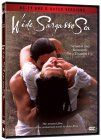
Wide Sargasso Sea
The opening sequence of Wide Sargasso Sea is a lush, slightly surreal shot of entangling strands of kelp, the plants that infest the waters of the title. It's a vivid, if eventually fairly heavy-handed, image that's referred to several times during the movie, indicating the possible fate of the cold-blooded, English gentleman, Rochester (Nathaniel Parker), in the seductive environs of the Caribbean... and in the passionate embrace of the sensual but rather unbalanced Antoinette (Karina Lombard).
Wide Sargasso Sea scores high marks for ambiance: it sets up a vivid, slightly menacing world of decadent ex-slaveholders and resentful ex-slaves, spiced up with a hint of voodoo magic and a touch of madness. Rochester is ill when he first sets foot in Jamaica, and everything has a sort of fever-dream quality to it, including the passion of his new bride; the lush countryside seems to swell up and become the entire world. As Antoinette repeatedly remarks, it seems as though it's England that is the dream, a cold, far-away place that recedes further and further into space and time.
Unfortunately, at some point Wide Sargasso Sea has to play on something more than atmosphere, and that's exactly where the film falls short. It casts a lovely visual spell, but at the same time that we're admiring the lush landscape and Antoinette's sultry beauty, we're also wondering where the story is taking us.
The story ought to be a fascinating one. In a nutshell, it's the story of "the madwoman in the attic," which is the back story of the famous novel Jane Eyre. Who was she? Why was she locked up in Rochester's house, and what drove her insane? Author Jean Rhys set out to explore these questions in the novel Wide Sargasso Sea, tracing a connection between Antoinette's madness and the clash between English, French, and Jamaican cultures, between master and slave, and between man and woman. It's an ambitious but fascinating task, and one that Rhys doesn't really pull off; the film version of Wide Sargasso Sea doesn't do any better, although it does capture the tone and setting of the novel very well.
Part of the problem is structural. We start out with Antoinette as a little girl, dealing with her mother's problems; this is essential to the development of the story later on, but it feels rushed here, as if we're flipping through the pages of the book to get to the main part of the story. When Rochester arrives, the story settles down, but the hasty presentation of the characters in the beginning of the film has its consequences in the rest of the film, as we don't really have a sense of who these people are, or why they're relating to each other the way they are. Both Antoinette and Rochester are given occasional voice-overs expressing their thoughts and reactions, which feel very much like afterthoughts, as if the filmmakers realized that they had to shore up the faltering story in some way.
In the end, the entire success of Wide Sargasso Sea depends on whether the changing relationship of Antoinette and Rochester is believable. It almost gets there... but it doesn't quite manage it. There are too many lingering glances that we're supposed to interpret in meaningful ways, too many quick shifts of personality that we're supposed to see as development; the conclusion is nicely done in a thematic sense, but it lacks the effectiveness that it would have gained from a more substantial plot or character development.
Viewers have the choice of the R-rated cut or the NC-17-rated cut of the film; I watched the NC-17 version and compared its running time to the R version... and found that it contained a whopping 30 seconds more of footage. That's right, half a minute. There's plenty of sex and naked breasts in Wide Sargasso Sea, but nothing that would be out of place in an R-rated movie; the 30 seconds in question is a brief full-frontal-nudity shot of Rochester. Oh dear. The film could have had all sorts of murder and violence on-screen and kept the R rating, but one glimpse of the "equipment" carried by half the human race, and no one under 17 is allowed to see it. (It's not even a vaguely pornographic shot, either; Rochester is just, well, naked.)
The DVD
Video
Wide Sargasso Sea has been given a nice transfer, one that should please fans of the film. It's an anamorphically-enhanced transfer at the film's original 1.85:1 aspect ratio, with a very clean print. A bit of pixellation appears in a few instances, and some edge enhancement is visible in some scenes, but overall the image looks very good and offers a respectable level of detail. Colors are one of the film's strong points, with the lush Caribbean landscape and the film's palette of light and shadow coming across very well.
Audio
A DTS 5.1 track leads out the audio choices for Wide Sargasso Sea, offering a very rich listening experience. The side channels are used reasonably well for surround effects, such as the ambiance of chattering birds and other jungle noises, although the surround isn't used as extensively or consistently as it could have been. The music, which is probably one of the best parts of the movie, sounds pleasingly full and rich; dialogue sounds good, although it doesn't have the depth of some of the other elements of the soundtrack. The Dolby 5.1 track is almost as good as the DTS track, with just a bit less depth in the sound. The last choice, a Dolby 2.0, is distinctly inferior to the 5.1, with a flat and slightly muffled sound.
Extras
The only special feature on the DVD is a set of trailers, for Wide Sargasso Sea and a few other New Line films.
Final thoughts
Wide Sargasso Sea doesn't work very well as a story, with characters whose motivations remain murky and a plot that jerks along rather than developing in a meaningful way. Nonetheless, its lush visuals and sensual score do create a vivid picture of a decadent, almost dreamlike place and time; it may be worth a rental, especially for fans of Jean Rhys' original novel.
|



| Popular Reviews |
| Sponsored Links |
|
|
| Sponsored Links |
|
|
| Release List | Reviews | Shop | Newsletter | Forum | DVD Giveaways | Blu-Ray | Advertise |
|
Copyright 2024 DVDTalk.com All Rights Reserved. Legal Info, Privacy Policy, Terms of Use,
Manage Preferences,
Your Privacy Choices 
| |||||||