
| Reviews & Columns |
|
Reviews DVD TV on DVD Blu-ray 4K UHD International DVDs In Theaters Reviews by Studio Video Games Features Collector Series DVDs Easter Egg Database Interviews DVD Talk Radio Feature Articles Columns Anime Talk DVD Savant Horror DVDs The M.O.D. Squad Art House HD Talk Silent DVD
|
 DVD Talk Forum |
|
|
| Resources |
|
DVD Price Search Customer Service #'s RCE Info Links |
|
Columns
  



 
|
|
|
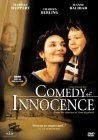
Comedy of Innocence (Comédie de l'innocence)
Camille seems like a normal nine-year-old boy, except perhaps for his habit of videotaping what's going on around him... and except for the fact that on the day of his birthday, he suddenly declares that his "real" mother is a different woman, one who lives across town. Ariane, his mother, alternates between playing along and trying to reason with him, but he's insistent, behaving exactly as if he really had awoken among strangers. What's going on?
I like stories with mysterious elements. I enjoy movies in which there's more to the story than meets the eye; I loved The Sixth Sense, the film that Comedy of Innocence (original title: Comédie de l'innocence) is prominently compared to on the DVD case. But in Comedy of Innocence, the elements just don't fit together to make an organic, consistent whole. It's all very well for weird things to happen in the story; in fact, if we're watching a thriller of some kind, we basically expect strange things to happen, or to learn that people have something to hide. However, we also expect the characters to behave in at least moderately rational and comprehensible ways. If the characters behave inexplicably, if they talk at cross-purposes in every scene... we're set adrift.
That's exactly what happens in Comedy of Innocence. The opening situation, in which Camille insists that Ariane (Isabelle Huppert) isn't his mother, is quite creepy. What doesn't make sense, though, is how his mother goes along with it. She allows her son to continue the pretense, even encouraging him in it to the point of going with him to visit the apartment that he claims is his real "home" and, later, visiting his claimed "real mother," Isabella (Jeanne Balibar) And when Isabella plays along, does Ariane object? No, she continues to weirdly play along, half protesting and half acquiescing to the "relationship." There's no rational explanation given for her odd behavior or her passivity in not speaking up to say "I'm his mother, who the heck are you and what kind of game are you playing with my son?"
Certainly the story requires that Isabella become entangled in the lives of Camille and his family, but it's a slap in the viewer's face (and a grave shock to any suspension of disbelief) to not provide a credible story development to account for it. If Comedy of Innocence pretends to be a psychological thriller, which it seems to, then it needs to create characters who are believable, and not merely puppets of the story.
We might ask the question: Does Comedy of Innocence tell a ghost story, or does it tell a story about characters who think they're involved in a ghost story? Either one is a potentially interesting way to go; unfortunately, Comedy of Innocence muffs each one. As a creepy thriller, Comedy of Innocence falls short by being at the same time too obvious and too obscure. The soundtrack is extremely manipulative (to the point that I started wondering if the film was engaging in self-parody), with dramatic "creepy moment" cues liberally plastered throughout the film, constantly reminding us that we're supposed to find the goings-on disturbing in some way. Yet as I've mentioned before, the characters constantly talk at cross-purposes: the dialogue goes nowhere, explains nothing, and instead of developing the plot, only serves to create more confusion about what the movie is about. So much for Comedy of Innocence as a thriller. As a psychological exploration of its characters, it's even less effective: if the characters' behavior makes no logical sense, and their dialogue reveals nothing meaningful, how are we to come to any greater understanding of them?
What about the ending? Does it bring the pieces together to form an interesting picture at the last minute? Sadly, no. The conclusion does resolve the question of "Is there something supernatural going on, or not?" but that's about it. It's neither psychologically convincing nor dramatically interesting; in fact, it's the kind of ending that makes you say "Why did I waste an hour and a half of my free time just to lead up to this?"
The only real bright spot in this murky film is young Nils Hugon's respectable performance as Camille; he's quite believable, and the few genuinely effective moments of the film are ones in which he's the center of attention, making us wonder whether he's a manipulative monster-child, a confused little boy, or something in between.
The DVD
Video
Comedy of Innocence is presented in a respectable anamorphic widescreen transfer, at its original 1.85:1 aspect ratio. The print is clean and the image as a whole is free of noise, with a generally fresh look to it; colors and contrast are natural-looking and generally pleasing to the eye. Edge enhancement is present, varying from mild to heavy depending on the scene, and the image as a whole has a soft appearance to it, but overall it's a solid transfer.
The English subtitles are optional, which is very good, but unfortunately for viewers who want to see them, they're badly placed and rather obtrusive. The words are in bright yellow and placed fairly high up on the screen, rather than right at the bottom of the image; the result is that in many scenes, the characters' faces are considerably obscured by the subtitles.
Audio
The French Dolby 5.1 track is reasonably good, providing good use of the surround channels for the music and the occasional sound effect. I found the dialogue to be occasionally slightly muffled-sounding, especially if the characters weren't front-and-center in the scene, but for the most part it sounds fine, and as a whole, the track is clean and natural-sounding.
Extras
Of most note is a 13-minute interview with Raoul Ruiz, the director of Comedy of Innocence, which focuses on the themes of the film; it will be of interest to those who appreciated the movie. Other minor bonus features are a trailer, a set of filmographies, and weblinks.
Final thoughts
Placing atmosphere above coherence, Comedy of Innocence concocts an odd patchwork of a film. If it were disassembled into its different parts and re-assembled with a better script, one that provided some sort of coherent narrative and plausible character motivations, Comedy of Innocence could very well be an intriguing film. However, what we actually end up with is a story that just feels pretentious and self-absorbed, never bothering to provide a narrative or characters that will draw the viewer in. While it's a rental candidate for those who are looking for mood rather than story, as a general recommendation I'll suggest just skipping it.
|



| Popular Reviews |
| Sponsored Links |
|
|
| Sponsored Links |
|
|
| Release List | Reviews | Shop | Newsletter | Forum | DVD Giveaways | Blu-Ray | Advertise |
|
Copyright 2024 DVDTalk.com All Rights Reserved. Legal Info, Privacy Policy, Terms of Use,
Manage Preferences,
Your Privacy Choices 
| |||||||