
| Reviews & Columns |
|
Reviews DVD TV on DVD Blu-ray 4K UHD International DVDs In Theaters Reviews by Studio Video Games Features Collector Series DVDs Easter Egg Database Interviews DVD Talk Radio Feature Articles Columns Anime Talk DVD Savant Horror DVDs The M.O.D. Squad Art House HD Talk Silent DVD
|
 DVD Talk Forum |
|
|
| Resources |
|
DVD Price Search Customer Service #'s RCE Info Links |
|
Columns
  



 
|
|
|
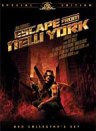
Escape From New York: Collector's Edition
WHAT'S IT ALL ABOUT?
Escape From New York is one of those odd cult favorites that float bizarrely above any critical disdain. This odd little film has a fervent built-in audience, recognizing it for the clunky, shot-on-the-shoestring B-movie sci-fi actioner that it undeniably is, but adoring every crazy frame. These people quote the film with laughter and groove to John Carpenter's minimalist synthesizer score, and they happily endure the choppy pace and modest production design. It's all part of the fun! I'm proud to say that I'm one of those people—an Escape From New York fan who gets off on every nuance of John Carpenter's kookily libertarian futurevision. Because of its adoring, foaming-at-the-mouth audience, the film has attained a stature beyond itself. It's a legendary but strangely small cult smash that, against all odds, has become a science-fiction classic.
Far off in a wild science-fiction future—yes, deep in an unfathomable 1997 police state—New York City has been walled in and designated an island prison. Monitored by guards in helicopters and tough guys in cement towers, the trashed city is home to the country's most violent criminals, who have established their own savage society among its darkened skyscrapers and crumbling landmarks. The plot kicks into gear when Air Force One—in an eerie foreshadow of recent of events—barrels toward the World Trade Center on a collision course. Terrorists have hijacked the plane, and the president (Donald Pleasence)—with the help of a humorously egg-like escape pod—suddenly finds himself stranded in the middle of the largest prison in the world. It's up to charismatic loner Snake Plissken (Kurt Russell), himself about to be incarcerated, to enter New York and rescue the leader of the free world.
The premise is undeniably killer. The story was apparently bumping around in Carpenter's head for half a decade before the director decided to film it as his follow-up to The Fog. Given a mere $5 million, Carpenter made as large a film as possible out of cardboard and rubber bands and a heap of luck, and the result is a movie that sometimes looks great, often looks cheap, and mostly just looks hilarious. If you really start peering into Escape From New York's rickety innards, you'll start seeing stuff that maybe you don't want to see—cornball plot devices, settings that don't resemble New York one tiny bit, haphazard structuring, laughable dialog—but why do you want to be doing that? Carpenter and star Russell have infused the film with an infectious sense of fun, amid all the head-scratcher goings-on, and you can't help but crack a smile and perhaps cheer a little for that wisecracker Snake.
What else works in Escape from New York? Thanks to Kurt Russell's terrific embodiment of the gruffly sly Snake Plissken, the film has a sideways sense of cool, a seething and detached hipness that makes it easier to ignore the film's inherent flaws. And Carpenter has complemented that coolness with a deep sense of irony and black humor. In the end, it can be argued that Escape From New York is more of a comedy than an action flick—it fails at most of its efforts to produce tension or thrills and is more successful with its comic scenes and dialog. Another terrific aspect of the film is the casting of spaghetti-western veteran Lee Van Cleef (The Good, the Bad, and the Ugly), as Plissken's chief nemesis. Adrienne Barbeau, Harry Dean Stanton, and Ernest Borgnine are also effective as inmates who come to Snake's aid. And Isaac Hayes (Chef from South Park!) plays a great, twitchy-eyed villain.
HOW'S IT LOOK?
I've always held the original DVD release of Escape From New York in contempt, as one of the muddiest, softest, ugliest transfers in my collection. I yearned for the day when a new special edition would usurp that old monstrosity. Well, that day has arrived, but I can't help but feel moderately disappointed in the results.
In this Special Edition, MGM presents Escape From New York in an all-new anamorphic-widescreen transfer of the film's original 2.35:1 theatrical presentation. Struck from a high-definition master, the new effort does improve (notice my use of the word improve, as opposed to correct) a lot of the wrongs of the previous DVD. Where the old DVD was besieged by mosquito noise and a murky darkness, the new DVD offers much more clarity and a generally brighter look. Where the old DVD's colors were muddy and smeary, the new DVD's colors are solid and appear to be more accurate. In general, the image is more stable and more pleasing to the eye.
However, although the old DVD's annoying softness has been improved, the image remains soft, particularly in backgrounds. And although there are a few scattered moments of extreme clarity in this image, most scenes—even close-up shots—are plagued by softness. (This may be a result of the source image. Perhaps the cameras Carpenter used were difficult to keep in focus.) And ringing and edge halos remain in evidence, hardly improved from the previous DVD. So, problems remain, but the improvements are impressive enough to require a repurchase.
HOW'S IT SOUND?
The DVD's newly remixed Dolby Digital 5.1 track is a step up from the Dolby Digital 2.0 track that graced the previous DVD—but only marginally. Both tracks suffer from a loss in fidelity over the years, but both do a pretty good job with the front soundstage, despite some roughness at the high end. Both offer some not-bad LFE activity, particularly in Carpenter's minimalist score. Dialog is mostly clear and clean in both.
The new 5.1 track adds a little activity in the rear channels, but nothing to get all excited about. The low end is slightly improved.
WHAT ELSE IS THERE?
I've been waiting for this Special Edition for a few years, having to make do with that ugly barebones DVD release. Now that I have what I yearned for and am slightly disappointed with the image quality, are the supplements at least worth clamoring about? Yeah, a couple of them are.
The one supplement that shines above all the others in this set is Disc 1's Commentary by Kurt Russell and John Carpenter, a port from the 1994 laser disc. This is exactly the commentary you would expect from this infectiously funny pair, full of relaxed humor and fun anecdotes. Carpenter calls the film an "odyssey," and spends most of the track talking about location shooting. (One location I wasn't aware of was the pre-facelift Wiltern Theater.) Kurt brings up some goofy ideas that he originally had for the character—fortunately nixed by Carpenter—and he has a funny story about the snake tattoo that disappears below his belt line. Carpenter remarks that both of them have ex-wives in the film. Overall, it's an entertaining commentary track that's a joy to listen to, but I would have enjoyed a new track with these two, particularly in light of how New York has changed since 2001.
Paired up with that now legendary track is a new but lackluster Commentary by Producer Debra Hill and Production Designer Joe Alves, in which the two participants focus on location shooting, thereby duplicating much of what we've already heard from Carpenter. This track does have the benefit of being recorded more recently, however.
Over on Disc 2, I enjoyed the 23-minute "Return to Escape from New York" Documentary, despite the fact that I wanted it to go on for 2 hours. Composed of talking-head interviews with John Carpenter, Kurt Russell, Adrienne Barbeau, Isaac Hayes, Harry Dean Stanton, writer Nick Castle, producer Debra Hill, director of photography Dean Cundey, and production designer Joe Alves, this is a terrific but frustratingly brief peek at the making of the film. The piece covers the usual ground of casting and locations—notably, the substitution of a burned-out area of St. Louis, Missouri for New York—and has some interesting things to say about the film's roots in the western genre. Russell even admits to channeling Clint Eastwood for Plissken.
Next is the Making of John Carpenter's Snake Plissken Chronicles Comic, a text-only advertisement/making-of feature about the comic book. This features a pretty cool step-by-step look at the creation of a page, but otherwise, this feature is a bust.
Also useless is the 2-minute "Snake Bites" Trailer Montage, which I assume to be imagery from the film's various trailers set to new music.
But then we get an eagerly awaited extra in the form of the 10-minute Missing Reel #1 with Commentary by John Carpenter and Kurt Russell. Unfortunately, this scene—which has become something of a legend among fans of the film—isn't as cool as this Escape From New York fan hoped it might be. Appearing in ugly non-anamorphic widescreen, the scene gives Snake a little backstory, illuminating how he came to be in custody. It also has the displeasing effect of humanizing the character. You can choose to watch the scene with or without commentary by our favorite yakking duo. Kurt has never seen the footage before, and Carpenter says, "Here we are, together again!" amid much laughter. Even Carpenter admits, "This scene doesn't add anything."
A Photo Gallery gives you three sets of photos for Behind the Scenes, Production Photos, and Lobby Cards.
You also get the film's Original Theatrical Trailer, Teaser Trailers #1 and #2, as well as trailers for Other Great MGM Releases, including The Terminator, The Fog, and Jeremiah.
Finally, included with the set is a miniature Snake Plissken comic book that you'll read once. Maybe.
WHAT'S LEFT TO SAY?
This Special Edition of Escape From New York will be a must-buy for fans of the film, but I must admit to being a bit disappointed by several aspects of the presentation. Image quality isn't the home run I hoped for. Sound quality is just okay. A couple of the supplements are great and welcome, but another couple are just plain bad. I'm giving this one a Highly Recommended rating—but just barely. It could have done more to impress fans.
|



| Popular Reviews |
| Sponsored Links |
|
|
| Sponsored Links |
|
|
| Release List | Reviews | Shop | Newsletter | Forum | DVD Giveaways | Blu-Ray | Advertise |
|
Copyright 2024 DVDTalk.com All Rights Reserved. Legal Info, Privacy Policy, Terms of Use,
Manage Preferences,
Your Privacy Choices 
| |||||||