
| Reviews & Columns |
|
Reviews DVD TV on DVD Blu-ray 4K UHD International DVDs In Theaters Reviews by Studio Video Games Features Collector Series DVDs Easter Egg Database Interviews DVD Talk Radio Feature Articles Columns Anime Talk DVD Savant Horror DVDs The M.O.D. Squad Art House HD Talk Silent DVD
|
 DVD Talk Forum |
|
|
| Resources |
|
DVD Price Search Customer Service #'s RCE Info Links |
|
Columns
  


 
|
|
|
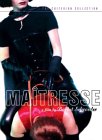
Maîtresse: Criterion Collection
The Movie
Ariane (Bulle Ogier) seems to be living a starkly affluent lifestyle in a spacious two-level apartment. The top floor is tastefully decorated, with oriental rugs, bamboo furniture, fine-inlaid furnishings, and the constant care and supervision of a well-trained housekeeper. Downstairs, Ariane keeps her torture devices: racks, cages, leather straps, whips, coffins, spiked heels, cat-o-nine-tails, Doberman Pinschers named
Ariane is a dominatrix, and her split-level flat exemplifies the dichotomy of her life and her desires in Barbet Schroeder's brash and titillating Maîtresse, a 1976 film that was so bawdy and so feared in its day that the movie found itself banned in many countries. Looking back from the early 21st Century, where it doesn't seem quite so shocking that a person might keep another person in a cage for hours at a time, one can question what the "big deal" was back then. Certainly there is plenty of nudity and sadomasochism in the film. Close-ups of a man being stretched on a rack, a naked and hooded man strapped to a wall and beaten with a switch, male full-frontal nudity involving a leather cord, a hammer, and several nails which I'm sure those "Penis Puppet" jackballs never even considered, and a woman being whipped and prodded with a leather belt remind us that we're not exactly watching The Sound of Music. But if Maîtresse were simply a film that strived to be controversial for controversy's sake, we might have ended up with the 1976 version of Showgirls. Thankfully, that isn't the case here.
The film focuses on the relationship between Ariane and Olivier (Gérard Depardieu). The film opens with Olivier roaring down the road his motorcycle, a vision of alpha-male masculinity if there ever was one, on his way to meet his old friend Mario for drinks. Mario sells books door-to-door, and Olivier joins him on a day's work. While out, they decide to break into what they believe to be an apartment whose tenant is on vacation. The apartment turns out to be Ariane's first-floor dungeon, and after she makes Olivier watch her humiliate a client, the two embark on an affair that has Olivier constantly reevaluating his role in Ariane's life. Is he the dominant or submissive? Does she really love him or is she unable to cast aside her dominatrix persona? Can Olivier reconcile himself with the ambiguous relationship between Ariane and the elusive Mr. Gautier, who seems to exert a level of control over Ariane that Olivier cannot elicit?
Maîtresse is a clever film that seems to undermine the entire cliché of "erotic thrillers" that pepper the landscape of late night premium cable. The film is about domination in the truest sense: who controls the relationship, Ariane or Olivier? Can a burly alpha-male type accept a partner whose entire lifestyle is based around physical authority and the administration of agony? Maîtresse is a fascinating look into the game of duality, the shattering of expectations and gender roles, and discovering the base elements of love even in the most unorthodox of realities.
The DVD
Video:
Maîtresse is presented in a widescreen aspect ratio of 1.66:1, and has been anamorphically enhanced for your widescreen-viewing pleasure. Criterion went back to the source to create a brand-new high definition transfer for this release, and the resulting video presentation is very impressive for a 28-year-old film. The level of image sharpness is quite agreeable, with reasonable amounts of detail and crispness in many scenes. This does vary throughout the film, as many scenes demonstrate some softness, but overall the picture is looking reasonably sharp. Colors are bright and lush throughout most of the film, although a few low-lit scenes betray a slight loss of shadow detail and expose some weaker contrast levels. These are exceptions more than the rule, as I found the picture to overall to be quite pleasing. Flesh tones seem warm and natural, and deep blue/blacks appear rich and satisfying. The transfer is free of pixelation and other telltale artifacts and compression noise. I failed to notice any ringing, edge haloing, or shimmering around fine edges or light sources. There are some occasional speckles and marks on the print, which is to be expected of a film of this age, but generally speaking this is a clean and impressive transfer.
Audio:
The audio, also restored by Criterion, is presented in monaural Dolby Digital 1.0, and is presented in its original French soundtrack language. This is a decent mono presentation. Dialog comes across warm and naturally, with only a hint of boxiness and clipping that again can be expected due to age and inherent limitations of the source material. With the limited fidelity available, the audio comes across reasonably well if not overly impressive.
Extras:
Conducted in 2002, the Barbet Schroeder interview runs approximately fourteen minutes in length. The director discusses how he first became involved in filmmaking, the origins of Maîtresse (Schroeder drew a lot of inspiration from a close friend who was an actual dominatrix), working with his principal actors, the production of the film, and reveals various anecdotal material relating to Maîtresse. The interview also contains many behind-the-scenes photographs from the making of the film.
Final Thoughts
What I enjoyed most about Maîtresse was its simplicity and its honesty, even at the heart of its most depraved moments (in one particularly gruesome scene, Schroeder filmed the actual butchering of a horse at an abattoir to create an allegorical representation of one character's emotional turmoil.) Both Depardieu (as Olivier) and Ogier (as Ariane) are nothing short of amazing and utterly believable in their roles. Olivier might come across as a big galoot, a man seemingly carved from wood, but the depth of his emotions, the sharpness of his insecurities come across with vivid realism and emotional gravity. Ariane convincingly displays the split levels of her emotions as easily as Schroeder moves his camera between the floors of her flat. Maîtresse is simple, honest, and if the subject matter is quite unorthodox, the emotions and struggles presented are exceptionally real.
There's very little to fault in Criterion release of Maîtresse on DVD. The transfer of the film demonstrates remarkable clarity for a film of the era. Maîtresse is not exactly mainstream fare, but its treatment on DVD demonstrates Criterion's commitment to quality presentations of the films in their care. While not one of the more feature-laden discs in their collection, and at times not an easy film to watch, Maîtresse definitely merits any serious film lover's attention.
|



| Popular Reviews |
| Sponsored Links |
|
|
| Sponsored Links |
|
|
| Release List | Reviews | Shop | Newsletter | Forum | DVD Giveaways | Blu-Ray | Advertise |
|
Copyright 2024 DVDTalk.com All Rights Reserved. Legal Info, Privacy Policy, Terms of Use,
Manage Preferences,
Your Privacy Choices 
| |||||||