
| Reviews & Columns |
|
Reviews DVD TV on DVD Blu-ray 4K UHD International DVDs In Theaters Reviews by Studio Video Games Features Collector Series DVDs Easter Egg Database Interviews DVD Talk Radio Feature Articles Columns Anime Talk DVD Savant Horror DVDs The M.O.D. Squad Art House HD Talk Silent DVD
|
 DVD Talk Forum |
|
|
| Resources |
|
DVD Price Search Customer Service #'s RCE Info Links |
|
Columns
  


 
|
|
|
Le Corbeau
This remarkable thriller from Henri-Georges Clouzot, the maker of such respected films as The Wages of Fear and Diabolique, is a misanthropic masterpiece that's darker than film noir. Twenty five years before The Sorrow and the Pity went public with the raw ugliness of the German occupation of France, this suspenseful mystery expressed the essence of the occupation. It was produced during the occupation, and overseen by the Germans themselves.
Criterion's superb presentation accompanies the seldom-screened feature with key text and documentary source material that explains the controversy that made Le Corbeau a sticky subject in the post-war readjustment period of reprisals and accomodations.
If we think of 40s thrillers, there are only a few American pictures that even approach the frightening complexity of Clouzot's Le Corbeau. Films noir could make an occasional artistic statement with the concept of paranoia, but Clouzot presents an autopsy of a diseased community in all its ugly detail, leaving not a single citizen in the clear. A grieving mother confirms a desire for revenge. A shopkeeper is quick to demonize a doctor thought to be an abortionist. A teenager steals money from her job, and then uses the story to solicit more money from sympathetic adults. A cripple uses her infirmity to entice a man into her bed. An elder doctor watches his young wife stray while making knowing remarks from the sidelines. The postmaster insists that all mail be delivered, including the hate mail, but is sure to intercept letters addressed to his wife. The sub-prefect of the town welcomes a management shakeup, until he becomes the target. Even a sweet girl crying on a playground is revealed to be a liar concealing one of the found poison pen letters.
It's no joke, as one person commits suicide because of the Corbeau's malice, and others not threatened with mob action may certainly have their lives ruined.
Clouzot ties this giant ensemble of suspicion into a circle of fear and betrayal. If a place is judged by its communal spirit of trust, the town of Le Corbeau is the devil's work. When he's presumed guilty, the beleaguered Dr. Germain, already an emotional refugee from an earlier life, becomes completely disgusted with human nature. Even those closest to him immediately doubt, such as Germain's sweetheart Laura. Those one would hope to be supportive make sardonic remarks from the sidelines, like Germain's best friend Dr. Michel. This is the anti-Capra film, a frightening stew of misanthropy.
Le Corbeau gets off to a fast start that makes the character introductions potentially confusing - it's important to get some names and faces straight right off to avoid losing one's way through the quickly-mutating storyline. Every couple of scenes reveal someone new who might be the writer of the evil letters that bring out every hidden secret and ugly truth behind the town hypocrites. There are some classic scenes, such as the nurse pursued down empty streets by a wave of threatening voices, or the single piece of paper that interrupts a mass, holding the congregation riveted as it drifts slowly down from the balcony.
In a chilling conclusion, the doctor must struggle with his emotions to refrain from deciding too quickly who the Corbeau is - the real letter writer is smart enough to deflect suspicion even as Dr. Germain closes in. There's a growing horror in the fear that the wrong person will be punished.
Although not a horror film, Le Corbeau received special mention in some classic literature about horror pictures by Carlos Clarens and Ivan Butler. They recognized the film's concept of a 'diseased communal mind.' Upon completion the movie was seized upon by the German occupiers, retitled A Small Town in France and distributed back in Germany as propaganda evidence of the depraved French mindset. But the Gestapo in France didn't like the film, as it was critical of an aspect of the occupation they needed the most - willing French informers. To them, Le Corbeau seemed an indictment of the occupation mindset where neighbors were likely to settle a dispute by denouncing the other party to the Nazis.
After the war, director Clouzot took a two year suspension from the film business as punishment for his alleged collaboration in working for the German-supported film company Continental.
The performances in the film are uniformly excellent. The cast may seem unfamiliar but several actors hail from familiar titles. Pierre Fresnay is in Grand Illusion, the nurse Héléna Manson is in Kameradschaft and Lola Montés, Pierre Larquey returns in Clouzot's Quai des Orfèvres and Diabolique and Antoine Balpetré shows up again in Bresson's Diary of a Country Priest.
Clouzot's pitiless community is satirical, but we immediately recognize the group behaviours as authentic. Rumors are accepted as truth, and privacy and presumption of innocence fall by the wayside. Pretty soon nobody respects anybody and the town is overrun by civilized savagery. In its unwavering negativity (broken, eventually, by the doctor's rediscovery of faith) Le Corbeau resembles the Val Lewton film The Seventh Victim which quite independently portrays a Greenwich Village populated by defeatists, failed artists, and disillusioned devil worshippers. There's even a person missing an arm in both pictures. It would take many years before horror films of any stripe approached Le Corbeau's basic nihilism. The chill of this thriller's final scenes betters the grim ending of something like The Night of the Living Dead. Reality is easily more frightening and disturbing than horror fantasy.
This is Criterion's fourth H.G. Clouzot film, after Diabolique, The Wages of Fear and Quai des Orfevres. It's as purely cynical and honestly chilling as any of them.
Criterion's DVD of Le Corbeau is a wonderful presentation. I had only seen a couple of scenes of the film on ragged & mangy 16mm prints, and this digital cleanup is remarkable. The scratch removal and overall picture punch-up is terrific 1 and the track sounds very clean, if a tiny bit metallic in places. What I mostly remember of the film are a few key stills in old film books, and when for instance Héléna Manson's face looms up in the broken mirror of her ransacked room, it was a shock to finally come face to face with a scene I'd thought about 30 years before.
The extras are carefully chosen. Alan Williams contributes an essay to a 16 page book which also offers a pair of translated articles from 1947 on the controversy around the film, one pro- and one con-. It was called The Corbeau Affair, and ironic spill-over from the film to reality. Besides an original trailer (with alternate angles on a couple of scenes) the disc offers a lengthy section of a 1975 French docu about the the director, and another hefty interview piece with Bertrand Tavernier, who patiently explains the entire context in which Le Corbeau was filmed. Tavernier speaks in English and isn't subtitled; I almost wish he spoke in French, as he speaks so softly he's sometimes difficult to understand.
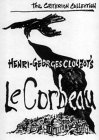
The packaging uses sinister Corbeau-like scribblings and the charcoal image of crow spreading a black cloud of ink over a city below ... it's very effective.
On a scale of Excellent, Good, Fair, and Poor, Le Corbeau rates:
Movie: Excellent
Video: Excellent
Sound: Excellent
Supplements: Video interview with Bertand Tarvernier, Excerpts from a 1975 documentary featuring Henri-Georges Clouzot, New essay by film scholar Alan Williams, Translated articles pro & con published during the Corbeau Affair in 1947.
Packaging: Keep case
Reviewed: February 11, 2004
| |
|



| Popular Reviews |
| Sponsored Links |
|
|
| Sponsored Links |
|
|
| Release List | Reviews | Shop | Newsletter | Forum | DVD Giveaways | Blu-Ray | Advertise |
|
Copyright 2024 DVDTalk.com All Rights Reserved. Legal Info, Privacy Policy, Terms of Use,
Manage Preferences,
Your Privacy Choices 
| |||||||