
| Reviews & Columns |
|
Reviews DVD TV on DVD Blu-ray 4K UHD International DVDs In Theaters Reviews by Studio Video Games Features Collector Series DVDs Easter Egg Database Interviews DVD Talk Radio Feature Articles Columns Anime Talk DVD Savant Horror DVDs The M.O.D. Squad Art House HD Talk Silent DVD
|
 DVD Talk Forum |
|
|
| Resources |
|
DVD Price Search Customer Service #'s RCE Info Links |
|
Columns
  


 
|
|
|
Sylvia
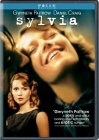
Sylvia Plath has achieved a measure of literary immortality and a certain enduring popularity, but ironically, perhaps less for her poetry than for her troubled life and eventual suicide. The Bell Jar might still be read today for its insight into adolescent depression, but would Plath be famous if she hadn't also been self-destructive? At any rate, Plath's story has enough tragic potential to justify a film based on her life: Sylvia, with Gwyneth Paltrow in the title role. After watching Sylvia, though, you might very well conclude that Plath's story doesn't have enough substance to it to merit this much attention; Sylvia is frustrating because it seems to have the ingredients necessary to tell a captivating story, but the whole ends up being far less than the sum of its parts.
The opening is, by far, the best moment in the film, with a slightly surreal-looking shot of Paltrow's face and a moody voiceover musing on life and death; it suggests that Sylvia will explore some very interesting mental territory. And, in a sense, it does: we follow Sylvia and her soon-husband Ted Hughes (Daniel Craig) as they struggle to write poetry, make a living, and relate to each other. Ted soon manages to outstrip Sylvia in the first two categories, as Sylvia develops severe writer's block, but neither of them seem to have much talent for communicating to each other, or dealing with the ups and downs of daily life. Exacerbating the situation is the fact that Sylvia is very unstable, with a history of suicide attempts.
However, the film becomes progressively (and rapidly) less interesting as it moves forward. Part of this is likely due to the film's lack of a clear structure; since we don't know where the story is headed, it's hard to settle in and become engaged with what's happening. On the one hand, the film skips ahead rapidly enough that we're never sure how long we'll spend in a particular time and place, but on the other hand, it lingers long enough in each spot that we get the feeling that we should be engaging more fully with what's happening. The emphasis of the film in terms of theme and character also never really comes into focus: is it Sylvia's unstable personality, her search for love, her work as a poet, or her relationships that form the center of the film? In scatter-shot fashion, Sylvia throws us a scene focusing on one thing, then another with a different emphasis, but this doesn't add up to a coherent picture.
The film's loose structure doesn't have to be a liability; many films successfully take a picaresque or "day in the life" approach to their material. In the case of Sylvia, the real problem is that neither of the main characters is interesting. It's not necessary for us to like them, or sympathize with them, but there has to be some reason for us to want to watch the rest of the film. Despite all the screen time devoted to her, Sylvia remains a fairly cardboard character: moody and erratic, but in a simplistic way. There's little sense that her passions or her rages arise in a meaningful way from the story as we see it, and so there's nothing for viewers to latch on to, and little hope of seeing meaningful development as the film proceeds.
The only reason to watch Sylvia, in the end, is an interest in the real life of the poet, Sylvia Plath, but even so, this is a film with a certain amount of style but, in the end, very little substance. Lingering shots of Paltrow's face do not substitute for adequate character development; being faithful to real events doesn't guarantee that the subject matter will be compelling or insightful, and Sylvia is neither. It's just depressing.
The DVD
Video
Sylvia appears in an anamorphically enhanced 2.35:1 widescreen transfer. Image quality is excellent, with a bright, clean picture that's free of any noise or flaws, and a generally crisp appearance. Colors look natural, and contrast is handled well even in darker scenes.
Audio
The Dolby 5.1 soundtrack for Sylvia is disappointingly uneven. On the positive side, the surround channels are used reasonably well even in this dialogue-focused film to create a sense of immersion. However, the volume isn't balanced well, with the result that music-only scenes are unpleasantly loud compared to the scenes with dialogue. The dialogue itself is often muffled-sounding (it doesn't help matters that the actors, and Daniel Craig in particular, tend to mumble their lines).
Extras
The only real special feature is a trailer for the film. A collection of previews for other Focus Features films plays automatically at the beginning of the DVD; unfortunately, these are not skippable. I enjoy preview trailers quite a bit, but making them unskippable is extremely annoying.
Final thoughts
Devotees of Sylvia Plath's poetry may (and I emphasize the "may") find Sylvia worth viewing as a glimpse into her life. Certainly the film is made with solid production values and a fair amount of style; it just never manages to elevate its material from "depressing story about unpleasant people" to "tragedy about flawed people." It's best as a rental choice if you're interested.
|



| Popular Reviews |
| Sponsored Links |
|
|
| Sponsored Links |
|
|
| Release List | Reviews | Shop | Newsletter | Forum | DVD Giveaways | Blu-Ray | Advertise |
|
Copyright 2024 DVDTalk.com All Rights Reserved. Legal Info, Privacy Policy, Terms of Use,
Manage Preferences,
Your Privacy Choices 
| |||||||