
| Reviews & Columns |
|
Reviews DVD TV on DVD Blu-ray 4K UHD International DVDs In Theaters Reviews by Studio Video Games Features Collector Series DVDs Easter Egg Database Interviews DVD Talk Radio Feature Articles Columns Anime Talk DVD Savant Horror DVDs The M.O.D. Squad Art House HD Talk Silent DVD
|
 DVD Talk Forum |
|
|
| Resources |
|
DVD Price Search Customer Service #'s RCE Info Links |
|
Columns


 
|
|
|
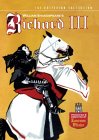
Richard III - Criterion Collection
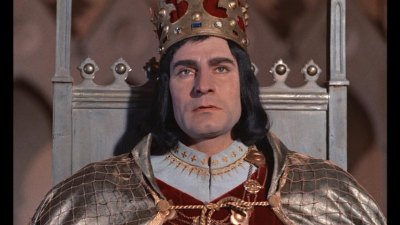 Sir Laurence Olivier directed and stared in three adaptations of Shakespeare plays. First Henry V in 1944 and then Hamlet in1948. The last was 1955's production of Richard III. Olivier is a consummate Shakespeare actor, bringing life to his characters and making the iambic pentameter sound beautifully poetic. For this production he surrounded himself with other high caliber actors, including John Gielgud as the Duke of Clarence and Ralph Richardson as the Duke of Buckingham. But even with this great talent pool, the movie comes off as being a little dated.
This play takes place near the end of the War of the Roses. For almost a hundred years, the houses of York and Lancaster have been fighting for the crown of England. As the play opens Henry VI and his son, the Prince of Wales, both Lancasters, have been defeated on the battlefield and Edward IV has just been crowned King. This is a position that his brother Richard, the Duke of Gloucester covets. Richard was born lame and deformed, but with a piercing intelligence and ruthless ambition. There are several people between him and the crown though, and even if he were to gain it, his claim might be tenuous. So he devises a plan to seduce Anne Neville (Claire Bloom) the Prince of Wales widow. If he can marry her, his claim will be that much more powerful.
But even with Anne's hand, there is still the matter of those people who come before him in the line of succession. With deceit and treachery, Richard plots against his brother and young nephews. Through murder and perfidy he takes the royal crown. But his machinations have cost him dearly as many people now look upon him with distrust and loathing. Will he be able to hold on to that which he strived so hard to obtain?
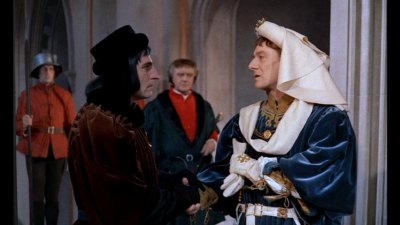 The acting in this film is simply superb. Everyone involved does an excellent job, and Olivier's portrayal of the devious king is classic. The only problem is that all of the performers are very traditional in their approach, and that style of acting seems a little dated. The movements and gestures are planned to accent the words of the play, not to try and seem realistic and natural. For instance, during the monolog in the first act, Richard's famous "Now is the winter of our discontent" speech, Olivier looks directly into the camera during most of this scene. He delivers the words impeccably, but it is not realistic to think that someone would be glaring at a wall or a door while they were speaking such lines.
The whole movie is in a traditional style too. The direction makes this look like a play that was filmed more than a movie. The camera work if fairly simplistic, with many scenes consisting of static long shots where the actors move within the confines of the frame. The actors talk to the camera the way they would address an audience attending the evening performance. The ending battle scene, which was filmed on location in Spain, took the camera out of the studio and moved the production away from the 'filmed play' look, but only slightly. There were some nice shots, including a well done process shot where Richard is drawing battle plans in the ground and the troops are superimposed over his sword, but much of the dialog still had people standing in front of the camera delivering their lines. That is not to imply that the film isn't good. It is good. It just seems a little dated after Kenneth Branagh's more dynamic films based on Shakespeare.
The DVD:
Audio:
The mono audio was just right for the movie. It was not dynamic or forceful, but the dialog is reproduced faithfully and easy to hear. There isn't any noticeable hiss or distortion. Being nearly 50 years old, I was very pleased with the way it sounded. There are English subtitles.
Video:
This movie is presented with a rather unusual aspect ratio of 1.66:1, the way it was originally theatrically shown in Europe. It is enhanced for 16:9 televisions.
Criterion went to a lot of trouble restoring this film. Several sources were used to obtain a complete version of this film, all for 35mm prints or better. This master was then restored and a high definition transfer was made. They did an excellent job. The Technicolor print is a joy to view. The blues (a color that is hard to reproduce) are bright and vivid, as are the rest of the colors. There is a slight red push, but it is minor. I didn't notice any scratches, dirt, or other print defects that are common with a film of this age. There was a minor amount of color bleeding from some of the dark red robes, but this was a minor matter. While a few of the scenes were not quite as vivid as the rest of the film, the entire movie had excellent image quality. The major problem I had was that some edge enhancement was applied. Aside from that, Criterion has released another top grade DVD.
The Extras:
The first DVD in this two-disc set contains the movie, and a commentary track with playwright and stage director Russell Lees. Lees is supplemented with prerecorded comments by Shakespeare authority John Wilders, former governor of the Royal Shakespeare Theatre. Their comments are very insightful and relevant. They point out the changes that were made to the original play, and offer explanations as to the purpose of the alterations. The historical background to the War of the Roses as well as the political atmosphere when Shakespeare was writing is discussed. The mechanics of the play, the functions of the scenes and the importance of lines and characters are also gone into in detail. This commentary is very good and is a welcome addition to the disc.
The second DVD has several nice extras too. It starts out with Great Acting: Laurence Olivier, a 1966 BBC television show. Theater critic Kenneth Tynan hosts this 47-minute interview with Olivier, where they discuss Richard III among other topics.
The Production Gallery contains on the set photos of the cast and crew with quotes from Olivier talking about the production.
One very interesting item is the TV trailer before the movie was shown on television. This 12½-minute promotional video has scenes from the movie and some behind the scenes shots.
The theatrical trailer is also included. Overall a nice set of extras, though I was expecting a little more than just an hour's worth of video. With the film running at over 2 ½ hours, I am glad they didn't squeeze everything onto one DVD, but with a second disc devoted to extras they did have room to include more. The 1911 silent version of Richard III would have been an interesting extra to include.
Final Thoughts:
This DVD is a great chance to see several exceptional actors at the top of their form. Olivier does a magnificent job as the warped Richard. His style of acting is a little dated, as is the direction for the film, but it is still an exceptional performance. Recommended.
|



| Popular Reviews |
| Sponsored Links |
|
|
| Sponsored Links |
|
|
| Release List | Reviews | Shop | Newsletter | Forum | DVD Giveaways | Blu-Ray | Advertise |
|
Copyright 2024 DVDTalk.com All Rights Reserved. Legal Info, Privacy Policy, Terms of Use,
Manage Preferences,
Your Privacy Choices 
| |||||||