| Release List | Reviews | Price Search | Shop | Newsletter | Forum | DVD Giveaways | Blu-Ray/ HD DVD | Advertise |

| Reviews & Columns |
|
Reviews DVD TV on DVD Blu-ray International DVDs Theatrical Reviews by Studio Video Games Features Collector Series DVDs Easter Egg Database Interviews DVD Talk TV DVD Talk Radio Feature Articles Columns Anime Talk DVD Savant HD Talk Horror DVDs Silent DVD
|
 DVD Talk Forum |
|
|
| Resources |
|
DVD Price Search Customer Service #'s RCE Info Links |
|
Columns

  

|
 |
The Tin Star |
|
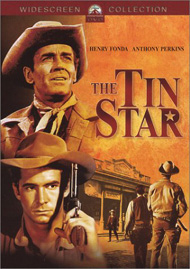
The Tin Star Paramount 1957 / B&W / 1:78 anamorphic 16:9 / 93 min. / Street Date May 11, 2004 / 14.99 Starring Henry Fonda, Anthony Perkins, Betsy Palmer, Michel Ray, Neville Brand, John McIntire, Mary Webster, Lee Van Cleef Cinematography Loyal Griggs Art Direction J. McMillan Johnson, Hal Pereira Film Editor Alma Macrorie Original Music Elmer Bernstein Written by Dudley Nichols from a story by Joel Kane & Barney Slater Produced by William Perlberg, George Seaton Directed by Anthony Mann |
Bounty Hunter Morg Hickman (Henry Fonda) finds things hostile when he brings the body of a wanted man into town. But he's befriended by widow Nona Mayfield (Betsy Palmer) and her half-indian son Kip (Michel Ray). He's also solicited by greenhorn Sheriff Ben Owens (Anthony Perkins), who needs some fast lessons to face up to the town troublemaker Bogardus (Neville Brand). Hickman advises Owens to quit the dirty job, but the young man likes the authority even though his steady girl Millie Parker (Mary Webster) refuses to marry a lawman - her dead father held the office previously.
At first The Tin Star seems like a retread forcing Anthony Perkins to play another son with a father figure in the old west, as he had done in the same year's The Lonely Man. This simple story of a Sheriff learning to stay alive as a lawman is a good example of great talent working somewhat below their potential.
Dudley Nichols' formulaic script has a conventional law and order story leavened with a few social messages, some progressive and others less so. We're given the ingrained 50s warning that it's a dangerous world out there and eternal vigilance is the price of freedom. Henry Fonda is on hand to let us know that disloyal mayors and businessmen aren't worth a Sheriff risking his life over - but a real man does it anyway. The experience of wearing a badge and using violence to put bad guys in their place is the best thing for the soul - young Perkins learns to command authority with confidence, and disillusioned Fonda is inspired to give life another go with a new family. He lost his old one, you see, because uncaring citizens wouldn't help him when he needed it - more fallout from the High Noon ideological genre fracas.
The best parts of the film are Fonda's marshallin' lessons. Fonda affects a way of walking, talking, and handling guns western-style that just makes one feel good to watch. He has a presence that doesn't rely on a Wayne-ish swagger (which Wayne didn't always use himself). The shootin' practice scene (a sure genre requirement) is particularly well done, even if two gunshots produce three hits in the water in one take. Fonda's critique of Perkins' fumbled handling of the ogre-like bad guy Neville Brand is insightful, as if the seasoned lawman was advising the rookie on his golf swing.
Evil in this cozy western town is easily defined, isolated and eliminated. Neville Brand's Bogardus character is the central bad guy, hothead, lynch mob instigator and overt racist. He sneers at Perkins, sneers at law and order and just plain needs to be put in the ground. If only real problems were like that. Perkins has a relatively easy job of it.
Savant saw The Tin Star at about age twelve when Neville Brand seemed like every bully that terrorized a schoolyard. He's sullen, aggressive and not likely to listen to reason. Perkins' girlfriend Millie (played by Mary Webster of The Delicate Delinquent and Master of the World) is an irritation, whining about not wanting to marry a man with a badge. By withholding marriage (and by extension, her favors), she even incurs sharp words from the kindly town doctor: her duty is to shut up, marry and start making little Perkinses.
Nichols touches all the bases. Racial equality was big, so Fonda's Morg Hickman learns a lesson in civility from available widow Betsy Palmer. The axiom, "a good Indian is a dead Indian" gets trotted out as a lie to be unmasked. Fonda is understandably bothered at first when he finds that Palmer's husband was a native American lynched because of his color. There's not much conflict here - a secondary threat surfaces in the form of two part-Indian locals who turn killers and threaten Betsy Palmer's boy. One of them is played by Lee Van Cleef in one of his typical minor appearances.
Fonda claims he wants to move on but he and Palmer eventually hook up without as much as a proposal scene. Too mushy, I suppose. It's enough to know that they're going to find another town that needs a Sheriff - that's what real men do best, it seems.
The Tin Star is nowhere near the edge of the 50s western. Interesting takes on the law and order subgenre were to be found in mini-classics like 3:10 To Yuma and the superlative Warlock, in which Fonda plays a combo town-tamer and gambling exploiteer like the real Wyatt Earp, only more mercenary. Anthony Mann was perhaps winding up his studio commitments and getting ready to launch himself as an "A" director of much more ambitious fare like Spartacus (which didn't work out) and his giant productions El Cid and The Fall of the Roman Empire.
Paramount presents its DVD of The Tin Star without a single extra, but the quality of the transfer and encoding is flawless. The VistaVision logo looks great (with its accompanying musical crescendo) and the B&W image stays rich and nuanced throughout, a pleasure to watch. Elmer Bernstein's score isn't as interesting as his later work, but at least one travelling cue bears a resemblance to Calvera's theme from The Magnificent Seven.
Strangely enough, the by-the-numbers script was nominated for an Oscar. Young Kip is played by Michel Ray, the star of the previous year's The Brave One.
On a scale of Excellent, Good, Fair, and Poor,
The Tin Star rates:
Movie: Good
Video: Excellent
Sound: Excellent
Supplements: none
Packaging: Keep case
Reviewed: May 21, 2004
Review Staff | About DVD Talk | Newsletter Subscribe | Join DVD Talk Forum
Copyright © DVDTalk.com All rights reserved | Privacy Policy | Terms of Use
|

| Release List | Reviews | Price Search | Shop | SUBSCRIBE | Forum | DVD Giveaways | Blu-Ray/ HD DVD | Advertise |