| Release List | Reviews | Price Search | Shop | Newsletter | Forum | DVD Giveaways | Blu-Ray/ HD DVD | Advertise |

| Reviews & Columns |
|
Reviews DVD TV on DVD Blu-ray International DVDs Theatrical Reviews by Studio Video Games Features Collector Series DVDs Easter Egg Database Interviews DVD Talk TV DVD Talk Radio Feature Articles Columns Anime Talk DVD Savant HD Talk Horror DVDs Silent DVD
|
 DVD Talk Forum |
|
|
| Resources |
|
DVD Price Search Customer Service #'s RCE Info Links |
|
Columns

  

|
 |
|
|

|
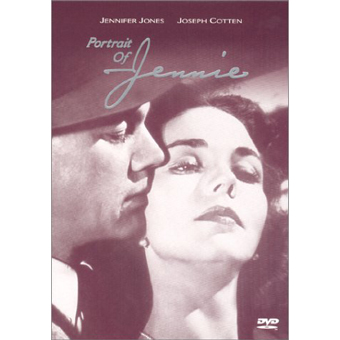
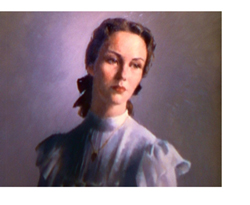
Portrait of Jennie Anchor Bay 1948 / B&W, tinted, brief color scene / 1:37 Academy / Street Date Nov. 28, 2000 Starring Jennifer Jones, Joseph Cotten, Ethel Barrymore, Lillian Gish, Cecil Kellaway, David Wayne, Albert Sharpe. Cinematography Joseph H. August Production Designers J. MacMillan Johnson and Joseph B. Platt Original Music Bernard Herrmann, Dimitri Tiomkin from themes by Claude Debussy Writing credits Leonardo Bercovici, Peter Berneis, Paul Osborn from the novel by Robert Nathan Produced by David O. Selznick Directed by William Dieterle |
Anchor Bay has followed its deluxe DVDs of Duel in the Sun and The Spiral Staircase with an exceptionally good-looking DVD of one of David O. Selznick's better films, 1948's Portrait of Jennie.
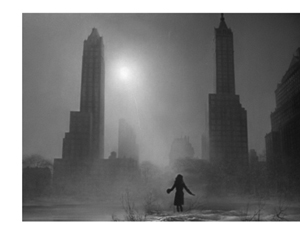
This superior fantasy was one of Selznick's productions designed around his wife, Jennifer Jones. Duel in the Sun was an attempt to overcome Jennifer's association with the religious-themed Song of Bernadette; here she plays a film-blanc inflected romantic lamia from out of time itself. Predating Somewhere in Time and Slaughterhouse-Five, and perhaps inspired by The Enchanted Cottage, Portrait of Jennie is a favorite romantic fantasy.
Synopsis:
Starving painter Eben Adams is freezing through a depression-era New York Winter when Miss Spinney, an elderly art dealer (Ethel Barrymore) buys one of his uninspired drawings. Real inspiration comes soon thereafter when Eben meets the adolescent Jennie Appleton (Jennifer Jones), a kid playing alone in central park. Jennie dresses and talks like a tot from 1910, and offers to sing a ghostly tune. Eben sketches her from memory and makes a substantial sale; but when he bumps into Jennie only a few days later, she appears to be several years older. Appearing and disappearing mysteriously, Jennie returns repeatedly, each time maturing by leaps, fulfilling a promise that the ten-year-old had made to "hurry and grow up so they can be together always". Suspecting that he's crazy and that Jennie is a phantom, Eben confides only in Miss Spinney. When the adult Jennie disappears, Eben assembles clues from her stories and from Jennie's teacher (Lillian Gish) that launch him in a race against a fated death. He rushes to the rocks below a storm-tossed Cape Cod lighthouse to keep a rendezvous with his ghostly lover.

When Savant was younger he thought Jennie was perfect, which it isn't. It is one of the more impressive romantic fantasies, and the perfect Jennifer Jones-Joseph Cotten combo. Dieterle's direction is excellent, never becoming too precious and bringing out moments that really do approach the 'timeless, ageless' beauty Selznick surely was striving for. The producer's creative team invests it with a terrific look; it's one of Savant's favorite B&W films and would look all wrong in color. Since the ephemeral Jennie is the subjective romantic imagination of charcoal & oils artist Eben Adams, the excessive pictorial emphasis given her seems entirely correct.
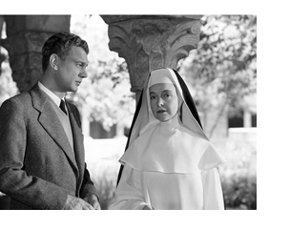
Jennifer Jones is something of a marvel. She successfully convinces us she's growing from pigtails to womanhood. Her coquettishness and immaturity are engaging and her adult incarnation embodies romance like a goddess fallen to Earth. Cotten already seems a bit old, but is totally charming; this is one of his best films. Good support is given from Cecil Kellaway and David Wayne, along with Albert Sharpe of Darby O'Gill and the Little People. Lillian Gish has little to do but spout quasi-reverent lines, more than the story needs. Ethel Barrymore, on the other hand, has a solid role and handles it perfectly.

The phantom Jennie, as other writers have suggested, may be a romantic projection of Barrymore's Miss Spinney (read: Spinster) character. Spinney is clearly in love with Eben. As in Somewhere in Time, this tale indulges the hopeful notion that there is someone out there ideally suited for all of us, and only the lucky find their ideal mate in their own place and time. Spinney is too old for Adams, as Jennie is too young for him, yet Time does not matter, only Love.1
Realist painter Eben is a surrealist hero. He finds something totally irrational in his life, and instead of denying it accepts and worships it for what it is. Thus he lives in a New York of his own creation, a (literally) canvas-textured world. When the mood is mysterious Central Park can look like a Mario Bava forest from Black Sunday. When the mood is romance, a seedy artist's garret becomes a sacred, glowing place. Reality and fantasy are no more segregated than Jennie's various impossible 'versions'. Eben finally finds himself on a rocky spit of land in an impossibly violent storm, making love to a woman who doesn't exist while a tidal wave (of reality?) crashes down to vanquish his fantasy forever. This is the closest that Hollywood movies have come to the delirious surrealism of Henry Hathaway's Peter Ibbetson.
It's a tough thing to criticize Portrait of Jennie but the flaws are there, and they are easily pinned on producer Selznick. The movie starts far too slowly, with reams of poetry text to read on screen, and pretentious and rather condescending narration to suffer through. Selznick has little feeling for nuance or subtlety. Every plot point is made literal and obvious. The only evidence of Jennie's existence is a scarf, which is treated as far too special an object by all who come in contact with it. Likewise, everyone who describes Jennie immediately refers to her ghostlike quality, as if they were reading heavenly publicity handouts. The retired costumer provides Eben with Jennie's background far too conveniently, and it's difficult not to roll our eyes when Lillian Gish practically hands Cotten a celestial roadmap with a red "X" for Land's End light. When the lovers meet, they trade ridiculous verbal nuggets of romantic wisdom as tons of water smashes them against the rocks. These appear to be last-minute looped additions.
After terrible reviews, Selznick yanked his film from theater chains and revised it, spending a small fortune on even more spectacular effects for the ending. When it failed again, he re-released it a third time in 1950 as Tidal Wave. Unlike Eben, Selznick couldn't accept the magic of his movie unless the public accepted it as well.
But most of the dialogue is fine. The adapted Debussy score is extremely good, and the comic relief in the Irish bar is welcome. The movie is a visual marvel, and Jones and Cotten are a sublimely attractive couple, making Portrait of Jennie a prime date movie. For that purpose it will work much better than Deep Red, take it from Savant.
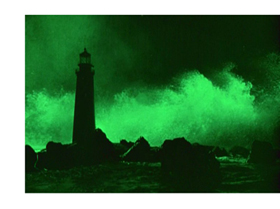
Anchor Bay's DVD presentation of Portrait of Jennie is quite good. In the 1990s a laserdisc was announced and abruptly cancelled, reportedly for a lack of decent source materials. Savant's VHS from the old Z Channel indeed had an annoying soundtrack buzz through an entire three reels. In the spirit of its original presentation, Anchor Bay has retained the ghostly green tinting of the final reel. Also present is the impressive Technicolor view of the eponymous portrait in a museum as it is admired by a pre-teen Anne Francis (now there's a bit of an out-of-time romance to ponder). What video can't replicate is the wonder of Magnavision, a special 'process' used for the film's premiere. The movie showed normally until the lightning bolt that initiates the green-tinted storm. At that point the masking receded from a giant pre-prepared screen, as a zoom projection lens enlarged the image just for the special effects finale. Coming five years before CinemaScope, this William Castle-like idea wasn't very practical for ordinary distribution.
On a scale of Excellent, Good, Fair, and Poor, Portrait of Jennie rates:
Movie: Very good
Video: Excellent
Sound: Excellent
Supplements: Theatrical trailer
Packaging: Keep case
Reviewed: November 19, 2000
Footnote:
1. Portrait of Jennie sidesteps the idea that Eben Adams might be some kind of child molester. Everyone has seen children that are already attractive to adults, and anyone who behaved as does Adams could very well be convicted as a sex offender, sensitive artist or not. Some things in Jennie have dated but not this; audiences never snicker at his behavior.
Return
Review Staff | About DVD Talk | Newsletter Subscribe | Join DVD Talk Forum
Copyright © DVDTalk.com All rights reserved | Privacy Policy | Terms of Use
|

| Release List | Reviews | Price Search | Shop | SUBSCRIBE | Forum | DVD Giveaways | Blu-Ray/ HD DVD | Advertise |