| Release List | Reviews | Price Search | Shop | Newsletter | Forum | DVD Giveaways | Blu-Ray/ HD DVD | Advertise |

| Reviews & Columns |
|
Reviews DVD TV on DVD Blu-ray International DVDs Theatrical Reviews by Studio Video Games Features Collector Series DVDs Easter Egg Database Interviews DVD Talk TV DVD Talk Radio Feature Articles Columns Anime Talk DVD Savant HD Talk Horror DVDs Silent DVD
|
 DVD Talk Forum |
|
|
| Resources |
|
DVD Price Search Customer Service #'s RCE Info Links |
|
Columns

  

|
 |
NIGHT and the CITY
|
||||
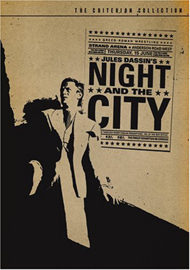
a clear case of conflict of interest, dearie. Night and the City is a key subject for both film noir and the blacklist period, and also a nice piece of connective tissue between American films set in the underworld of crime and their British counterparts about spivs and other lowlifes. Made in a great hurry to conceal its director from the Fox board of directors, it ended up being completed in two versions. Even though I wrote a chapter on the film for the first Film Noir Reader in 1996, I wasn't aware that there was a different English cut of the film until told by the Criterion DVD producer, Issa Clubb. Restored from the original cut nitrate element 'rediscovered' by Fox in one of its own vaults in 1999, Night and the City looks better than ever before. It's a mesmerizing tale of misplaced ambition, cutthroat business practices and expressionist doom sans redemption. As such, it's a key noir; through it we feel not only the jaded cynicism of its source author Gerald Kersh but also the frenzied anxiety of its director Jules Dassin, who was hounded out of Hollywood and America by the HUAC witch hunt.
Night and the City has more textbook noir attributes than any picture this side of the baroque visions of Orson Welles, but its attitude is easily distinguished from movies that affect a romantic twist on the style. The Third Man makes Vienna look like a bizarre funhouse at midnight, with zither music creating an attractive mood amid all the decaying bomb ruins. Jules Dassin's London is forbidding and hostile. It is the labyrinth described by essayist Paul Arthur, an externalized reflection of Harry Fabian's tortuous quest to "live the life of ease and plenty" without working for it. Harry's ambition is easily understood by anyone hungering for the good life we see all around us. But his plan is to take a shortcut to what he wants even if it means alienating his friends and associates, including the only people who care whether he lives or dies. The movie (especially the American cut) expresses an attitude not found in Gerald Kersh's excellent novel of the sordid Cockney East End of London. In the book Harry is a despicable louse and con man who deceives himself most of all. He doesn't realize that everyone knows he's a ponce living off the earnings of a streetwalker. At the end he's preparing to sell his 'girlfriend' to a white slaver. There's no defending that Harry on any grounds. If society is sick, it's because people like Harry Fabian are in it. The movie shares the anti-capitalist sentiments of 'radical' noirs like Try and Get Me!, Force of Evil and Body and Soul: something is seriously wrong with a system that overburdens honest working people and rewards cheap thugs and sharp businessmen. When push comes to shove, kingpins like Kristo are simply above the law, insulated from prosecution by smart attorneys and armies of toadying underlings. The near-subhuman The Strangler (Mike Mazurki) is willing to commit murder just to regain Kristo's good graces. Harry "just wants to be somebody," 1 and believes his career can be made by a single stroke of bluff and deception. Hugh Marlowe's Adam Dunne calls him "an artist without an art" (another pithy phrase) but Harry is a consummate con artist. If Harry knew how to stay faithful to some key associates he might have gotten somewhere. Instead of building a career out of his relationships, as most of us decide is the way to go, Fabian turns his entire life into a giant con game. He muscles in on the racket of the most powerful gangster in the city, using the gangster's father as a shield. For operating money he steals from his own business partner and his trusting girlfriend. But just as con men always think they're fooling people, Harry is blind to the effects of his own deceptions. He doesn't realize that his partner thinks he's two-timing him with his wife instead of just leading her on. And he's too frantic trying to hold together the loose ends of his scheme, to keep unforeseen events from bringing the whole thing down on his head. Harry's slick 'deal' ends up with those who trust him dead, outraged or heartbroken. Even worse, the entire underworld is mobilized to kill Harry before dawn. Night and the City is beautifully directed and acted, a necessity with a screenplay and characters wrapped up in hysteria and tawdry intrigue. Richard Widmark's best performance is here -- we get the feeling that the range of characters he was given in films was far below his capabilities. Widmark is matched by English actors Francis L. Sullivan (Joan of Arc) and Googie Withers (Dead of Night) as a diabolically dysfunctional husband and wife. They negotiate marital relations over a silver fox fur coat, a scene that speaks volumes about marriage in a material society. Gene Tierney and Hugh Marlowe were jammed into the story at the last minute as a favor to Darryl F. Zanuck, the sympathetic mogul who kept blacklisted Jules Dassin on the payroll by finding him work in the company's London subsidiary. Tierney received most of the abuse in the film's lukewarm critical reception. But almost every reviewer remarked on the great performance by Stanislaus Zbyszko, perhaps not realizing that he was a famous ex-champion wrestler in retirement. Night and the City's ending rivals that of the bleakest films noir: Brute Force, Hollow Triumph, Detour. It tends to be received differently depending on who's watching. My father-in-law, a hardworking insurance agent, thought it was the right ending, that Harry Fabian got exactly what he deserved. The rest of us are dismayed by Harry's lack of ethics but also remember the anxiety of being young and concerned about how to get what we want out of life. The tendency is to feel slightly guilty just for being ambitious; the miserable story of Harry Fabian is almost a psychic punishment for sins not committed. Criterion's flawless transfer of Night and the City brings extra punch to both the picture and the soundtrack. The only noir I've seen look better on disc is MGM's He Walked by Night. The extras, produced and largely edited by Issa Clubb, are all unusual. Director Dassin is featured in two interviews, a new one about this film made by Criterion and a 1972 French interview where the director gets down-and-dirty in stories about Hollywood. He tells the famous horse-castrating story about mogul Louis B. Mayer and says exactly why the actors, writers and directors betrayed by Elia Kazan don't forgive him. Right up Savant's alley is a dynamite 'soundtracks and versions' comparison between the English and American cuts of the film by Christopher Husted, an excellent narrator who should have gotten credit on the packaging. Besides sampling the English version's (rather limp) score by Benjamin Frankel the comparison shows several key scenes in the English version that do not appear in the standard cut. The alternate opening scene lets Gene Tierney try out a half-hearted English accent and attempts to make Harry Fabian a much softer character; Darryl F. Zanuck's rewrite improves this part of the film greatly by sticking to basics -- Harry has come to Mary's apartment only to steal from her, and their relationship is already threatened by his cheap con-games. The big difference in the British version is that it retains more of the Gene Tierney subplots that were shoehorned into the film. Later on we see a British-only scene where an unpaid hotel manager (played by Edward Chapman of Things to Come and X- The Unknown) comes to collect 280 pounds from Harry. The necessity of paying that debt recasts Harry as more sympathetic, as he makes a sincere speech about his desperate need to succeed. In the English version he has a forger make Helen's fake liquor license to get the money for the hotel. In the American version the money is for other urgent needs. The comparison also shows the morbidly jealous Phil Nosseross catching Harry and Helen kissing outside his window. They're each conning the other for business reasons but Phil misinterprets the scene as wife poaching and resolves to do Harry in. In the American version Phil seems more intelligent, figuring out Harry and Helen's conspiracy on just the evidence of the missing fur coat. Although dropping the kissing scene simplifies the story, the more adult context of the English scene adds to the sordid atmosphere. Elsewhere, the American cut is cleaner and more to the point; the English version retains more material created for Hugh Marlowe and Gene Tierney. Also included is the far softer English ending, which presents Mary and Adam as lovers consoling each other after Harry's untimely exit. For once, the Americans got it right. Savant did the commentary, which jams in everything I could discover about the film and the Kersh novel. I think I'm ready to take in the East End as a tourist now after reading all about the filming of this show, a favorite ever since I was invited to see it on a Steenbeck in the UCLA Film Archive's first offices back in 1971. I bought a script of the film in 1976, which turned out to be a Fox file original with notes by Darryl Zanuck. That unique bit of research led to the chapter in the Film Noir Reader. Paul Arthur contributes a learned insert essay that encapsulates the film's meaning in just a few short paragraphs. The disc also has an original trailer in which the narrator pronounces Googie Withers' first name as "goo-jee." I assumed it was "goo-gee" and cheerfully mispronounce it throughout my commentary. (Note: according to an email (1/30/04) from Rob Ewen of Harrow, UK, the American trailer mispronounces Googie's name ... it is "goo-gee." So I was right after all. Huzzah.)
On a scale of Excellent, Good, Fair, and Poor,
Night and the City rates:
Footnote:
1. ... a line lifted from Night and the City by Dassin's betrayer Elia Kazan and used to Oscar-winning effect by Terry Malloy in On the Waterfront.
Review Staff | About DVD Talk | Newsletter Subscribe | Join DVD Talk Forum |
|

| Release List | Reviews | Price Search | Shop | SUBSCRIBE | Forum | DVD Giveaways | Blu-Ray/ HD DVD | Advertise |