| Release List | Reviews | Price Search | Shop | Newsletter | Forum | DVD Giveaways | Blu-Ray/ HD DVD | Advertise |

| Reviews & Columns |
|
Reviews DVD TV on DVD Blu-ray International DVDs Theatrical Reviews by Studio Video Games Features Collector Series DVDs Easter Egg Database Interviews DVD Talk TV DVD Talk Radio Feature Articles Columns Anime Talk DVD Savant HD Talk Horror DVDs Silent DVD
|
 DVD Talk Forum |
|
|
| Resources |
|
DVD Price Search Customer Service #'s RCE Info Links |
|
Columns

  

|
 |
The Americanization of Emily |
|
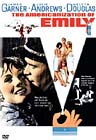
The Americanization of Emily Warners 1964 / B&W / 1:85 anamorphic 16:9 / 115 min. / Street Date May 10, 2005 / 19.97 Starring James Garner, Julie Andrews, Melvyn Douglas, James Coburn, Joyce Grenfell, Ed Binns, Liz Fraser, Keenan Wynn, William Windom Cinematography Philip H. Lathrop Art Direction George W. Davis, Hans Peters, Elliot Scott Film Editor Tom McAdoo Original Music Johnny Mandel Written by Paddy Chayefsky from the novel by William Bradford Huie Produced by Martin Ransohoff Directed by Arthur Hiller |
An interesting choice for the Warners Controversial Classics line, The Americanization of Emily takes on an issue considered by many to be off limits. Paddy Chayefsky's black comedy rewrite of the novel by William Bradford Huie dares to say that the reverence for War and its heroes is a societal sickness. Chayefsky later became known for his bitter satires about dystopic institutions, Hospital and Network. In contrast to their bile and anger, his screenplay for Emily is one of his most charming efforts. It has to be, for at its heart it has as subversive a message to sell as Charlie Chaplin's Monsieur Verdoux. War may be Hell, but to Chayefsky its glorification is a worse obscenity. All the medals, accolades, tombs and revered remembrances of Wars are like overdone Christmas decorations. Chayefsky argues that because wars all turn out to have been avoidable political spats, it's insanity to perpetuate the institution by honoring its dead.
The Americanization of Emily is as clever as they come, but the logic of some of Chayefsky's arguments is a little shaky. Some of it plays like double-talk, a series of thick arguments that boil down to position speeches that differ from something like The Fountainhead only in Chayefsky's writing skills -- he's such a smoothie, he could sell yellow snow to Eskimos. A lot of his criticism pokes sick fun at War in general, not just its glorification. There's considerable tension over the fact that the film is set during D-Day, which society generally assumes was an unquestionably justified military action. Garner dismisses the sacrifice of soldiers taking islands in the South Pacific, using the argument that "somebody could get killed" to let others do the fighting. The main characters undergo confusing third-act attitude shifts to the opposite of what they've been saying for the previous 100 minutes. Chayefsky was wise to leave his thesis in a foggy state, as peacetime audiences take deep offense at hearing that Uncle John or Cousin Jimmy died for nothing. Even the liberal milestone The Best Years of Our Lives makes a villain out of a character who presents that argument.
Emily keeps the issues on a personal level. The real problem with the glorification of war is that the relatives of brave men that fought honorably and did their duty, cannot bear criticism of the conflicts they fought in. Any attempt to discuss "our" wars as less than noble crusades, is interpreted as an attack on the dead heroes who fought in them.
Emily takes place during WW2, the exceptional "good war" that was both just and unavoidable. The movie is far more controversial today than it was in 1964. In Chayefsky's screenplay, James Garner's self-proclaimed professional coward defends America against European criticism by proudly asserting that the USA never produced a warmongering despot like Hitler or Mussolini. We never had a leader that invaded other countries and started wars as a part of national policy...
The Americanization of Emily is a highly entertaining movie, a good romance with excellent work from attractive and vivacious stars Andrews, Garner and Coburn. The chatter is bright and the humor is non-stop, so average viewers may be surprised when Chayefsky's dialogue begins toppling sacred cows right and left.
The film was quite adult for its time, acknowledging that all kinds of chicanery and hanky-panky go on in the high ranks of the military. Garner's Dog Robber was once a hotel manager specializing in the procurement of females, a skill he employs to better serve his admiral. As Andrews' volunteer driver finds out, young motor pool girls are rewarded with impossible-to-find clothing & perfumes and invited to parties where things Englanders haven't tasted in years -- like avocadoes - are to be found in abundance. Some sleep with the generals, and some don't ...
Emily invites us into the corruption by getting us to side with Garner's slick operator Charlie - he's just taking care of business, after all. Then Charlie lays into the British, first calling Emily a prig because she isn't casual about sex, and then lambasting her country's snooty military tradition that sends sons off to die alongside their fathers. Emily (and her mother, played nicely by Joyce Grenfell) is a sitting duck for his arguments, as she's lost a father, a brother and a husband to the war already. Garner's discourse against blind jingoism makes some sense, of course. But The Americanization of Emily is no fantasy like Catch-22 that targets military corruption through abstract exaggeration. Chayefsky argues that all conflict is a sham, and that's just not true. Not only are there genuine monsters like Hitler to be resisted, millions of helpless combatants on all sides don't share Charlie Madison's luxury of choice -- they're in it whether they want to be or not.
Nor does it seem fair for Charlie to pick on the English, as there are plenty of American families that follow similar military traditions. The English island is fighting for its very survival, so the sacrifices by its men make perfect sense. Chayefsky skates on thin ice here. The scene where Charlie disabuses Emily's mother of her illusions is wickedly pointed, but it's also cruel, and a cheap shot. He's perfectly happy to clobber the old lady with opinions he'd never air before his superior officers. Charlie really is a coward.
Chayefsky keeps all of this going by centering on the plight of Madison and Emily, who eventually face their future in a traditional way, by declaring that love will solve all their problems. As this is a romance, it doesn't matter that they're of different nationalities or that Charlie is "the most corrupt man she's ever known."
It's easy enough to just turn one's brain off and enjoy the great acting and funny lines. Chayefsky invents several clever euphemisms to substitute for rough language and at one point even has Charlie call Emily a bitch. She doesn't want to become Americanized, i.e., seduced by Yankee consumer riches and arrogance. He gets to rub her indignation back in her face, by telling her as they break up their relationship, "I want you to remember that when you last saw me, I was unregenerately eating a Hershey Bar!" Emily uses these arguments in a sophisticated context. Charlie is being ironic and just playing at arrogance,- but the signals get mixed anyway.
Chayefsky is a brilliant writer and his stylized dialogues are great to listen to. Interestingly enough, this movie, Hospital and Network all resort to the same plot trick: a major character goes nuts and starts seeing visions that warp reality for the other characters.
The film is a career highpoint for most of its actors. Garner is all over Charlie Madison, the apex of his winning, smart-ass Maverick persona. James Coburn shapes up as star material with a snappy major supporting role, and Melvyn Douglas is spot-on as the Admiral fighting not for victory but for the betterment of his branch of the service. There's also good playing both farcical and straight from Edward Binns, William Windom, Liz Fraser and Keenan Wynn, who does a great drunk act with Dobie Gillis alumnus Steve Franken. Alan Sues and Judy Carne (both of Rowan & Martin's Laugh-In) are a camera specialist and "Nameless Broad" respectively; the film may be progressive in some regards, but its females are mostly bimbos. Sharon Tate is said to be visible somewhere. She was or was soon to be producer Martin Ransohoff's girlfriend.
Ransohoff's production is splendid, with excellent B&W photography and clever cinematic shortcuts to make us think we're seeing a lot more production value than we are. This and Mary Poppins are Julie Andrews' first films, and she's so good in a mature role that we immediately understand why she felt stifled by her kiddie-nanny career. Emily admits to sleeping around and has no shame ... it's a challenging role and she carries it off with dignity.
The only gripe about the physical production are the women's hairstyles: Andrews, Fraser and all of Garner's good-time motor pool girls have poofy 1964 big-hair hairdos ... there's little or no period feeling.
The Americanization of Emily certainly has a different take on D-Day than Saving Private Ryan, even though they share the same opinion about the odds for survival on Normandy Beach. Its precocious but suspicious thesis is brilliantly written, and the movie is highly enjoyable. You know Marty, that Paddy Chayefsky can really write.
Warners' Controversial DVD of The Americanization of Emily looks great in enhanced B&W widescreen. It's in perfect shape. The wider frame gives us a better look at all the non-PC details and reveals studio sound stages standing in for a military base prepping for operation Overlord. A featurette called Action on the Beach is a tame look at the filming of the D-Day scene out beyond Malibu. There's an original trailer as well.
Director Arthur Hiller provides an interesting commentary with plenty of personal reminiscences. His take on the movie is that the script isn't anti-war, it's just against its glorification, which is fair enough. He does let us know that the U.S. military did not approve of the script and offered zero cooperation. It's interesting that the military will spend taxpayer money to promote itself through movies it feels are good PR for the services, while denying aid to others. I suppose it's no more twisted than spending defense money on recruiting propaganda. I've collected pamphlets sent to my college-age sons that portray the Army as a beer party on the beach with a lot of swimsuit models. That's just the attitude The Americanization of Emily deplores.
On a scale of Excellent, Good, Fair, and Poor,
The Americanization of Emily rates:
Movie: Excellent
Video: Excellent
Sound: Excellent
Supplements: Trailer, original featurette Action on the Beach, audio commentary
with director Arthur Hiller.
Packaging: Keep case
Reviewed: May 12, 2005
Review Staff | About DVD Talk | Newsletter Subscribe | Join DVD Talk Forum
Copyright © DVDTalk.com All rights reserved | Privacy Policy | Terms of Use
|

| Release List | Reviews | Price Search | Shop | SUBSCRIBE | Forum | DVD Giveaways | Blu-Ray/ HD DVD | Advertise |