| Release List | Reviews | Price Search | Shop | Newsletter | Forum | DVD Giveaways | Blu-Ray/ HD DVD | Advertise |

| Reviews & Columns |
|
Reviews DVD TV on DVD Blu-ray International DVDs Theatrical Reviews by Studio Video Games Features Collector Series DVDs Easter Egg Database Interviews DVD Talk TV DVD Talk Radio Feature Articles Columns Anime Talk DVD Savant HD Talk Horror DVDs Silent DVD
|
 DVD Talk Forum |
|
|
| Resources |
|
DVD Price Search Customer Service #'s RCE Info Links |
|
Columns


|
 |
Point Blank
|
||||
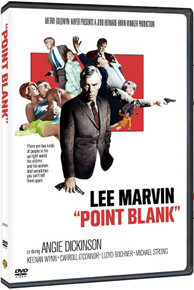
Point Blank was filmed long after the official end of the noir era but exhibits several of its classic themes. This movie about a Hit Man with a serious case of Antonioni-itis cleaned up theatrically alongside Warners' other popular 1967 bloodbath, Bonnie & Clyde. It continued to play in frequent Los Angeles revivals and midnight shows for five or six years, where one could always detect a certain tobacco-like aroma ... the film's hazy L.A. dreamscape was perfect head-trip material.
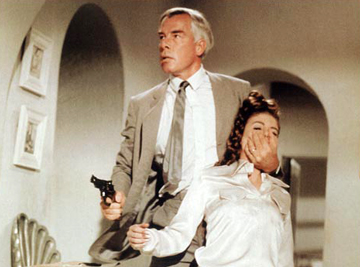
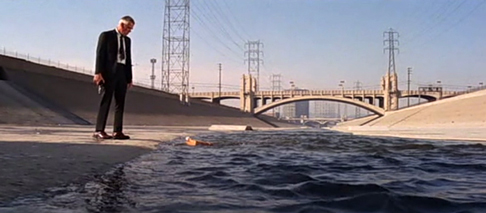
The key image in Point Blank is massive Lee Marvin striding down the old LAX corridors like a robot on overdrive, inter-cut jarringly with intimate shots of Sharon Acker putting on her makeup. This essential LA gangster film was made by a UK director whose only previous feature was a musical about the Dave Clark Five. Yet John Boorman has a natural understanding of hardboiled intrigue and powerhouse action scenes. The most dynamic moments are frequently repeated in flashbacks, often in slow motion. Marvin's Walker crashes through a doorway to strong-arm his ex-wife and shoot big black holes in her empty bed: it plays like a ballet yet is one of the more violent actions in any movie of the 1960s. Surely Sam Peckinpah was watching... Point Blank is a simple revenge and payback story boiled down to its existential essence, and then pumped up with a visual treatment that resembles the work of Alain Resnais. It's interesting that just five or six years after Last Year at Marienbad, ordinary American audiences would have no trouble following the time-fractured exploits of a (possibly) ghostly hit man. The moment of Walker's shooting in Alcatraz is repeated at least five times and scene after scene unfolds in a weird limbo that co-exists with everyday Los Angeles reality (something L.A. residents have always understood). Jump cuts leap ahead in time exactly as would Kubrick's 2001 the next year. Rationally speaking the story makes no sense, as Walker is twice shot point-blank in an Alcatraz cell. He then hobbles painfully into the currents of San Francisco Bay that routinely sweep even strong swimmers out to sea. But our Walker unaccountably turns up a year later with a full wardrobe of undefined origin, to make short work of one mob functionary after another. 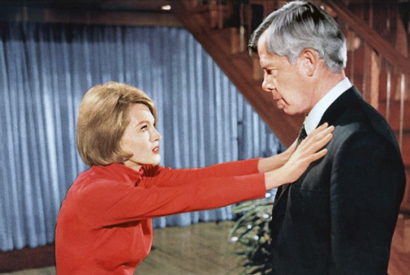
After a classic crash-'em car ride with John Stegman, Walker works his way upward through the mob hierarchy, a faceless corporation of ruthless executives that carry no money but wield excessive power. There's great fun to be had watching Walker decimate their best killers. He suckers Lloyd Bochner's Carter, an unlikable bully, into stepping into his own death trap. Point Blank flirts with nudity as regards Angie Dickinson, who helps Walker but is frustrated by his lack of feeling. The second best image in the show is the sight of Dickinson losing her composure and hitting, slapping and slugging Marvin as hard as she can. He stands like an immovable rock until she collapses in exhaustion. It's an abstract illustration of relationship problems that would be worthy of Jacques Tati, if he made violent movies. Boorman frames a steady stream of bizarre visuals through Philip Lathrop's wide-angled Panavision lens. Perfumes and unguents mix in the bottom of a bathtub, another prophetic image from 2001. Images are diffracted through gratings and a psychedelic light show at a disco nightclub is used as a wild setting for a brutal fistfight. The only visual cliché is one mannered shot of characters posed 'just so' in a shattered mirror. Marvin is a Golem with a magnum pistol, gray-haired and wearing a constant mask-like expression. John Vernon stands out as the treacherous mobster, begging Walker to help him in a roomful of loud men. Carroll O'Connor and Keenan Wynn are also excellent as the top dogs that Walker can't seem to push around. |
Review Staff | About DVD Talk | Newsletter Subscribe | Join DVD Talk Forum
Copyright © DVDTalk.com All rights reserved | Privacy Policy | Terms of Use
|

| Release List | Reviews | Price Search | Shop | SUBSCRIBE | Forum | DVD Giveaways | Blu-Ray/ HD DVD | Advertise |