| Release List | Reviews | Price Search | Shop | Newsletter | Forum | DVD Giveaways | Blu-Ray/ HD DVD | Advertise |

| Reviews & Columns |
|
Reviews DVD TV on DVD Blu-ray International DVDs Theatrical Reviews by Studio Video Games Features Collector Series DVDs Easter Egg Database Interviews DVD Talk TV DVD Talk Radio Feature Articles Columns Anime Talk DVD Savant HD Talk Horror DVDs Silent DVD
|
 DVD Talk Forum |
|
|
| Resources |
|
DVD Price Search Customer Service #'s RCE Info Links |
|
Columns

  

|
 |
FRIENDLY PERSUASION
|
||||
In the middle 'fifties, the underachieving Allied Artists studio made a stab at attracting big time production and top talent. It was a short-lived trend that produced Billy Wilder's delightful Love in the Afternoon, and this much more successful crowd-pleaser. The great artist William Wyler took Jessamyn West's aggressively pacifist novel Friendly Persuasion and created this beautiful idyll, a possible Utopia Americana. The family values earned and tested in this drama imply a real examination of American hopes, as opposed to the Reader's Digest brand of complacent denial that deep-fried much of the culture at the time. Friendly Persuasion is an immensely entertaining and thoughtful movie that finds an ideological middle ground, a rarity in any decade.
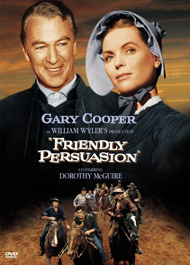
Jess and Eliza Birdwell (Gary Cooper & Dorothy McGuire) are prosperous farmers of the Quaker faith in 1863 Indiana, Union territory threatened by Confederate raiders. Prim, devout, and a bit blind to the worldly yearnings of her family, Eliza (an ordained Quaker minister herself) defends her family against outside temptations, as represented by the gambling, dancing, music and fighting of the county fair. Her resistance is mostly in vain. Jess has a passion for unseemly buggy-racing, daughter Mattie (Phyllis Love) is enraptured by a non-Quaker Yankee soldier, and Little Jess (Richard Eyer) has sadistic ideas about strangling her house pet, a Goose named Samantha. When Jess brings a forbidden musical instrument, an organ, into the house, Eliza finds that reconciling her beliefs with reality all the more difficult. Finally, the outside world erupts into the Birdwell's peaceful existence in a way that cannot be ignored. Older son Josh (Anthony Perkins) takes up arms with the militia to oppose the Confederates, and the possibility of real war destroying the entire valley puts Eliza's principles to the test. Sweet, gentle and hilarious, Friendly Persuasion is simply a superior entertainment. William Wyler is one of the most consistently brilliant directors from old-school Hollywood, and his work here is first-class, expressing the beauty and innocence of the Birdwells' country life with an honest directness. As is usual with Wyler, the balance and handling of the perfect cast makes all the difference. McGuire is just dotty enough to be unaware of the very un-Quakerish human natures of her own family; Gary Cooper strikes a good balance between his 'cute' and serious personae. The handling of the supporting cast is also exemplary. In only his second film, Anthony Perkins is remarkably adept in his portrayal of the conscience-stricken Josh. Richard Eyer's Little Jess is an antidote for all those cutesy moppets that plague American movies, a stubborn, imaginative little ankle-biter. Less acclaimed but equally impressive are the delightful Phyllis Love (this seems to be her only notable film) and Robert Middleton, a stock villain who here gets a rare opportunity to play a tolerant non-Quaker character. Marjorie Main has a familiar but welcome comedy scene. Friendly Persuasion has a bushel of minor speaking roles. To show the sensitivity and thought that went into each and every one of them, take a look at the 'bit' of the bushwhacker who tries to kill Jess: it's Richard Garland, known mainly for other Allied Artists' parts in decidedly unheralded movies like Attack of the Crab Monsters. The three minutes he's onscreen are extremely good, and his spiritual conversion (helped by the wonderful Tiomkin music) is conveyed without a single word of dialogue. There are some troubling rumbles inside Friendly Persuasion, a film so charming it even makes Pat Boone's title singing seem inspired. Seen in historical context, it's really kind of an overachieving Heimat movie, 1 carrying a valuable message. Set in a rural past where Eliza Birdwell must defend her family from sins no more virulent than benign organ music and chaste 2-step dancing, Friendly Persuasion doesn't have to deal with the contemporary problems of drug addiction, juvenile delinquency and atomic-psychological despair. Let the joyously virginal daughter Mattie's ignorance get her inadvertently pregnant, and let's see what that does to Eliza's eternal optimism. The intelligent wisdom of Jessamyn West defuses this by confronting the Birdwell family with real problems, and resolving them in a credible way through hope and virtue.The Birdwells are themselves a misunderstood and suspected religious minority. The issue of the Civil War and conscientious objection is well addressed. Sam Jordan (Robert Middleton)'s observation that he's all in favor of "someone holding out for a better way of settling things" is definitely not a Heimat sentiment. Hard realists might insist that the Confederate Raid would most likely result in rape and murder. Others would argue that Eliza's open offer of food and stores to the enemy soldiers, the practical gesture that spares her family, is simple collaboration. It's the weakest moment in West/Wilson's thesis -- and supposes that Quaker Eliza's instinctual hospitality would override a reality like War. Yet the film builds up so much good will and general respect for people that the scene is compelling. Friendly Persuasion's attitude toward sex is anything but repressive. The sight of Mattie's bare feet atop her soldier-lover's boots is plenty suggestive, as are the antics of the horny Hudspeth girls. The persuasion of the title refers to the Quaker tenet of meeting hostility with optimistic reason, but in the romantic context it clearly points to Jess and Eliza's night in the barn, where the forbidden Organ issue is resolved in a bed of hay. Yep, Eliza is softened with sex, a resolution that ideologues will find sexist. Yet she's not defeated; that Barn Night is a rare vision of marital compromise, and loving married sex. The production history of Friendly Persuasion must also have had its share of strange compromises; blacklisted writer Michael Wilson's credit on this DVD is a new addition, as his name was never there before. 2 Was Gary Cooper, whose onscreen nobility was belied by his blind cooperation with the Witch hunters during the H.U.A.C years, aware of Michael Wilson's involvement? The person to credit with pulling all of this together has to be director Wyler. Apparently the hawkish Cooper wanted to bolster his role with more 'action', and objected to staying behind on the farm when son Perkins goes off to fight. Was he perhaps concerned about those who called him a dupe of Carl Foreman, the 'left-wing' writer of High Noon? The encounter with the bushwhacker, Wyler's substitute for a Cooper 'action' scene, is a brilliant compromise. 3Warner's DVD of Friendly Persuasion is a handsome widescreen transfer that for the first time on video reflects William Wyler's wonderful widescreen compositions. His impressive depth staging, as in the first shots of the Raid sequence, is particularly helped by the cropping of the top and bottom of the frame. Image-wise, the picture is good but not terrific, as there is a bit more grain than would be desired and the colors seem to have faded a bit. Savant's seen this release on the screen several times and the 35mm prints were usually terrible, indicating that this orphaned Allied Artists feature went through a lot of foster homes without preservation. The audio is strong and clear - this is one of Dimitri Tiomkin's most beautiful movie scores. For extras there is a nice trailer, some bio material, and a strange television show from 1955 that pretends to be a 'live' rehearsal of a scene for TV audiences. A fuzzy kinescope, it is nonetheless fascinating. Cooper's 'cutes' are in full swing; he warbles an awful song, credited in the V.O. to Tiomkin. When asked where he learned to sing, says, "Opera. Horse opera." Got a family? Friendly Persuasion may be the most persuasive case for virtuous, optimistic living ever put on film, a slice of 50s Americana that offers a glimpse of possible glory behind the whitewashed, conformist propaganda machine that 'family entertainment' has become.
On a scale of Excellent, Good, Fair, and Poor, Friendly Persuasion rates:
Footnotes: 1. Heimat movies are German 'family films' concerned with rural, rustic values and problems that can be solved by the application of conservative solutions, mostly elderly wisdom. In the German New Wave, a number of openly subversive movies attempted to link this complacent genre to incipient Fascism: Ich Liebe Dich, Ich Tote Dich posits a Heimat community rife with totalitarian repression. Lack of an intellectual or political agenda doesn't make average American movies Fascist or repressive ... Tammy is just plain vacant entertainment. But consider something like the PAX network Christy television movies, which play as gratingly repressive Heimats: beautiful & saintly white people triumph, colorful hicks are patronized, all problems are due to a vague idea of 'progress' and not social ills, cardboard villains are killed off to rid the world of inconsistencies and inconvenient, untidy issues.Return 2. Is restoring these credits justice or revisionism? Surely Wilson deserves the credit, but now average viewers will never know it was denied him. Savant saw the same credit alteration on The Bridge on the River Kwai, but that disc's docu pointed out the change and showed the old credit version too. Savant thinks special cards at the end or the beginning of the movie would be better. By changing the titles the corporate owners of America's movies will be able to pretend that the blacklist never happened. Return 3. It is said that Jessamyn West was an active participant in altering her story and working out these conflicts to stay true to her humanist-pacifist line. Wyler would work with her again on The Big Country, a picture Savant wants to review when it comes out later this Spring. Return The Children's Hour The Best Years of Our Lives The Little Foxes Roman Holiday Mrs. Miniver
Review Staff | About DVD Talk | Newsletter Subscribe | Join DVD Talk Forum |
|

| Release List | Reviews | Price Search | Shop | SUBSCRIBE | Forum | DVD Giveaways | Blu-Ray/ HD DVD | Advertise |