| Release List | Reviews | Price Search | Shop | Newsletter | Forum | DVD Giveaways | Blu-Ray/ HD DVD | Advertise |

| Reviews & Columns |
|
Reviews DVD TV on DVD Blu-ray International DVDs Theatrical Reviews by Studio Video Games Features Collector Series DVDs Easter Egg Database Interviews DVD Talk TV DVD Talk Radio Feature Articles Columns Anime Talk DVD Savant HD Talk Horror DVDs Silent DVD
|
 DVD Talk Forum |
|
|
| Resources |
|
DVD Price Search Customer Service #'s RCE Info Links |
|
Columns

  

|
 |
ALFIE
|
||||
London of the middle 60s seemed to have everything: The Beatles, James Bond, mod fashions, Jaguar sports cars. According to the media, it was also supposed to be one literally swingin' place: a noted documentary of the time was called Tonight Let's All Make Love In London. Interestingly, most of the movies that took the Swingin' London Scene at face value have dated badly, while others that questioned it, like Richard Lester's sublime The Knack ...and How to Get It, have fared much better. By far the most satisfying is a play adaptation that confirmed the star status of Michael Caine promised in his previous films, Zulu and The Ipcress File: a stirring dissection of womanizing entitled Alfie.
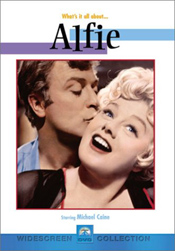
Alfie Elkins (Michael Caine) is a cockney Londoner with a high score as a ladies man. At any given moment he's living with one 'bird' while keeping a string going on the side. He's seeing Siddie (Millicent Martin) for quickie liaisons in parked cars, while Gilda (Julia Foster) stays at home. Earnest streetcar conductor Humphrey (Graham Stark) would love to marry Gilda, but she only has eyes for Alfie. A rest cure for the early signs of tuberculosis sends Alfie into the paths of a number of potential conquests. He connects with the doctor who diagnoses him (Eleanor Bron), a nurse named Carla (Shirley Anne Field), and even his roommate's wife Lily (Vivien Merchant), whom Alfie beds almost out of pity because of her age. He doesn't know it, but rich American Ruby (Shelley Winters) plays the same games he does. And dutiful homemaker 'bird' Annie (Jane Asher) will eventually tire of his increasingly selfish behavior. When is Alfie going to learn that other people have feelings too? Morality tales in the movies often present a hero who just thinks about doing wrong, and is fortunate enough to get a vision of what lies ahead for himself. He backs off from his bad behavior, or changes his outlook, or his politics. The fadeout sees him forging ahead in a new direction. A lot of liberal movies have this facile structure. The reformed publicist played by Humphrey Bogart in The Harder They Fall decides that boxing is no damn good, and starts to write his exposé. Here in Alfie we have a different animal, a materialist '60s man who sees no need to look beyond his own desires, so far as morality is concerned. Alfie Elkins gets by on his charm and good looks, and finds nothing wrong with letting the female sex make life comfy for him. As a holdover from the play, Alfie constantly talks to the camera, explaining himself, letting us in on his little larcenies, and justifying his essential dishonesty. Although Alfie is Caine's starring vehicle, there's a brace of arresting female performances. The standout is Vivien Merchant -- the sympathy we feel for this depressed mother of five is cosmic, and the lonely suffering she goes through in the 'caring' hands of Alfie, well, it cuts like a knife. Millicent Martin and Julia Foster are bright and distinctive, and even more close to home is Jane Asher, fresh from The Masque of the Red Death). We watch her move from naïve country girl fresh for picking, all the way to, 'Here's your keys, I'm outta here, guv', in just a few short scenes. From the very start it's Alfie's women we care about, admire, and feel for. He's cast them all as supporting players in a real-life movie of his own devising that, if it had a title, would be called Alfie Gets What He Wants. This is no Playboy fantasy, as none of the women are zaftig lookers or knockout sex goddesses. Gilda and Annie are actually on the mousy side. Siddie is no head-turner either. Ruby, who impresses Alfie the most, is an over-the-hill Yankee good time girl. And Lily, the forlorn housewife of a casual friend, is practically middle-aged. Alfie's hedonism doesn't have a lot of style because he himself is not very affluent. He simply has to dominate the opposite sex to feel like a man, and apparently any woman in need of male companionship will do. No matter how much he claims to be in charge, Alfie's no more in control of his life than the raggedy dog that shows up on the embankment at the beginning and end of the movie. Without getting into specifics, there's a comeuppance section to the story, where Alfie sees not only the specter of the happy, 'human' life he might have had, but the son that will never be his. And he's brought to tears of emptiness and waste and horror at the sight of the consequences of one of his 'casual' affairs. Expecting a sex romp, we instead are given a vision of the cheapness of self-indulgence. Perhaps there are some who can play a promiscuous game and do no harm; Alfie shows the damage and regret that results, even when all concerned pretend that nobody is being hurt. The conclusion of Alfie is uplifting and painfully bittersweet. Alfie Elkins has a glimmer of a realization. No epiphany, no great revelation, just the faint idea that maybe there's more to the game of living than he's previously believed, that maybe we do carry the responsibility for one another's hearts. Alfie's capable of befriending the dog ... maybe he can change. Paramount's DVD of Alfie is a welcome sight. A couple of years before the demise of the laser disc, Paramount responded to consumer screams by finally releasing a number of coveted titles letterboxed like Once Upon a Time in the West. They reached into the cult stack and in fast succession brought out unknowns like The Assassination Bureau, The Italian Job, along with bigger fish Barbarella and Alfie. Even Danger: Diabolik came out. But only Barbarella sold in respectable numbers, and it was the only one to show up early on DVD. Savant didn't think the others were going to happen, considering Paramount's very tentative commitment to its library. Alfie looks and sounds great. Shot in the same 2-perf Techniscope process by the cameraman of Caine's The Ipcress File, it has a tad more grain than a new film, that's scarcely noticeable with the excellent transfer. The dark and dank interiors don't turn into mush, as they did on the laser disc. The sound is also clear, and if some of the cockney accents throw you, the English subs are a thumb stroke away. The subs are also good to pick up on the less-audible lyrics of the famous Cher end title tune, which, by the way plays over an inspired end credits sequence that seems to celebrate the movie rather than just end it. When Alfie plays on TV, flat or scope, I always tune in to experience the lift of that conclusion. Best thing Cher ever did. The film is accompanied by its clever original trailer.
On a scale of Excellent, Good, Fair, and Poor, Alfie rates:
Review Staff | About DVD Talk | Newsletter Subscribe | Join DVD Talk Forum |
|

| Release List | Reviews | Price Search | Shop | SUBSCRIBE | Forum | DVD Giveaways | Blu-Ray/ HD DVD | Advertise |